Within RAG errors
When real citations prove the wrong thing
A real citation can look reassuring while supporting only part of a claim, a weaker claim, or a different conclusion entirely.
On this page
- What citation misalignment looks like in practice
- Why claim level support matters more than source lists
- Reader checks for exceptions, scope and overclaiming
Page outline Jump by section
Introduction
One of the most persuasive features of a grounded AI system is the presence of citations. When an answer points to a real document, users often assume the claim has been verified. Yet a citation can be genuine and still fail to support what the AI says. This problem—citation misalignment—occurs when a source is attached to a claim that it only partly supports, supports in a narrower context, or does not support at all. The result is a form of false verification: the appearance of evidence without genuine evidential support.
 Within retrieval-augmented generation (RAG) systems, this is a particularly important failure mode. The system may retrieve authentic documents and generate authentic citations, but the relationship between claim and evidence can still be flawed. Research on citation faithfulness has shown that users can be misled not only by fabricated sources but also by real sources that are attached to the wrong conclusions.[Leibniz Research Portal]research.uni-hannover.deLeibniz Research PortalCorrectness is not Faithfulness in Retrieval Augmented Generation Attributions - Leibniz University Hannover Resea…
What citation misalignment looks like in practice
Citation misalignment is rarely obvious. The source exists. The document is real. The cited passage may even discuss the same topic. The problem is that the specific claim being made is not what the source actually establishes.
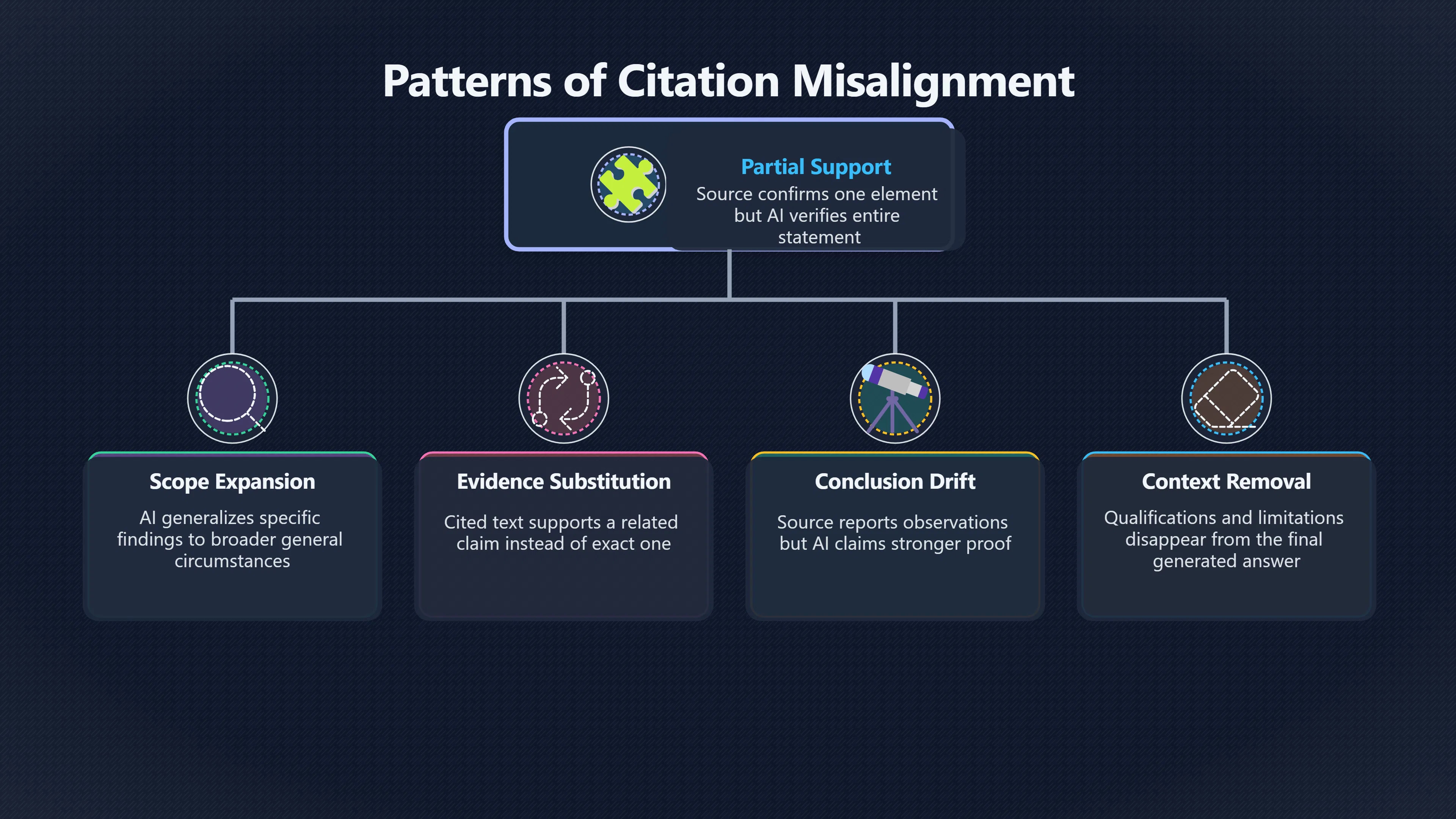
Several common patterns appear in grounded AI systems:
- Partial support presented as complete support. A source confirms one element of a statement, but the AI presents the entire statement as verified.
- Scope expansion. A document discusses a finding under specific conditions, while the AI generalises it to broader circumstances.
- Evidence substitution. The cited text supports a related claim rather than the exact claim being made.
- Conclusion drift. The source reports observations, while the AI cites it as proof of a stronger conclusion.
- Context removal. Qualifications, limitations, exceptions, or uncertainty in the source disappear from the generated answer.
Consider a hypothetical policy document stating that a programme improved outcomes for one pilot region over six months. An AI system might answer, “The programme has been proven effective nationwide,” and attach the pilot-study citation. The source is real, but the conclusion exceeds what the document establishes. The citation reassures readers even though the reasoning is unsound.
This distinction matters because many users check only whether a source exists, not whether it supports the precise wording of the claim.
Why claim-level support matters more than source lists
A long list of references can create an illusion of reliability. However, trustworthy attribution depends on whether each individual claim is supported by the cited evidence.
Researchers increasingly distinguish between citation correctness and citation faithfulness. Citation correctness asks whether a cited document could support a statement. Citation faithfulness asks whether the model genuinely relied on that evidence and whether the attribution accurately reflects the reasoning behind the answer. Studies have found that many apparently correct citations are not faithful in this stronger sense, with experiments reporting substantial rates of post-rationalised attribution. In some evaluations, up to 57% of citations lacked faithfulness despite appearing plausible to users.[Leibniz Research Portal+2Leibniz Research Portal]research.uni-hannover.deLeibniz Research PortalCorrectness is not Faithfulness in Retrieval Augmented Generation Attributions - Leibniz University Hannover Resea…
This finding has important governance implications. Many AI products present citations as transparency features, but transparency alone does not guarantee validity. A system can expose its sources while still creating misleading connections between evidence and conclusions.
For readers, the critical question is not:
“Does the answer have sources?”
Instead, it is:
“Does this specific source support this specific claim?”
Those are very different standards.
Why humans are vulnerable to false verification
Citation misalignment exploits a common shortcut in human judgement. Most people do not have time to inspect every source in detail. When they see footnotes, hyperlinks, or quoted passages, they often treat them as signals that verification has already occurred.
This creates several risks:
- Authority transfer. Credibility from a genuine source transfers to unsupported claims nearby.
- Reduced scrutiny. Readers become less likely to challenge statements that appear documented.
- Overconfidence. Decision-makers may treat uncertain conclusions as established facts.
- Error propagation. Incorrectly supported claims can be repeated in reports, meetings, and downstream AI systems.
The danger is especially significant in domains where users assume citations imply rigorous checking, such as law, medicine, science, public policy, or corporate compliance.
A citation attached to the wrong conclusion can be more persuasive than no citation at all because it provides a visible justification for trusting the answer.
Reader checks for exceptions, scope and overclaiming
Users do not need to perform a full audit of every source. A few targeted checks can reveal many cases of citation misalignment.
Check whether the source answers the same question
A source and a claim can share keywords while addressing different questions.
Ask:
- Does the document actually discuss the proposition being asserted?
- Is the AI answering a broader question than the source addresses?
- Has the cited material been repurposed to support a different conclusion?

Check the boundaries of the evidence
Many overclaims emerge when AI systems ignore limits present in the source.
Look for:
- Geographic restrictions
- Time restrictions
- Population restrictions
- Experimental conditions
- Stated uncertainties
If the source says “in this sample”, “during the study period”, or “under these conditions”, those limits matter.
Check whether certainty has increased
A common failure pattern is moving from cautious language to confident language.
For example:
- Source: “The findings suggest…”
- AI answer: “The findings prove…”
- Source: “Associated with…”
- AI answer: “Caused by…”
- Source: “May improve…”
- AI answer: “Improves…”
The citation remains real, but the strength of the conclusion changes.
Check what is missing
Sometimes the most important information is what the answer leaves out.
Look for:
- Caveats
- Exceptions
- Contradictory findings
- Confidence intervals
- Alternative explanations
A citation may technically point to the correct document while omitting the details that would change how the claim should be interpreted.
Governance responses to citation misalignment
Addressing citation misalignment requires more than improving retrieval. Governance efforts increasingly focus on attribution quality itself.
Emerging approaches include:
- Claim-level verification, where individual statements are checked against retrieved passages.
- Evidence selection systems, which identify the exact supporting text rather than merely citing an entire document.
- Natural language inference checks, which test whether evidence logically entails a generated claim.
- Citation-faithfulness evaluation, which measures whether the model genuinely relies on cited evidence instead of attaching sources after the answer is formed.
- Granular provenance tracking, which links claims to precise passages rather than broad documents.[arXiv+2CoLab]arxiv.orgVeriCite: Towards Reliable Citations in Retrieval-Augmented Generation via Rigorous VerificationOctober 13, 2025…
These approaches reflect a broader shift in AI governance. The challenge is no longer simply preventing fabricated citations. It is ensuring that citations function as evidence rather than decoration.
The central lesson
When grounded AI systems get documents wrong, the mistake is often not the absence of evidence but the misalignment between evidence and claim. A real citation can create a powerful impression of verification even when it supports only part of an assertion, supports a weaker version of it, or points toward a different conclusion altogether.
For that reason, trustworthy AI requires more than source retrieval. It requires claim-level accountability, where every important statement is supported by the evidence attached to it. Until that standard is met, readers should treat citations as invitations to verify, not as proof that verification has already occurred.
eBay marketplace picks
Marketplace Samples
Example marketplace items related to this page. Use the search link to explore similar finds on eBay.



Endnotes
1.
Source: arxiv.org
Link:https://arxiv.org/abs/2510.11394
Source snippet
VeriCite: Towards Reliable Citations in Retrieval-Augmented Generation via Rigorous VerificationOctober 13, 2025...
Published: October 13, 2025
2.
Source: colab.ws
Link:https://colab.ws/articles/10.1145%2F3767695.3769505
3.
Source: arxiv.org
Link:https://arxiv.org/abs/2508.06401
Source snippet
August 8, 2025...
Published: August 8, 2025
4.
Source: research.uni-hannover.de
Link:https://research.uni-hannover.de/en/publications/correctness-is-not-faithfulness-in-retrieval-augmented-generation-attributions%2884d2b468-e710-4cc5-bd22-f3646c5291db%29.html
Source snippet
Leibniz Research PortalCorrectness is not Faithfulness in Retrieval Augmented Generation Attributions - Leibniz University Hannover Resea...
5.
Source: fis.uni-hannover.de
Link:https://www.fis.uni-hannover.de/portal/en/publications/correctness-is-not-faithfulness-in-retrieval-augmented-generation-attributions%2884d2b468-e710-4cc5-bd22-f3646c5291db%29.html
6.
Source: research.uni-hannover.de
Link:https://research.uni-hannover.de/de/publications/correctness-is-not-faithfulness-in-retrieval-augmented-generation-attributions%2884d2b468-e710-4cc5-bd22-f3646c5291db%29.html
Source snippet
Leibniz Research PortalCorrectness is not Faithfulness in Retrieval Augmented Generation Attributions - Leibniz Universität Hannover Fors...
7.
Source: fis.uni-hannover.de
Link:https://www.fis.uni-hannover.de/portal/de/publications/correctness-is-not-faithfulness-in-retrieval-augmented-generation-attributions%2884d2b468-e710-4cc5-bd22-f3646c5291db%29.html
Source snippet
is not Faithfulness in Retrieval Augmented Generation Attributions | Research@Leibniz UniversityJuly 18, 2025...
Published: July 18, 2025
Additional References
8.
Source: youtube.com
Link:https://www.youtube.com/watch?v=2-Cg_1FtHk8&list=PLmPJQXJiMoUVvvzXCBKSt0aA8A5NlryjV
Source snippet
* Natural Language Processing: [https://www.youtube.com/watch?v=cs049uQWbpg&list=PLmPJQXJiMoUUSqSV7jcqGiiypGmQ_ogtb](https://www.youtube.com/watch?v=cs049uQWbpg&list=PLmPJQXJiMoUUSqSV7jcqGiiypGmQ_ogtb) * Data Science Mock In...
9.
Source: youtube.com
Link:https://www.youtube.com/watch?v=0SYV7o_fd50&list=PLmPJQXJiMoUWFW2JxRSAfhcsQ0Cr9qbv-&pp=gAQB
Source snippet
* [Deep Learning]({{ 'deep-learning/' | relative_url }}) & Neural Networks: [https://www.youtube.com/watch?v=2-Cg_1FtHk8&list=PLmPJQXJiMoUVvvzXCBKSt0aA8A5NlryjV](https://www.youtube.com/watch?v=2-Cg_1FtHk8&list=PLmPJQ...
10.
Source: youtube.com
Link:https://www.youtube.com/watch?v=pufyEgNOT0s&list=PLmPJQXJiMoUU3h2LaP6pi9-U9vC3iZeU4&pp=gAQB
Source snippet
* Intro to Data Science:[https://www.youtube.com/watch?v=Zkyog5u1OGw&list=PLmPJQXJiMoUWXbjyedFTmXPzzoeMJV4fe](https://www.youtube.com/watch?v=Zkyog5u1OGw&list=PLmPJQXJiMoUWXbjyedFTmXPzzoeMJV4fe) * Python for Data Science: ht...
11.
Source: youtube.com
Link:https://www.youtube.com/watch?v=cs049uQWbpg&list=PLmPJQXJiMoUUSqSV7jcqGiiypGmQ_ogtb
Source snippet
* Data Science Mock Interviews: [https://www.youtube.com/watch?v=pHwUllYAXqk&list=PLmPJQXJiMoUURuxLJoroTyBf9zxvgHDvk&pp=gAQB](https://www.youtube.com/watch?v=pHwUllYAXqk&list=PLmPJQXJiMoUURuxLJoroTyBf9zxvgHDvk&pp=gAQB) * Interview Q...
12.
Source: youtube.com
Link:https://www.youtube.com/watch?v=Zkyog5u1OGw&list=PLmPJQXJiMoUWXbjyedFTmXPzzoeMJV4fe
Source snippet
* Python for Data Science: [https://www.youtube.com/watch?v=NTZkMI5tuh8&list=PLmPJQXJiMoUWtuekopnh4BhTFkDBvmhnC](https://www.youtube.com/watch?v=NTZkMI5tuh8&list=PLmPJQXJiMoUWtuekopnh4BhTFkDBvmhnC) * Statistics & Mathematics...
13.
Source: youtube.com
Link:https://www.youtube.com/watch?v=NTZkMI5tuh8&list=PLmPJQXJiMoUWtuekopnh4BhTFkDBvmhnC
Source snippet
* Statistics & Mathematics:[https://www.youtube.com/watch?v=iZ2r7aIwMbc&list=PLmPJQXJiMoUU52xCfjyoGRfoLCHKFtDxX](https://www.youtube.com/watch?v=iZ2r7aIwMbc&list=PLmPJQXJiMoUU52xCfjyoGRfoLCHKFtDxX) * [Machine Learning]({{ 'mach...
14.
Source: youtube.com
Title: * LLM for Generative AI application development
Link:https://www.youtube.com/watch?v=As3TT3xlddU&list=PLmPJQXJiMoUW7pge9N-J5NQuPcwhzFTfY&pp=gAQB
Source snippet
* AWS for Data Science: [https://www.youtube.com/watch?v=0SYV7o_fd50&list=PLmPJQXJiMoUWFW2JxRSAfhcsQ0Cr9qbv-&pp=gAQB](https://www.youtube.com/watch?v=0SYV7o_fd50&list=PLmPJQXJiMoUWFW2JxRSAfhcsQ0Cr9qbv-&pp=gAQB) * Deep Learning & Neu...
15.
Source: youtube.com
Link:https://www.youtube.com/watch?v=fuO6QXAo-5M&list=PLmPJQXJiMoUWfMvIqAn0VI_LHlw4AmVrb
Source snippet
* Data Science Career Guide:[https://www.youtube.com/watch?v=9pytkbvF8AU&list=PLmPJQXJiMoUWoG8fRUXPRcZec9LgdHmCL](https://www.youtube.com/watch?v=9pytkbvF8AU&list=PLmPJQXJiMoUWoG8fRUXPRcZec9LgdHmCL) * Recommendation Systems...
16.
Source: youtube.com
Link:https://www.youtube.com/watch?v=pHwUllYAXqk&list=PLmPJQXJiMoUURuxLJoroTyBf9zxvgHDvk&pp=gAQB
Source snippet
* Interview Question Series: [https://www.youtube.com/watch?v=pufyEgNOT0s&list=PLmPJQXJiMoUU3h2LaP6pi9-U9vC3iZeU4&pp=gAQB](https://www.youtube.com/watch?v=pufyEgNOT0s&list=PLmPJQXJiMoUU3h2LaP6pi9-U9vC3iZeU4&pp=gAQB) * Intro to Data...
17.
Source: youtube.com
Link:https://www.youtube.com/watch?v=iZ2r7aIwMbc&list=PLmPJQXJiMoUU52xCfjyoGRfoLCHKFtDxX
Source snippet
* Machine Learning end to end in Python:[https://www.youtube.com/watch?v=8PFt4Jin7B0&list=PLmPJQXJiMoUWKj26qv_Pw5Aofxncu84JB](https://www.youtube.com/watch?v=8PFt4Jin7B0&list=PLmPJQXJiMoUWKj26qv_Pw5Aofxncu84JB) * Ensemble Mo...
Topic Tree