Within Decisions
How AI scores become real world decisions
Most consequential automation comes from the mix of model scores, thresholds and business rules that decide what happens next.
On this page
- From data collection to operational action
- Why rules and thresholds matter as much as models
- Where responsibility sits when systems act automatically
Page outline Jump by section
Introduction
When people hear that an AI system made a decision, they often imagine the model itself choosing an outcome. In practice, most important automated decisions emerge from a chain of systems. The AI model usually produces a score, probability or ranking. A separate decision engine then applies thresholds, business policies, legal requirements and operational rules to determine what happens next. The real-world outcome—approval, denial, investigation, prioritisation or escalation—comes from the combination of prediction and policy rather than from the model alone. This distinction is central to understanding automated decision-making because organisations are responsible not only for model accuracy but also for the rules that translate predictions into actions.[NIST Publications]nvlpubs.nist.govPublications Artificial Intelligence Risk Management Framework (AI RMF 1.0NIST PublicationsArtificial Intelligence Risk Management Framework (AI RMF 1.0)June 4, 2025 — by N AI · 2023 · Cited by 228 — The Framewo…

From data collection to operational action
A decision engine sits between an AI prediction and a real-world outcome. Its job is to turn statistical information into operational behaviour.
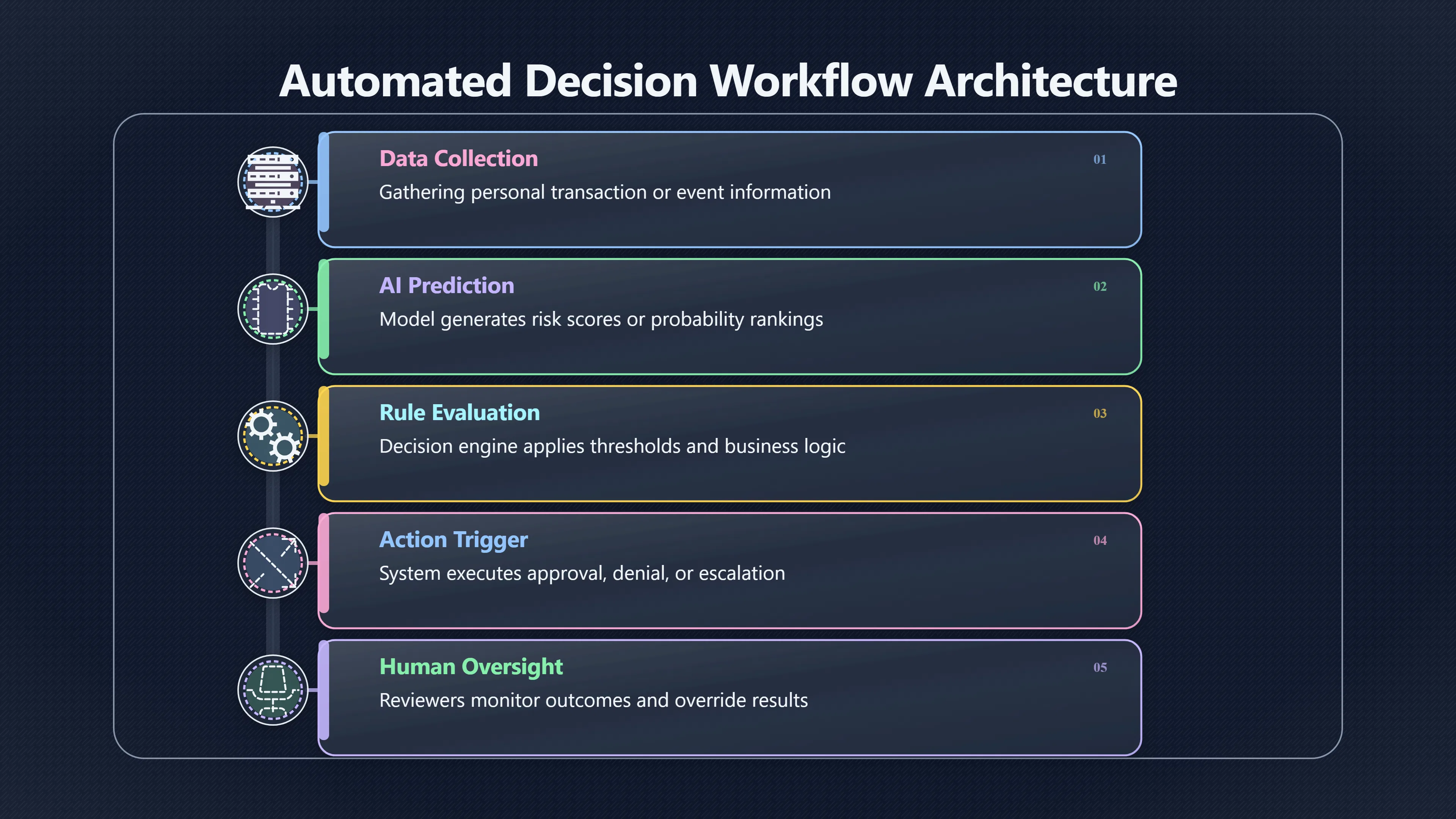
A simplified workflow often looks like this:
- Data about a person, transaction or event is collected.
- An AI model generates a score or prediction.
- The decision engine evaluates that output against rules and thresholds.
- The system triggers an action.
- Human review, appeals or audits may occur afterwards.
The model might estimate the probability that a credit applicant will repay a loan, that a payment is fraudulent, or that a benefits claim deserves further scrutiny. The decision engine then decides what to do with that estimate. A score above one threshold may trigger approval, a score below another may trigger rejection, while scores in between may be sent to a human reviewer.[InRule+2OECD]inrule.comIn Rule8 Examples of Decision Automation that Drive Business …AI models surface insights; rules engines enforce policy and ensure complReal-world use cases include claims, loans, onboarding, pricing, fraud detection …Read more
This architecture appears across many sectors:
- In banking, AI-generated risk scores help determine whether applications proceed, require additional checks or are declined.[OECD+2European Banking Authority]oecd.orgAI in financeIt is used in fraud detection, credit decisions, risk management, customer service, compliance, and portfolio management…
- In fraud detection, suspicious transactions receive risk scores that may trigger alerts, temporary holds or investigations.[IBM]ibm.comAI Fraud Detection in Banking | IBMAI for fraud detection refers to implementing machine learning (ML) algorithms to mitigate fraudule…
- In public administration, predictive systems may help prioritise cases for investigation rather than automatically determine guilt or wrongdoing.[OECD]oecd.orgAI‑Driven Fraud Detection and Digital Transformation…24 Mar 2026 — The project aimed to explore how advanced data analytics and ar…
The important point is that the AI score is rarely the final decision. The organisation decides how much weight to give that score and what actions follow.
Why rules and thresholds matter as much as models
Many discussions about AI focus on model performance. Yet two organisations can use the same model and produce very different outcomes because they configure different thresholds and business rules.
Imagine a fraud model that scores transactions from 0 to 100.
- One organisation may investigate transactions above 70.
- Another may investigate only those above 90.
- A third may automatically freeze accounts above 95.
The underlying prediction is identical, but the consequences are dramatically different.
Thresholds reflect organisational priorities. Lower thresholds often catch more risky cases but generate more false alarms. Higher thresholds reduce unnecessary interventions but may miss genuine problems. Choosing where to place these cut-offs is therefore a policy decision as much as a technical one.[InRule]inrule.comIn Rule8 Examples of Decision Automation that Drive Business …AI models surface insights; rules engines enforce policy and ensure complReal-world use cases include claims, loans, onboarding, pricing, fraud detection …Read more
Decision engines frequently incorporate additional rules alongside AI outputs:
- Regulatory requirements.
- Eligibility criteria.
- Internal risk policies.
- Resource constraints.
- Geographic restrictions.
- Customer-service priorities.[oecd.org]oecd.orgAI in financeIt is used in fraud detection, credit decisions, risk management, customer service, compliance, and portfolio management…
As a result, a person can receive an adverse outcome even when the AI score itself was not extreme. The interaction between multiple rules may ultimately determine the result.
This explains why audits that examine only the machine-learning model can miss important sources of unfairness or error. The operational logic surrounding the model may have as much impact as the model itself.

The hidden layer between prediction and action
Decision engines are often described as rules engines because they execute predefined logic consistently at large scale. They transform analytical outputs into operational workflows. In many industries, this layer exists specifically because organisations need predictable enforcement of policies, compliance obligations and business procedures.[InRule]inrule.comIn Rule8 Examples of Decision Automation that Drive Business …AI models surface insights; rules engines enforce policy and ensure complReal-world use cases include claims, loans, onboarding, pricing, fraud detection …Read more
For example, an insurer might combine:
- A claim-risk score from an AI model.
- Customer history rules.
- Regulatory requirements.
- Fraud indicators.
- Manual review requirements for large claims.
The resulting action emerges from the entire chain rather than from any single component.
This layered structure also means responsibility cannot be assigned solely to the model developer. Organisations decide which rules are applied, how thresholds are set, when humans become involved and which actions are triggered automatically. Governance frameworks increasingly emphasise evaluating the whole socio-technical system rather than only the algorithm.[NIST Publications]nvlpubs.nist.govPublications Artificial Intelligence Risk Management Framework (AI RMF 1.0NIST PublicationsArtificial Intelligence Risk Management Framework (AI RMF 1.0)June 4, 2025 — by N AI · 2023 · Cited by 228 — The Framewo…
Why automation can appear more human than it is
Many organisations place a human somewhere in the workflow and describe the process as human-supervised. In practice, the effectiveness of that oversight depends on what the human can actually do.
A reviewer who merely clicks “approve” on recommendations generated by a decision engine may contribute little meaningful judgement. Research and regulatory guidance increasingly distinguish between nominal human involvement and genuine oversight capable of identifying and correcting errors.[ZEW+2AI Act Service Desk]zew.deHuman Oversight Done Right: The AI Act Should Use…The EU's proposed Artificial Intelligence Act (AI Act) is meant to ensure safe AI…
Several factors can weaken oversight:
- Large volumes of cases that encourage rapid approval.
- Excessive trust in system recommendations.
- Limited access to supporting information.
- Lack of authority to override outcomes.
- Poor explanations of how scores were generated.
When these conditions exist, a process may function as effectively automated even if a person technically remains part of the workflow.
Where responsibility sits when systems act automatically
A common misconception is that responsibility shifts to the AI once automated decisions are deployed. Regulatory and governance frameworks generally take the opposite view.
Organisations that deploy AI systems remain accountable for the decisions that affect individuals. Human oversight requirements in the European Union’s AI Act are designed to ensure that high-risk systems can be monitored, interpreted and overridden when necessary. The objective is to minimise risks to health, safety and fundamental rights rather than to remove human responsibility. Artificial Intelligence Act+2AI Act Service Desk[artificialintelligenceact.eu]artificialintelligenceact.euArtificial Intelligence ActArticle 14: Human Oversight | EU Artificial Intelligence ActHuman oversight shall aim to prevent or minimise t…
The AI Act also establishes rights for affected individuals to obtain meaningful explanations of the role an AI system played in significant decisions. The focus is not merely on the model’s internal workings but on how its outputs contributed to the final decision-making process.[Artificial Intelligence Act]artificialintelligenceact.euArtificial Intelligence ActArticle 86: Right to Explanation of Individual Decision-MakingThe right to obtain from the deployer clear and…
Similarly, UK data-protection guidance recognises protections relating to decisions based solely on automated processing when those decisions produce legal or similarly significant effects.[ICO]ico.org.ukICORights related to automated decision making including …“The data subject shall have the right not to be subject to a decision basedsolely on automated processing, including profiling, which produces legal effects …Read more
In practice, responsibility typically spans several actors:
- Model developers who create predictive systems.
- System designers who build decision workflows.
- Organisations that set thresholds and policies.
- Managers who define acceptable risks.
- Human reviewers who oversee outcomes.
Because decision engines connect predictions to actions, accountability often resides most clearly with the organisation operating the system rather than with the model in isolation.
The key lesson: outcomes are policy choices as well as technical outputs
The most consequential part of many AI deployments is not the prediction itself but the mechanism that converts that prediction into action. A model may estimate risk, likelihood or priority, but a decision engine determines whether someone is approved, rejected, investigated, delayed or escalated.
Understanding automated decision-making therefore requires looking beyond model accuracy. Thresholds, business rules, escalation paths and oversight mechanisms shape real-world outcomes just as much as machine-learning performance. When organisations evaluate fairness, accountability and safety, the decision engine—not only the AI model—must be part of the analysis.[NIST Publications+2InRule]nvlpubs.nist.govPublications Artificial Intelligence Risk Management Framework (AI RMF 1.0NIST PublicationsArtificial Intelligence Risk Management Framework (AI RMF 1.0)June 4, 2025 — by N AI · 2023 · Cited by 228 — The Framewo…
Amazon book picks
Further Reading
Books and field guides related to How AI scores become real-world decisions. Use these as the next step if you want deeper reading beyond the article.
Competing in the Age of AI
Shows how AI systems and business rules create automated actions.
Weapons of Math Destruction
Illustrates impacts of decision engines and scoring rules.
eBay marketplace picks
Marketplace Samples
Example marketplace items related to this page. Use the search link to explore similar finds on eBay.




Endnotes
1.
Source: nvlpubs.nist.gov
Title: Publications Artificial Intelligence Risk Management Framework (AI RMF 1.0)
Link:https://nvlpubs.nist.gov/nistpubs/ai/nist.ai.100-1.pdf
Source snippet
NIST PublicationsArtificial Intelligence Risk Management Framework (AI RMF 1.0)June 4, 2025 — by N AI · 2023 · Cited by 228 — The Framewo...
Published: June 4, 2025
2.
Source: inrule.com
Link:https://inrule.com/examples-of-decision-[automation
Source snippet
Real-world use cases include claims, loans, onboarding, pricing, fraud detection...Read more...
3.
Source: oecd.org
Link:https://www.oecd.org/en/topics/sub-issues/digital-finance/artificial-intelligence-in-finance.html
Source snippet
AI in financeIt is used in fraud detection, credit decisions, risk management, customer service, compliance, and portfolio management...
4.
Source: oecd.org
Link:https://www.oecd.org/content/dam/oecd/en/publications/reports/2021/08/artificial-intelligence-machine-learning-and-big-data-in-finance_8d088cbb/98e761e7-en.pdf
Source snippet
of creditworthiness of prospective borrowers, enhance the underwriting decision...
5.
Source: ibm.com
Link:https://www.ibm.com/think/topics/ai-fraud-detection-in-banking
Source snippet
AI Fraud Detection in Banking | IBMAI for fraud detection refers to implementing machine learning (ML) algorithms to mitigate fraudule...
6.
Source: oecd.org
Link:https://www.oecd.org/en/publications/public-governance-case-studies_575651e4-en/ai-driven-fraud-detection-and-digital-transformation-in-law-enforcement-in-lithuania_3c77cd6a-en.html
Source snippet
AI‑Driven Fraud Detection and Digital Transformation...24 Mar 2026 — The project aimed to explore how advanced data analytics and ar...
7.
Source: oecd.ai
Link:https://oecd.ai/en/wonk/government-automated-decision-making-transparency-and-responsibility-in-the-public-sector
Source snippet
Government automated-decision-making: transparency...Apr 7, 2025 — Let's examine the current landscape of algorithmic transparency in th...
8.
Source: oecd.org
Link:https://www.oecd.org/en/topics/sub-issues/ai-principles.html
Source snippet
AI principlesThe OECD AI Principles are the first intergovernmental standard on AI. They promote innovative, trustworthy AI that respects...
9.
Source: zew.de
Link:https://www.zew.de/en/publications/human-oversight-done-right-the-ai-act-should-use-humans-to-monitor-ai-only-when-effective
Source snippet
Human Oversight Done Right: The AI Act Should Use...The EU's proposed Artificial Intelligence Act (AI Act) is meant to ensure safe AI...
10.
Source: ico.org.uk
Link:https://ico.org.uk/for-organisations/[uk-gdpr
Source snippet
solely on automated processing, including profiling, which produces legal effects...Read more...
11.
Source: oecd.ai
Link:https://oecd.ai/en/wonk/how-to-achieve-trustworthy-algorithmic-decision-making
Source snippet
Ensuring trustworthy algorithmic decision-makingThe review focused on the use of algorithms in significant decisions about individuals, l...
12.
Source: oecd.org
Link:https://www.oecd.org/en/publications/2025/06/governing-with-artificial-intelligence_398fa287/full-report/how-artificial-intelligence-is-accelerating-the-digital-government-journey_d9552dc7.html
Source snippet
It situates government as a developer...Read more...
13.
Source: oecd.org
Title: f1498c02 en
Link:https://www.oecd.org/content/dam/oecd/en/publications/reports/2024/09/regulatory-approaches-to-artificial-intelligence-in-finance_43d082c3/f1498c02-en.pdf
Source snippet
(e.g. around liquidity & credit risks)...
14.
Source: oecd.org
Link:https://www.oecd.org/content/dam/oecd/en/publications/reports/2026/01/supervision-of-artificial-intelligence-in-finance_1295e5e2/92743dc1-en.pdf
Source snippet
ligence (AI) in Finance and discusses reported challenges encountered in the...
15.
Source: oecd.org
Title: ai in public financial management 8089f818
Link:https://www.oecd.org/en/publications/2025/06/governing-with-artificial-intelligence_398fa287/full-report/ai-in-public-financial-management_8089f818.html
Source snippet
AI in public financial management: Governing with Artificial...18 Sept 2025 — Australia's Robodebt scheme, introduced in 2016, was an au...
16.
Source: artificial-intelligence-act.com
Link:https://www.artificial-intelligence-act.com/
Source snippet
[EU AI Act]({{ 'eu-ai-act/' | relative_url }}) - Updates, Compliance, TrainingThe AI Act bans AI systems that manipulate human behavior in a way that causes physical or psych...
17.
Source: youtube.com
Link:https://www.youtube.com/watch?v=C5NGczQMHu0
Source snippet
InRule - Frequently Asked Questions...
18.
Source: youtube.com
Title: In Rule
Link:https://www.youtube.com/watch?v=8RINdMxFfTM
19.
Source: bankingsupervision.europa.eu
Title: ECB Banking
Link:https://www.bankingsupervision.europa.eu/press/supervisory-newsletters/newsletter/2025/html/ssm.nl251120_1.en.html
Source snippet
European Banking AuthorityAI's impact on banking: use cases for credit scoring and fraud...20 Nov 2025 — Banks now use AI for credit sco...
20.
Source: ai-act-service-desk.ec.europa.eu
Link:https://ai-act-service-desk.ec.europa.eu/en/ai-act/article-14
Source snippet
High-risk AI systems must be designed to allow human oversight during their operation to minimise risks to health, safety, and fundamenta...
21.
Source: artificialintelligenceact.eu
Link:https://artificialintelligenceact.eu/article/14/
Source snippet
Artificial Intelligence ActArticle 14: Human Oversight | EU Artificial Intelligence ActHuman oversight shall aim to prevent or minimise t...
22.
Source: artificialintelligenceact.eu
Link:https://artificialintelligenceact.eu/article/86/
Source snippet
Artificial Intelligence ActArticle 86: Right to Explanation of Individual Decision-MakingThe right to obtain from the deployer clear and...
23.
Source: ai-act-service-desk.ec.europa.eu
Link:https://ai-act-service-desk.ec.europa.eu/en/guideline-explorer
Source snippet
on the classification of high-risk AI systems(1) The Artificial Intelligence Act (the 'AI Act'), which entered into force on 1 August 202...
24.
Source: internationaltaxjournal.online
Link:https://internationaltaxjournal.online/index.php/itj/article/view/213
Source snippet
AI-Driven credit scoring and risk assessment in banksSep 25, 2025 — This paper analyzes the transformational shift in the banking sector...
25.
Source: artificialintelligenceact.eu
Link:https://artificialintelligenceact.eu/high-level-summary/
Source snippet
Design their high risk AI system to allow deployers to implement human oversight.Read more...
26.
Source: artificialintelligenceact.eu
Title: It lays the foundations for the regulation of AI in the EU.Read more
Link:https://artificialintelligenceact.eu/ai-act-explorer/
Source snippet
The AI Act Explorer | EU Artificial Intelligence ActThe European Union has introduced new legislation on artificial intelligence: The EU...
27.
Source: eduvest.greenvest.co.id
Link:https://eduvest.greenvest.co.id/index.php/edv/article/view/52362
Source snippet
Scoring P2P Lending Fintech: Right to Explanation in AI...by AS Maghfirli · 2025 — This study analyzes the legal framework governing the...
28.
Source: researchhub.id
Link:https://researchhub.id/index.php/optimal/article/view/6544
Source snippet
The Role of Artificial Intelligence in Risk Management for...16 June 2025 — AI technologies like machine learning and natural language p...
Published: June 2025
Additional References
29.
Source: researchgate.net
Link:https://www.researchgate.net/publication/398240409_Regulatory_Challenges_of_AI-Driven_Credit_Scoring_in_Indonesian_Banking_Between_Algorithmic_Bias_and_Consumer_Protection
Source snippet
Regulatory Challenges of AI-Driven Credit Scoring in...4 Dec 2025 — This article examines the regulatory gaps in Indonesian laws related...
30.
Source: linkedin.com
Link:https://www.linkedin.com/top-content/artificial-intelligence/eu-ai-regulation-impact/eu-law-on-automated-decision-making-regulation/
Source snippet
EU Law on Automated Decision-Making RegulationThe EU Law on Automated Decision-Making Regulation covers rules that require companies to e...
31.
Source: medium.com
Link:https://medium.com/%40danykitishian/ai-driven-decision-making-29be2b097b64
Source snippet
Foundations of AI‑Driven Decision‑MakingThis page explains why algorithmic decisions differ from human ones; surveys the learning paradig...
32.
Source: linkedin.com
Link:https://www.linkedin.com/pulse/from-credit-scoring-fraud-detection-o9jdc
Source snippet
From Credit Scoring to Fraud Detection: The Expanding...This article explores how AI is expanding its role in FinTech — from credit scor...
33.
Source: avolutionsoftware.com
Link:https://www.avolutionsoftware.com/our-resources/nist-ai-risk-management-framework-rmf/
Source snippet
NIST AI Risk Management Framework (RMF)The NIST AI Risk Management Framework, often called the NIST AI RMF, gives organizations a practic...
34.
Source: linkedin.com
Link:https://www.linkedin.com/pulse/oecd-regulatory-approaches-artificial-intelligence-finance-iason-kojlf
Source snippet
Regulatory Approaches to Artificial Intelligence in FinanceThe OECD report provides a comprehensive analysis of AI's growing role in fina...
35.
Source: decisionbrain.com
Link:https://decisionbrain.com/[responsible-ai
Source snippet
Responsible AI Decision MakingExplore the potential and limitations of Generative AI in decision-making, addressing challenges like biase...
36.
Source: edps.europa.eu
Title: 2025 09 23 techdispatch 22025 human oversight automated making
Link:https://www.edps.europa.eu/data-protection/our-work/publications/techdispatch/2025-09-23-techdispatch-22025-human-oversight-automated-making
Source snippet
#2/2025 - Human Oversight of Automated...by W Wiewiórowski · Cited by 4 — For the purposes of this document, human oversight refers to t...
37.
Source: fsb.org
Title: OECD – FSB Roundtable on Artificial Intelligence AI in Finance
Link:https://www.fsb.org/uploads/OECD-%E2%80%93-FSB-Roundtable-on-Artificial-Intelligence-AI-in-Finance.pdf
Source snippet
FSB Roundtable on Artificial Intelligence (AI) in Finance30 Sept 2024 — These technologies have increased efficiency in operations, risk...
38.
Source: blog.montaignecentre.com
Title: on the relative importance of the ai act right to explanation
Link:https://blog.montaignecentre.com/en/on-the-relative-importance-of-the-ai-act-right-to-explanation/
Source snippet
Montaigne Centrum BlogOn the Relative Importance of the AI Act Right to Explanation29 Apr 2024 — The AI Act now contains a more explicit...
Topic Tree