Within AI Boundary
Why inference became the AI boundary
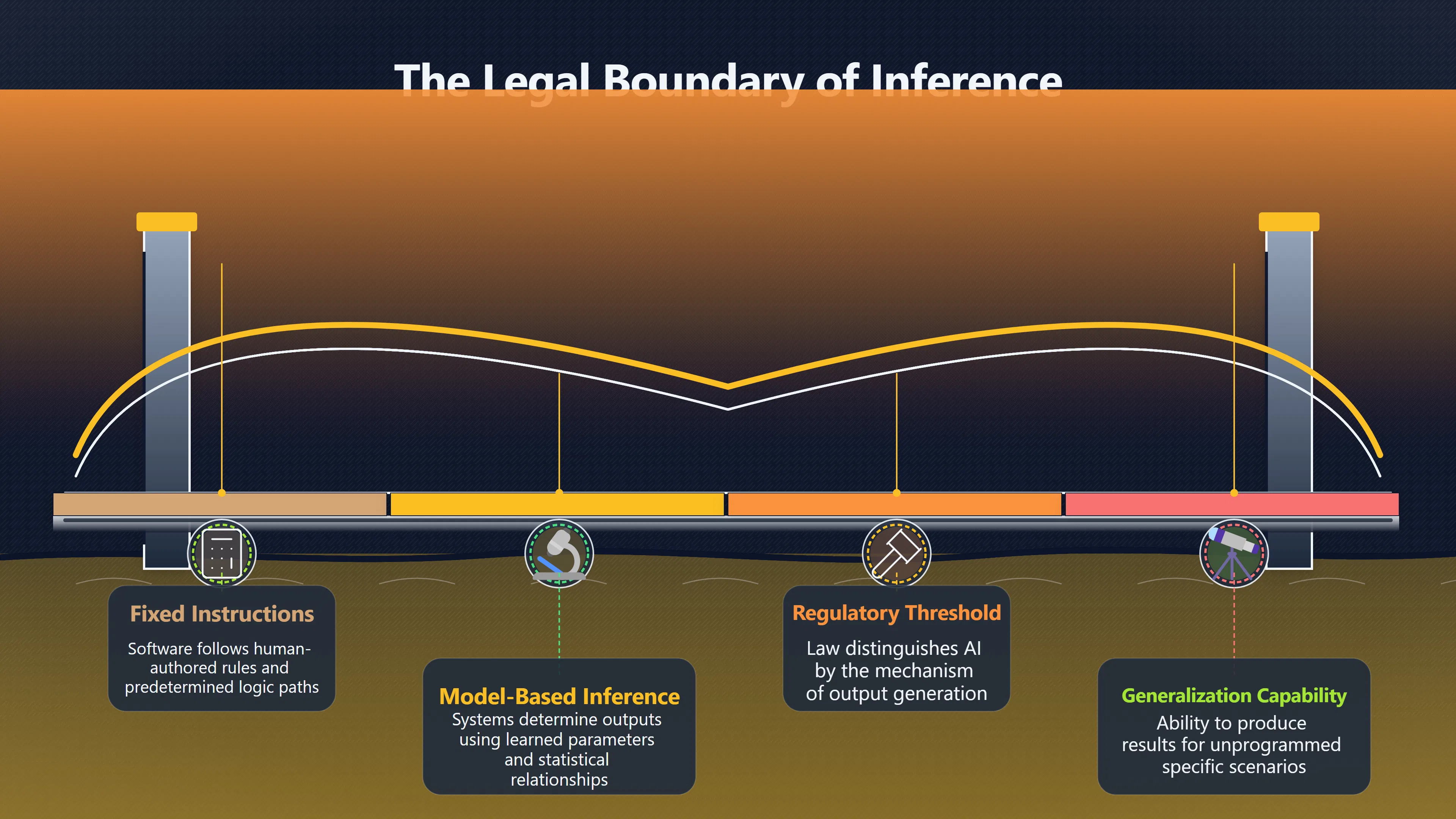
Modern AI rules increasingly separate AI from ordinary software by asking whether a system infers outputs rather than follows fixed instructions.
On this page
- What inference means in AI definitions
- Why fixed instructions usually fall outside AI
- Where OECD, EU and NIST definitions converge
Page outline Jump by section
Introduction
Modern AI regulation increasingly relies on a single question to distinguish artificial intelligence from ordinary software: does the system infer how to generate outputs, or does it simply execute rules written in advance by humans? This focus on inference has become the legal boundary because regulators needed a definition that captures machine learning and generative AI without accidentally classifying every spreadsheet, database, calculator, or workflow engine as AI. Across major frameworks, including the OECD definition, the European Union’s AI Act, and guidance from the US National Institute of Standards and Technology (NIST), the defining feature is not whether software is complex, automated, or useful. The key issue is whether it produces outputs through model-based inference rather than solely through fixed human instructions.[OECD+2Artificial Intelligence Act]oecd.orgExplanatory memorandum on the updated OECD definitionExplanatory memorandum on the updated OECD definition…May 13, 2025 — An AI system is a machine-based system that, for explicit or…
What inference means in AI definitions
In everyday language, inference means drawing a conclusion from available information. In AI law and policy, the term has a more specific meaning. An AI system receives inputs and determines how to generate outputs—such as predictions, recommendations, decisions, or content—through a model or computational process that is not fully specified by hand-written rules for every possible case.[OECD+2OECD.AI]oecd.orgExplanatory memorandum on the updated OECD definitionExplanatory memorandum on the updated OECD definition…May 13, 2025 — An AI system is a machine-based system that, for explicit or…
The OECD’s updated definition, adopted in 2023 and subsequently reflected in the EU AI Act, places the word “infers” at the centre of the definition. Rather than describing AI as software that merely follows objectives, the definition states that an AI system “infers, from the input it receives, how to generate outputs”. This wording was not accidental. It was introduced specifically to identify the characteristic that separates AI techniques from conventional software engineering.[OECD+2OECD.AI]oecd.orgExplanatory memorandum on the updated OECD definitionExplanatory memorandum on the updated OECD definition…May 13, 2025 — An AI system is a machine-based system that, for explicit or…
The legal significance of inference is that the system is not limited to a complete catalogue of human-authored instructions. Instead, it uses learned parameters, statistical relationships, optimisation processes, or other model-based methods to determine outputs for situations that were not individually programmed in advance.[ai-act-service-desk.ec.europa.eu+2Orrick]ai-act-service-desk.ec.europa.euA I Act Service DeskAI Act Service Desk - Recital 12 - European UnionThis capability to infer refers to the process of obtaining the outputs, such as predict…
A fraud-detection model illustrates the idea. A programmer may define the training process and objectives, but the model itself identifies patterns across large volumes of data and applies those patterns to new transactions. The resulting output is inferred rather than directly prescribed line by line. That ability to generalise beyond explicit instructions is what regulators are trying to capture.[OECD]oecd.orgExplanatory memorandum on the updated OECD definitionExplanatory memorandum on the updated OECD definition…May 13, 2025 — An AI system is a machine-based system that, for explicit or…
Why fixed instructions usually fall outside AI
Legal definitions could have focused on automation, software complexity, or autonomy. Instead, regulators largely rejected those approaches because they would sweep in enormous amounts of ordinary software.
A payroll calculator may process thousands of employee records automatically. A database system may execute millions of operations per day. A workflow engine may route documents across an entire organisation. Yet these systems generally follow predetermined instructions. Their behaviour can be traced back to rules that humans explicitly defined. They do not infer how to generate outputs from data in the way modern AI systems do.[Lexology+2Orrick]lexology.comEU Commission publishes Guidelines on definition of an “…February 28, 2025 — 28 Feb 2025 — An AI system must be able to infer…
The EU AI Act’s interpretive guidance explicitly states that systems based solely on rules defined by natural persons to execute operations automatically should not be treated as AI systems. This exclusion is important because otherwise the law would regulate vast categories of conventional software that present different technical and governance issues.[Lexology]lexology.comEU Commission publishes Guidelines on definition of an “…February 28, 2025 — 28 Feb 2025 — An AI system must be able to infer…
Consider two ways of identifying suspicious financial transactions:
- Rule-based system: “Flag every transaction above £10,000.”
- Inference-based system: Analyse historical data and estimate the probability that a transaction is fraudulent.
Both systems may generate alerts, but only the second derives its output from inferred relationships in data rather than a fixed threshold established for every case. The legal distinction therefore turns on mechanism rather than outcome.[ai-act-service-desk.ec.europa.eu]ai-act-service-desk.ec.europa.euA I Act Service DeskAI Act Service Desk - Recital 12 - European UnionThis capability to infer refers to the process of obtaining the outputs, such as predict…
This explains why regulators consistently avoid defining AI by what it does. Many AI systems and ordinary software systems perform similar functions. The question is how they reach their outputs.
Why lawmakers chose inference instead of other tests
Inference became the preferred legal test because alternative boundaries proved unstable.
A definition based on complexity would fail because some traditional software systems are extraordinarily complex while some AI models are relatively simple.
A definition based on autonomy would also be problematic. Many non-AI systems operate autonomously once deployed, while some AI systems remain tightly supervised by humans.
A definition based on adaptation alone would be too narrow because many AI systems do not continue learning after deployment, yet are still clearly AI systems.[Artificial Intelligence Act]artificialintelligenceact.euArtificial Intelligence ActArticle 3: Definitions | EU Artificial Intelligence ActAn AI system is a machine-based system that can operate…
Inference solves these problems by focusing on the mechanism that most modern AI techniques share. Whether the system is a neural network, a statistical classifier, a recommendation engine, or a large language model, it generally generates outputs through some form of inference from inputs rather than through an exhaustive collection of hand-written rules.[OECD+2OECD.AI]oecd.orgExplanatory memorandum on the updated OECD definitionExplanatory memorandum on the updated OECD definition…May 13, 2025 — An AI system is a machine-based system that, for explicit or…
For legislators, this creates a more technology-neutral standard. The law does not need to list every AI technique individually. Instead, it can ask whether the system possesses the capability to infer outputs in the relevant sense.
Where OECD, EU and NIST definitions converge
Although the OECD, the European Union, and NIST serve different purposes, their definitions now align remarkably closely around inference.
The OECD defines an AI system as a machine-based system that “infers” how to generate outputs such as predictions, recommendations, decisions, or content.[OECD]oecd.orgExplanatory memorandum on the updated OECD definitionExplanatory memorandum on the updated OECD definition…May 13, 2025 — An AI system is a machine-based system that, for explicit or…
The EU AI Act adopted substantially the same concept. Article 3 and related guidance describe AI systems as machine-based systems that infer from received inputs how to generate outputs capable of influencing physical or virtual environments. The Act’s explanatory material emphasises that inference is the feature distinguishing AI from software based solely on human-defined rules. Artificial Intelligence Act+2ai-act-service-desk.ec.europa.eu[artificialintelligenceact.eu]artificialintelligenceact.euArtificial Intelligence ActArticle 3: Definitions | EU Artificial Intelligence ActAn AI system is a machine-based system that can operate…
NIST uses closely related language in its AI Risk Management Framework, describing AI systems as machine-based systems that generate outputs such as predictions, recommendations, or decisions for given objectives. NIST explicitly notes that its formulation is adapted from OECD and international standards work.[NIST Publications]nvlpubs.nist.govai.100 1NIST PublicationsArtificial Intelligence Risk Management Framework (AI RMF 1.0)by N AI · 2023 · Cited by 228 — The AI RMF refers to an AI…
This convergence matters because organisations increasingly operate across jurisdictions. While regulatory obligations differ, the core conceptual boundary between AI and ordinary software is becoming more consistent internationally. The shared emphasis on inference provides a common foundation for compliance, governance, and risk assessment.[OECD+2Artificial Intelligence Act]oecd.orgExplanatory memorandum on the updated OECD definitionExplanatory memorandum on the updated OECD definition…May 13, 2025 — An AI system is a machine-based system that, for explicit or…
The grey areas that keep the debate alive
Inference is now the dominant legal test, but applying it is not always straightforward.
Some systems combine fixed rules with statistical models. Credit-scoring tools, recommendation engines, and decision-support systems often include multiple stages of processing. Certain stages may be purely rule-based, while others rely on inferred relationships learned from data. Determining whether the overall system qualifies as AI can therefore require examining the entire workflow rather than a single component.[arXiv]arxiv.orgarXiv When Do Data-Driven Systems Exhibit the Capability to Infer?When Do Data-Driven Systems Exhibit the Capability to Infer?June 10, 2026…
Another challenge is that “inference” itself remains a technical concept. Regulators have provided guidance, but experts continue to debate where sophisticated analytics ends and legally defined AI begins. Recent research examining implementation of the EU AI Act argues that the capability to infer is the central criterion yet still leaves grey areas for some statistical and data-driven systems.[arXiv]arxiv.orgarXiv When Do Data-Driven Systems Exhibit the Capability to Infer?When Do Data-Driven Systems Exhibit the Capability to Infer?June 10, 2026…
These edge cases do not undermine the broader trend. Across major frameworks, inference has emerged as the preferred legal mechanism for drawing the boundary because it captures the distinctive way AI systems generate outputs while excluding conventional software that merely automates predetermined instructions.[OECD+2ai-act-service-desk.ec.europa.eu]oecd.orgExplanatory memorandum on the updated OECD definitionExplanatory memorandum on the updated OECD definition…May 13, 2025 — An AI system is a machine-based system that, for explicit or…
Amazon book picks
Further Reading
Books and field guides related to Why inference became the AI boundary. Use these as the next step if you want deeper reading beyond the article.
Artificial Intelligence
Explains what modern AI systems do, how learning and inference differ from hand-coded rules, and where AI boundaries lie.
Prediction Machines
Frames AI primarily as a prediction technology, closely matching the inference-versus-rules distinction.
Life 3.0
Provides accessible context for how modern AI systems operate and are defined.
On Intelligence
Rating: 4.5/5 from 23 Google Books ratings
Focuses on prediction and inference as core features of intelligent systems.
eBay marketplace picks
Marketplace Samples
Example marketplace items related to this page. Use the search link to explore similar finds on eBay.


![Listing image for [Lot] New World Aeternum Developer Exclusive Artbook / Desk Mat / Steelbook Game](/assets/images/marketplace-covers/916acd431b120e527ce9.jpg)
![Listing image for [Lot] New World Aeternum Developer Exclusive Artbook / Desk Mat / Steelbook Game](/assets/images/marketplace-covers/4262455386b429ab533b.jpg)
Endnotes
1.
Source: oecd.org
Title: Explanatory memorandum on the updated OECD definition
Link:https://www.oecd.org/content/dam/oecd/en/publications/reports/2024/03/explanatory-memorandum-on-the-updated-oecd-definition-of-an-ai-system_3c815e51/623da898-en.pdf
Source snippet
Explanatory memorandum on the updated OECD definition...May 13, 2025 — An AI system is a machine-based system that, for explicit or...
Published: May 13, 2025
2.
Source: nvlpubs.nist.gov
Title: ai.100 1
Link:https://nvlpubs.nist.gov/nistpubs/ai/nist.ai.100-1.pdf
Source snippet
NIST PublicationsArtificial Intelligence Risk Management Framework (AI RMF 1.0)by N AI · 2023 · Cited by 228 — The AI RMF refers to an AI...
3.
Source: oecd.ai
Title: What is AI?
Link:https://oecd.ai/en/wonk/definition
Source snippet
Can you make a clear distinction between AI...An AI system is a machine-based system that, for explicit or implicit objectives, infers...
4.
Source: ai-act-service-desk.ec.europa.eu
Title: A I Act Service Desk
Link:https://ai-act-service-desk.ec.europa.eu/en/ai-act/recital-12
Source snippet
AI Act Service Desk - Recital 12 - European UnionThis capability to infer refers to the process of obtaining the outputs, such as predict...
5.
Source: orrick.com
Title: EU Commission Clarifies Definition of AI Systems
Link:https://www.orrick.com/en/Insights/2025/04/EU-Commission-Clarifies-Definition-of-AI-Systems
Source snippet
24 Apr 2025 — In general, inference relates to an AI system's ability to create (infer) output from input received without being bound so...
6.
Source: lexology.com
Link:https://www.lexology.com/library/detail.aspx?g=81cc3967-1bd8-4b37-93be-37b7e4c35277
Source snippet
EU Commission publishes Guidelines on definition of an “...February 28, 2025 — 28 Feb 2025 — An AI system must be able to infer...
Published: February 28, 2025
7.
Source: arxiv.org
Title: arXiv When Do Data-Driven Systems Exhibit the Capability to Infer?
Link:https://arxiv.org/abs/2606.11769
Source snippet
When Do Data-Driven Systems Exhibit the Capability to Infer?June 10, 2026...
Published: June 10, 2026
8.
Source: nvlpubs.nist.gov
Title: AI.600 1
Link:https://nvlpubs.nist.gov/nistpubs/ai/NIST.AI.600-1.pdf
Source snippet
Intelligence Risk Management Frameworkby N AI · 2024 · Cited by 144 — “Confabulation” refers to a phenomenon in which GAI systems generat...
9.
Source: oecd.org
Link:https://www.oecd.org/content/dam/oecd/en/publications/reports/2022/02/oecd-framework-for-the-classification-of-ai-systems_336a8b57/cb6d9eca-en.pdf
Source snippet
OECD Framework for the Classification of AI systems (EN)The framework classifies AI systems and applications along the following dimensio...
10.
Source: artificial-intelligence-act.com
Title: E U AI Act
Link:https://www.artificial-intelligence-act.com/
Source snippet
EU AI Act - Updates, Compliance, TrainingThe EU AI Act sets harmonised rules for the development, placement on the market and use of AI s...
11.
Source: ai-regulation.com
Title: oecds definition on ai and the eu ai act
Link:https://ai-regulation.com/oecds-definition-on-ai-and-the-eu-ai-act/
Source snippet
Defining AI Systems: Is the OECD's Update a Quandary for the...1 Dec 2023 — “An AI system is a machine-based system that can, for a give...
12.
Source: arxiv.org
Link:https://arxiv.org/html/2603.10023
Source snippet
4). (b). “an... AI system: A machine-based system that makes inferences from inputs from...Read more...
13.
Source: youtube.com
Link:https://www.youtube.com/watch?v=TljH8ZmnZRk
Source snippet
EU AI Act - Objectives and Terminology - AIGP Certification...
Published: August 2026
14.
Source: youtube.com
Title: EU AI Act
Link:https://www.youtube.com/watch?v=hUTe7ktjmGU
Source snippet
If You Make AI Content, This New Law Is About You...
15.
Source: artificialintelligenceact.eu
Link:https://artificialintelligenceact.eu/article/3/
Source snippet
Artificial Intelligence ActArticle 3: Definitions | EU Artificial Intelligence ActAn AI system is a machine-based system that can operate...
Additional References
16.
Source: scribd.com
Link:https://www.scribd.com/document/839343335/Guidelines-on-the-defintion-of-an-artificial-intelligence-system-established-by-AI-Act-Ixojui4ZikNjNYjfkxWZJG1aTk-112455
Source snippet
AI System Definition Guidelines (EU) | PDF6 Feb 2025 — Recital 12 AI Act then provides further guidance on techniques that enable this ab...
17.
Source: avolutionsoftware.com
Link:https://www.avolutionsoftware.com/our-resources/nist-ai-risk-management-framework-rmf/
Source snippet
NIST AI Risk Management Framework (RMF)The NIST AI Risk Management Framework, often called the NIST AI RMF, gives organizations a practic...
18.
Source: cedpo.eu
Link:https://cedpo.eu/wp-content/uploads/CEDPO-MicroInsightPaper-How-to-define-an-AI-System-under-the-AI-Act-EN.pdf
19.
Source: linkedin.com
Link:https://www.linkedin.com/posts/skateconroy_in-2023-oecdai-updated-their-definition-activity-7171286808784228353-SrH2
Source snippet
S. Kate Conroy PhD's Post6 Mar 2024 — In 2023 OECD.AI updated their definition of AI system. — “An AI system is a machine-based system th...
20.
Source: holisticai.com
Link:https://www.holisticai.com/blog/ai-definition-comparison
Source snippet
explicit or implicit objectives, infers, from the input it receives, how to...Read more...
21.
Source: aoshearman.com
Title: nist proposes a framework for ai risk management
Link:https://www.aoshearman.com/en/insights/ao-shearman-on-data/nist-proposes-a-framework-for-ai-risk-management
Source snippet
8 Feb 2023 — The AI RMF offers a flexible voluntary framework to manage the risks of AI technologies. It promotes a change in organisatio...
22.
Source: europeanlawinstitute.eu
Title: ELI Response on the definition of an AI System
Link:https://www.europeanlawinstitute.eu/fileadmin/user_upload/p_eli/Publications/ELI_Response_on_the_definition_of_an_AI_System.pdf
Source snippet
The concept of 'AI system' under the new AI Act11 Dec 2024 — According to the wording of the final definition, an AI system does not have...
23.
Source: aiactblog.nl
Title: ai system definition commission guidelines
Link:https://www.aiactblog.nl/en/posts/ai-system-definition-commission-guidelines
Source snippet
When is software an 'AI system' under the AI Act?30 Jul 2025 — The sixth element of the AI system definition in Article 3(1) AI Act is th...
24.
Source: site.unibo.it
Title: 2024 04 01 NIST AI RISK MANAGEMENT GENAI
Link:https://site.unibo.it/hypermodelex/en/publications/2024-04-01-nist-ai-risk-management-genai.pdf/%40%40download/file/2024-04-01-NIST-AI-RISK-MANAGEMENT-GENAI.pdf
Source snippet
Intelligence Risk Management Framework13 Apr 2024 — NIST makes the following notes regarding this document: • NIST plans to host this doc...
25.
Source: orca.security
Title: nist ai risk management framework ai rmf
Link:https://orca.security/resources/blog/nist-ai-risk-management-framework-ai-rmf/
Source snippet
NIST AI Risk Management Framework (AI RMF) Explained20 May 2026 — Learn how the NIST AI Risk Management Framework (AI RMF) helps organiza...
Published: May 2026
Topic Tree