Within Responsible AI
Can hiring AI learn the wrong lesson?
Recruiting models trained on historical hiring patterns can treat old workforce imbalance as if it were evidence of merit.
On this page
- What the Amazon recruiting tool revealed
- Why historical success data can reproduce exclusion
- Checks that matter before automated screening
Page outline Jump by section
Introduction
AI hiring systems are often presented as objective tools that identify the best candidates more efficiently than human recruiters. The central problem is that many of these systems learn from historical hiring outcomes. If past recruitment decisions were shaped by unequal opportunities, workforce imbalances, or long-standing patterns of exclusion, the model may interpret those patterns as evidence of merit. Instead of discovering who is most capable, it can learn who was most likely to be hired before.
 This challenge sits at the heart of responsible AI. Hiring algorithms do not independently decide what success looks like; they infer it from data. When historical data reflects an unequal labour market, automated screening can reproduce those inequalities at scale, often with an appearance of neutrality. Understanding how this happens is essential for evaluating whether AI is helping organisations find talent or merely automating old assumptions.[EEOC]eeoc.govEEOC Launches Initiative on Artificial Intelligence and Algorithmic Fairness | U.S. Equal Employment Opportunity CommissionOctober 28…
Can hiring AI learn the wrong lesson?
Machine-learning systems are designed to detect patterns that predict an outcome. In recruitment, that outcome might be a previous hiring decision, a promotion, a performance rating, or employee retention.
The difficulty is that these outcomes are not purely measures of ability. They are the result of human decisions made within specific social and organisational contexts. If a company historically hired more men into technical roles, for example, a model trained on those hiring records may learn that characteristics associated with male applicants correlate with success. The algorithm is not consciously discriminating; it is identifying statistical patterns in the data it was given.
This creates a feedback loop. Past decisions become training data. Training data becomes a prediction model. The model then influences future decisions, reinforcing the original pattern. What began as a historical imbalance can become an automated recommendation system that treats inequality as evidence.[NIST]nist.govai rmf rfi 0017ai rmf rfi 0017
What the Amazon recruiting tool revealed
The most widely discussed example is Amazon’s experimental recruiting system, which was developed to help identify promising job applicants for technical positions.
According to reporting by Reuters, the system was trained using a decade of historical résumés submitted to Amazon. Because the technology sector had been heavily male-dominated during that period, many of the examples associated with successful applicants came from men. The model therefore learned patterns that favoured male candidates. Amazon eventually discovered that the tool penalised résumés containing terms such as “women’s”, including references like “women’s chess club captain”, and downgraded applicants from certain women’s colleges. The company ultimately abandoned the project.[JobCannon]jobcannon.ioamazon recruiter 2018Amazon scrapped AI recruiter that penalised 'women's' (2018) — JobCannon Research · JobCannon…
What makes the case significant is not simply that the system showed bias. Rather, it demonstrated how a model can learn the wrong lesson from apparently relevant data. The algorithm was not instructed to discriminate against women. It inferred that characteristics associated with male applicants were linked to previous hiring success because that was what the historical records appeared to show.[The Guardian]theguardian.comOpen source on theguardian.com.
The Amazon case has become a reference point in discussions about AI accountability because it exposed a broader principle: if historical success reflects unequal access to opportunities, then training on historical success can reproduce exclusion rather than identify talent.[Axios]axios.comamazon ai recruiter favored menThe algorithm, implemented in 2014 and trained on a decade's worth of job applications primarily from men, inadvertently favored male can…
Why historical success data can reproduce exclusion
The Amazon example illustrates several mechanisms through which hiring AI can inherit inequality.
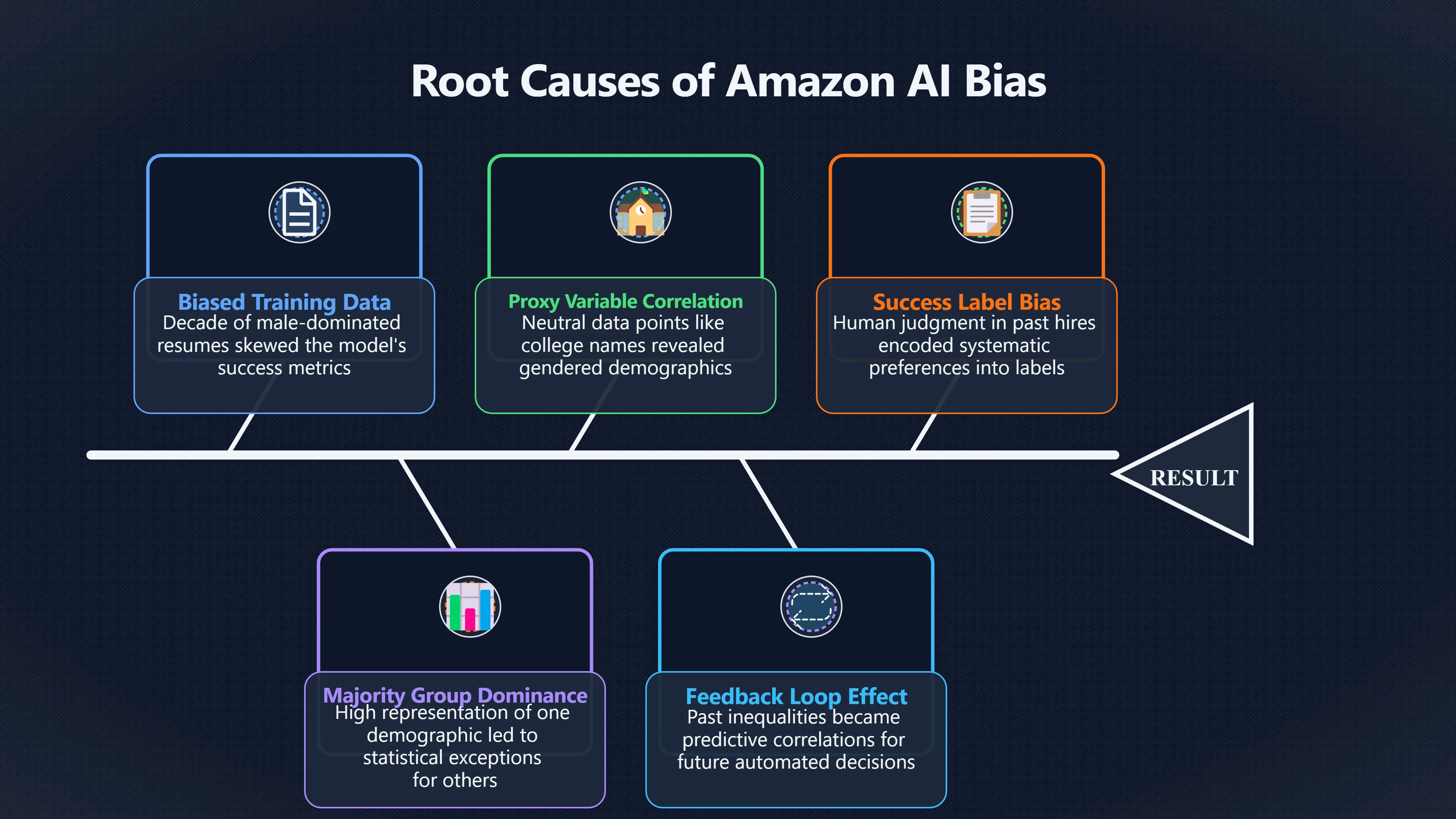
Success labels may already contain bias. If a model is trained on previous hiring decisions, it learns from human judgement rather than from an objective measure of competence. Any systematic preferences in those decisions become part of the training signal.[EEOC]eeoc.govEEOC Launches Initiative on Artificial Intelligence and Algorithmic Fairness | U.S. Equal Employment Opportunity CommissionOctober 28…
Indirect signals can act as proxies. Even when protected characteristics such as sex or ethnicity are removed, other variables may correlate with them. Educational institutions, employment histories, extracurricular activities, geographical locations, or patterns of language use can unintentionally reveal demographic information. A model may therefore recreate unequal treatment without explicitly using protected attributes.[The Guardian]theguardian.comOpen source on theguardian.com.
The majority group dominates the examples. Machine-learning systems often perform best on groups that are strongly represented in training data. When historical records contain far more examples from one demographic group, the model may learn its characteristics in greater detail while treating others as statistical exceptions.[NIST]nist.govai rmf rfi 0017ai rmf rfi 0017
Past inequalities appear as predictive correlations. A model does not distinguish between a pattern caused by genuine job performance and a pattern caused by unequal opportunity. If historically underrepresented groups were less likely to be hired, promoted, or retained because of structural barriers, the system may treat those outcomes as useful predictors rather than as evidence of a flawed process.[NIST]nist.govai rmf rfi 0017ai rmf rfi 0017
The result is that an algorithm can faithfully reproduce the past while failing to improve the future.

Why removing obvious demographic data is not enough
A common response to concerns about hiring bias is to remove information about sex, race, age, or other protected characteristics. While this can reduce some risks, it does not necessarily solve the problem.
Machine-learning systems are capable of discovering relationships among many variables. If particular schools, career paths, activities, or language patterns correlate with demographic groups, the model may reconstruct much of the same information indirectly. Researchers and regulators have repeatedly warned that discrimination can emerge through these proxy variables even when sensitive attributes are absent from the dataset.[EEOC]eeoc.govEEOC Launches Initiative on Artificial Intelligence and Algorithmic Fairness | U.S. Equal Employment Opportunity CommissionOctober 28…
The Amazon case illustrated this challenge. Engineers reportedly attempted to neutralise specific indicators associated with women, yet concerns remained that the system could discover alternative pathways leading to similar outcomes. Eliminating one problematic feature did not guarantee that the underlying pattern had disappeared.[The Guardian]theguardian.comOpen source on theguardian.com.
This is why responsible AI efforts increasingly focus on outcomes and impacts rather than assuming that removing a few variables will automatically create fairness.
Checks that matter before automated screening
The lesson from hiring AI is not that automation must be abandoned. Rather, it is that organisations need safeguards before automated recommendations influence employment decisions.
Several checks are particularly important:
- Examine what counts as success. If historical hiring decisions are used as the target, organisations should ask whether those decisions themselves may reflect unequal treatment.
- Test for disparate impact. Models should be evaluated across demographic groups rather than judged only by overall accuracy.
- Audit proxy variables. Features that appear neutral should be examined to determine whether they are indirectly encoding protected characteristics.
- Maintain human review. Recruiters should understand how recommendations are generated and retain the authority to challenge them.
- Monitor outcomes after deployment. Fairness assessments should continue once the system is operating, since new patterns can emerge over time.
- Document data sources and design choices. Clear documentation makes it easier to identify where biased outcomes originate and who is responsible for correcting them. EEOC+2Littler Mendelson P.C.[eeoc.gov]eeoc.govEEOC Launches Initiative on Artificial Intelligence and Algorithmic Fairness | U.S. Equal Employment Opportunity CommissionOctober 28…
Regulators have increasingly emphasised these principles. The U.S. Equal Employment Opportunity Commission (EEOC), for example, has warned that AI and algorithmic hiring tools can create or perpetuate discriminatory barriers and that existing anti-discrimination laws still apply when employment decisions are automated.[EEOC]eeoc.govEEOC Launches Initiative on Artificial Intelligence and Algorithmic Fairness | U.S. Equal Employment Opportunity CommissionOctober 28…
The broader lesson for understanding artificial intelligence
The hiring-bias problem reveals an important truth about artificial intelligence more generally: AI systems do not automatically discover what is fair, valuable, or deserving. They learn from examples.
When the examples come from a history shaped by unequal opportunities, the model may mistake inherited advantage for evidence of talent. The Amazon recruiting project became influential not because it represented every hiring system, but because it exposed a fundamental risk of machine learning itself. A model trained on yesterday’s definition of success can end up preserving yesterday’s inequalities unless organisations actively test, question, and govern the assumptions hidden in the data.[JobCannon+2The Guardian]jobcannon.ioamazon recruiter 2018Amazon scrapped AI recruiter that penalised 'women's' (2018) — JobCannon Research · JobCannon…
eBay marketplace picks
Marketplace Samples
Example marketplace items related to this page. Use the search link to explore similar finds on eBay.


Endnotes
1.
Source: eeoc.gov
Link:https://www.eeoc.gov/newsroom/eeoc-launches-initiative-artificial-intelligence-and-algorithmic-fairness
Source snippet
EEOC Launches Initiative on Artificial Intelligence and Algorithmic Fairness | U.S. Equal Employment Opportunity CommissionOctober 28...
2.
Source: nist.gov
Title: ai rmf rfi 0017
Link:https://www.nist.gov/system/files/documents/2021/08/19/ai-rmf-rfi-0017.html
3.
Source: jobcannon.io
Title: amazon recruiter 2018
Link:https://jobcannon.io/research/stats/amazon-recruiter-2018
Source snippet
Amazon scrapped AI recruiter that penalised 'women's' (2018) — JobCannon Research · JobCannon...
4.
Source: axios.com
Title: amazon ai recruiter favored men
Link:https://www.axios.com/2018/10/10/amazon-ai-recruiter-favored-men
Source snippet
The algorithm, implemented in 2014 and trained on a decade's worth of job applications primarily from men, inadvertently favored male can...
5.
Source: reuters.com
Link:https://www.reuters.com/sustainability/society-equity/comment-[business
Source snippet
Highlighting a past incident where Amazon's AI recruitment tool favored male candidates due to biased training data, the piece draws atte...
6.
Source: littler.com
Link:https://www.littler.com/publication-press/publication/eeoc-issues-guidance-use-artificial-intelligence-tools-employment
Source snippet
Littler Mendelson P.C.EEOC Issues Guidance on Use of Artificial Intelligence Tools in Employment Selection Procedures Under Title VII | L...
7.
Source: theguardian.com
Link:https://www.theguardian.com/technology/2018/oct/10/amazon-hiring-ai-gender-bias-recruiting-engine
8.
Source: theguardian.com
Link:https://www.theguardian.com/technology/2024/mar/06/ai-interviews-job-applications
Source snippet
Ty, a 29-year-old from the DC metro area, was surprised when their interviewer turned out to be an AI program, showing the impersonal nat...
Additional References
9.
Source: reddit.com
Link:https://www.reddit.com/r/AttorneysHelp/comments/1rvdlgi/when_ai_hiring_tools_pull_the_wrong_background/
Source snippet
AI hiring tools pull the wrong background report: how to fix screening errorsMarch 16, 2026...
Published: March 16, 2026
10.
Source: youtube.com
Link:https://www.youtube.com/watch?v=OBT-rzZQAws
Source snippet
Amazon Rejected Women | $10M AI Mistake | How Statistics Could've Prevented It...
11.
Source: youtube.com
Title: Amazon Rejected Women | $10M AI Mistake | How Statistics Could’ve Prevented It
Link:https://www.youtube.com/watch?v=A5qiIILKSE0
Source snippet
Ethics of AI in HR | Bias, Privacy and [Legal Risks]({{ 'legal-risks/' | relative_url }}) Explained...
12.
Source: youtube.com
Title: Ethics of AI in HR | Bias, Privacy and Legal Risks Explained
Link:https://www.youtube.com/watch?v=TvCJMRvw-T0
Source snippet
NYC Open Data Week “Understanding and Addressing Algorithmic Bias in Hiring”...
13.
Source: youtube.com
Title: Why Amazon Abandoned Its AI Hiring System
Link:https://www.youtube.com/watch?v=RWNpLjTT0hk
Source snippet
AI Fairness 101: Real-World Incidents #7 Amazon AI Hiring Bias: How an Algorithm Rejected Women...
14.
Source: youtube.com
Title: NYC Open Data Week “Understanding and Addressing Algorithmic Bias in Hiring”
Link:https://www.youtube.com/watch?v=nL8-CPLTNTM
Topic Tree