Within Hiring Bias
Why accurate hiring AI can still be unfair
Hiring algorithms need group-level outcome checks because high overall accuracy can hide unfair rejection patterns.
On this page
- What disparate impact means in automated screening
- Why overall accuracy can mask group harm
- Practical safeguards before and after deployment
Page outline Jump by section
Introduction
A hiring algorithm can achieve impressive overall accuracy and still create unfair barriers for particular groups of applicants. This is why disparate impact testing has become a central safeguard before organisations deploy AI screening tools. Rather than asking only whether a model predicts hiring outcomes correctly, disparate impact testing examines whether the system disproportionately rejects people from legally protected groups, such as applicants distinguished by sex, race, age, disability, or other protected characteristics.
 Within the broader problem of how hiring AI can learn inequality from past success, disparate impact testing addresses a specific risk: historical hiring patterns may be embedded in training data, allowing an apparently neutral system to reproduce exclusion at scale. Employment regulators, AI governance frameworks, and responsible-AI practitioners increasingly treat group-level outcome testing as a necessary step before automated screening systems influence real hiring decisions.[NIST+2NIST]nist.govtrustworthy ai managing risks artificial intelligenceTrustworthy AI: Managing the Risks of Artificial Intelligence | NISTSeptember 29, 2022…
What disparate impact means in automated screening
Disparate impact refers to a situation where a hiring practice appears neutral but produces substantially different outcomes for different groups. The key issue is not whether a system explicitly uses protected characteristics. A tool can generate discriminatory effects even when race, sex, or age are removed from the data because other variables may act as proxies for those characteristics.[Production AI Institute]productionai.instituteOpen source on productionai.institute.
In AI-assisted recruitment, disparate impact testing asks questions such as:
- Are women advancing through the screening process at the same rate as men?
- Do applicants from different racial groups receive interview recommendations at similar rates?
- Are older candidates being filtered out more often than younger candidates with comparable qualifications?
- Does a disability-related characteristic indirectly reduce selection rates?
The purpose is to evaluate outcomes rather than intentions. An algorithm does not need to be designed with discriminatory intent to create discriminatory effects. Employment law has long recognised this distinction, and regulators have increasingly applied the same logic to automated decision tools.[McGuireWoods]mcguirewoods.comMc Guire Woods EEOC Issues Guidance on Artificial Intelligence Hiring ToolsEEOC Issues Guidance on Artificial Intelligence Hiring Tools - McGuireWoodsMay 23, 2023…
The role of the four-fifths rule
One commonly used screening test is the “four-fifths rule” or “80% rule”. Under guidance used in employment discrimination analysis, a group’s selection rate may warrant further scrutiny if it is less than 80% of the selection rate achieved by the highest-performing comparison group. For example, if 50% of one group progresses to interview but only 30% of another group does, the ratio is 60%, falling below the four-fifths threshold.[McGuireWoods]mcguirewoods.comMc Guire Woods EEOC Issues Guidance on Artificial Intelligence Hiring ToolsEEOC Issues Guidance on Artificial Intelligence Hiring Tools - McGuireWoodsMay 23, 2023…
However, governance experts caution that the four-fifths rule is only an initial indicator rather than a complete fairness judgement. Legal analysis, statistical significance, context, sample size, and business necessity all matter. Treating the rule as a complete definition of fairness can oversimplify a more complex legal and ethical question.[arXiv]arxiv.orgThe four-fifths rule is not disparate impact: a woeful tale of epistemic trespassing in algorithmic fairnessFebruary 19, 2022…
Why overall accuracy can mask group harm
One of the most common misunderstandings in AI deployment is assuming that a highly accurate model must also be fair. In practice, aggregate performance can conceal unequal treatment.
Imagine an AI screening system that correctly predicts successful hires 90% of the time across all applicants. At first glance, this appears excellent. Yet if most applicants belong to one demographic group, the model can maintain high overall accuracy while systematically rejecting qualified candidates from a smaller group.
This happens because machine-learning systems optimise for statistical performance against their training objectives. If historical hiring data contains unequal patterns, the model may learn shortcuts that improve prediction scores while disadvantaging certain populations. A performance dashboard focused only on accuracy, precision, or efficiency may therefore miss harmful outcome disparities.[Snowflake]snowflake.comAlgorithmic Bias: Types, Detection & Mitigation | SnowflakeAlgorithmic Bias: Types, Detection & Mitigation | Snowflake…
Researchers and governance frameworks consequently recommend examining performance separately across demographic groups. Metrics such as selection rates, false-positive rates, false-negative rates, and true-positive rates can reveal problems that remain invisible in aggregate statistics.[Snowflake]snowflake.comAlgorithmic Bias: Types, Detection & Mitigation | SnowflakeAlgorithmic Bias: Types, Detection & Mitigation | Snowflake…
A practical example can be seen in discussions surrounding biased recruitment systems. The lesson from high-profile failures was not merely that the models made mistakes. It was that traditional performance measures did not automatically reveal how certain groups were being disadvantaged. Group-level testing was needed to uncover the problem.[OECD.AI]oecd.aiA I Recruitment Systems Cause Bias and Unfair Job RejectionsAI Recruitment Systems Cause Bias and Unfair Job Rejections - OECD.AIJune 3, 2021…

Practical safeguards before deployment
Disparate impact testing is most useful when conducted before applicants are affected by automated decisions.
Organisations typically begin by evaluating historical data used for training. If the data reflects past inequalities, the resulting model deserves closer scrutiny. Testing then measures how different demographic groups fare when the model processes representative applicant datasets.
Several safeguards are commonly recommended:
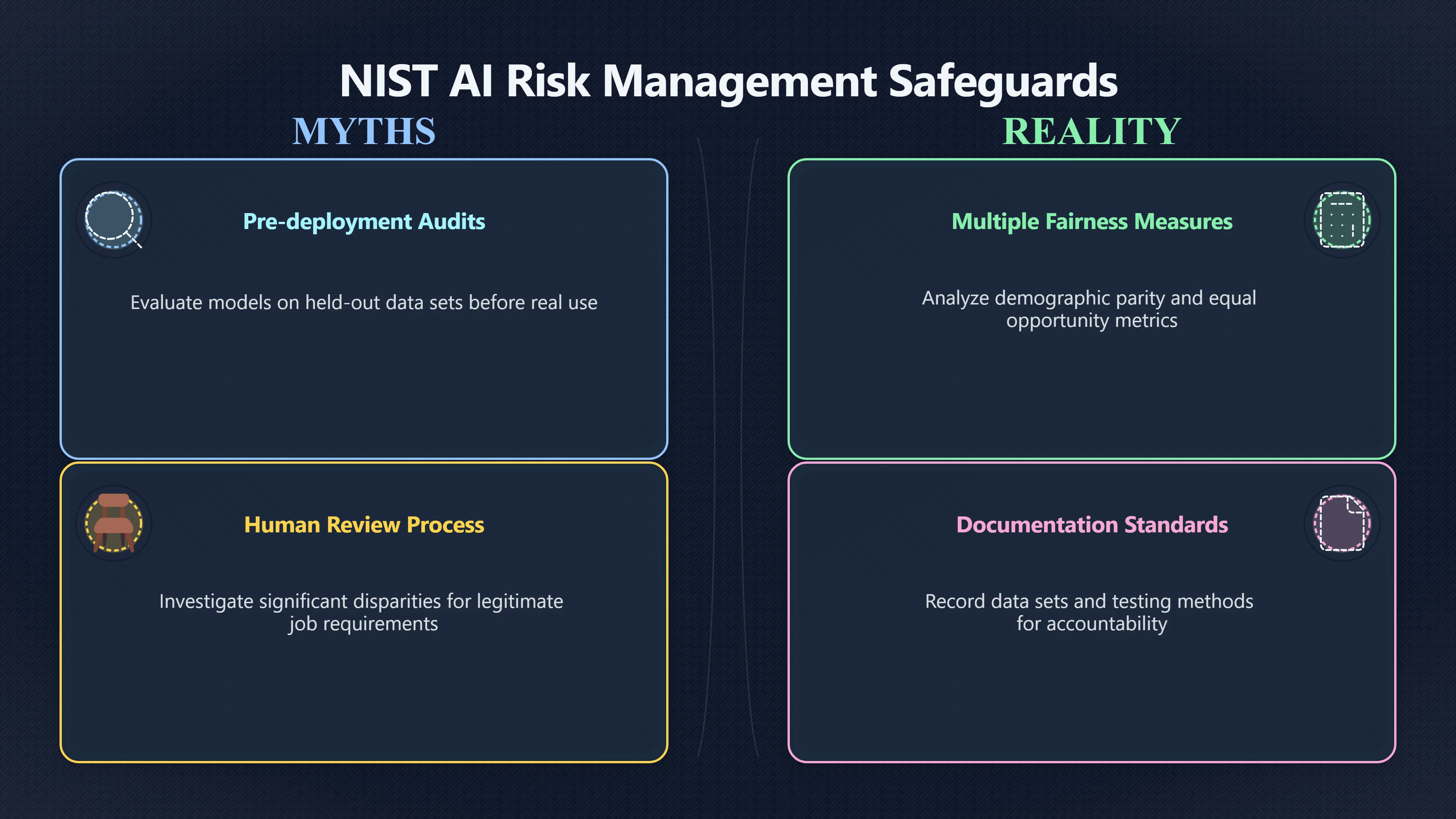
Pre-deployment audits. Models are evaluated on held-out datasets before use in real recruitment. Selection rates and error rates are compared across groups to identify disparities.[I.S. Partners]ispartnersllc.comI.S. Partners Framework Principles of NIST AI RMFI.S. Partners Framework Principles of NIST AI RMF
Multiple fairness measures. Organisations increasingly look beyond a single metric. Demographic parity, equal opportunity, calibration, and related measures can reveal different kinds of imbalance.[Snowflake]snowflake.comAlgorithmic Bias: Types, Detection & Mitigation | SnowflakeAlgorithmic Bias: Types, Detection & Mitigation | Snowflake…
Human review of adverse findings. Significant disparities should trigger investigation rather than automatic deployment. Teams need to determine whether the disparity reflects a legitimate job-related requirement or an avoidable bias in the system.[NIST]nist.govtrustworthy ai managing risks artificial intelligenceTrustworthy AI: Managing the Risks of Artificial Intelligence | NISTSeptember 29, 2022…
Documentation and accountability. Governance frameworks emphasise documenting datasets, testing methods, assumptions, and mitigation decisions so that organisations can demonstrate responsible oversight.[NIST]nist.govtrustworthy ai managing risks artificial intelligenceTrustworthy AI: Managing the Risks of Artificial Intelligence | NISTSeptember 29, 2022…
These safeguards shift the focus from simply building an accurate model to demonstrating that the model can be trusted in a real employment setting.
Why testing must continue after launch
Passing a fairness audit before deployment does not guarantee fair outcomes indefinitely. Hiring pools change, labour markets evolve, and models may behave differently when exposed to real-world applicant populations.
For this reason, responsible AI governance increasingly treats disparate impact testing as an ongoing monitoring activity rather than a one-time certification exercise. NIST’s risk-management approach emphasises measuring and managing risks throughout the AI lifecycle, recognising that fairness problems can emerge after deployment even when earlier evaluations appeared satisfactory.[NIST+2NIST AI Resource Center]nist.govtrustworthy ai managing risks artificial intelligenceTrustworthy AI: Managing the Risks of Artificial Intelligence | NISTSeptember 29, 2022…
Post-deployment monitoring typically includes:
- Regular reviews of applicant selection rates.
- Periodic fairness audits using recent hiring data.
- Investigation of complaints and unexpected outcome patterns.
- Revalidation when models, data sources, or job requirements change.
This lifecycle approach reflects an important insight: fairness is not a permanent property of a hiring algorithm. It is a condition that must be continually assessed as the system operates in changing social and organisational environments.[I.S. Partners]ispartnersllc.comI.S. Partners Framework Principles of NIST AI RMFI.S. Partners Framework Principles of NIST AI RMF

Why impact tests matter for trustworthy hiring AI
Disparate impact testing exists because recruitment systems influence access to jobs, income, and career opportunities. In that context, high predictive performance alone is not enough.
The central question is whether an automated screening tool creates unjustified barriers for particular groups of applicants. By examining real outcomes rather than relying solely on technical accuracy metrics, disparate impact testing helps organisations detect when historical inequalities have been encoded into automated decision-making. It therefore serves as one of the most important governance mechanisms for preventing hiring AI from learning that past exclusion is evidence of future merit.[Production AI Institute+2NIST]productionai.instituteOpen source on productionai.institute.
Amazon book picks
Further Reading
Books and field guides related to Why accurate hiring AI can still be unfair. Use these as the next step if you want deeper reading beyond the article.
Fairness and Machine Learning
Directly addresses disparate impact, discrimination, and fairness metrics.
Automating Inequality
Shows how data-driven systems can reproduce unequal treatment at scale.
Weapons of Math Destruction
Explains how accurate models can still create harmful group outcomes and discrimination.
Hello World
Uses real-world examples of algorithmic decision-making and fairness concerns.
eBay marketplace picks
Marketplace Samples
Example marketplace items related to this page. Use the search link to explore similar finds on eBay.




Endnotes
1.
Source: nist.gov
Title: trustworthy ai managing risks artificial intelligence
Link:https://www.nist.gov/speech-testimony/trustworthy-ai-managing-risks-artificial-intelligence
Source snippet
Trustworthy AI: Managing the Risks of Artificial Intelligence | NISTSeptember 29, 2022...
Published: September 29, 2022
2.
Source: nist.gov
Title: Artificial Intelligence Risk Management Framework (AI RMF 1.0) | NIST
Link:https://www.nist.gov/publications/artificial-intelligence-risk-management-framework-ai-rmf-10
Source snippet
Artificial Intelligence Risk Management Framework (AI RMF 1.0) | NIST...
3.
Source: mcguirewoods.com
Title: Mc Guire Woods EEOC Issues Guidance on Artificial Intelligence Hiring Tools
Link:https://www.mcguirewoods.com/client-resources/alerts/2023/5/eeoc-issues-guidance-on-artificial-intelligence-hiring-tools/
Source snippet
EEOC Issues Guidance on Artificial Intelligence Hiring Tools - McGuireWoodsMay 23, 2023...
Published: May 23, 2023
4.
Source: arxiv.org
Link:https://arxiv.org/abs/2202.09519
Source snippet
The four-fifths rule is not disparate impact: a woeful tale of epistemic trespassing in algorithmic fairnessFebruary 19, 2022...
Published: February 19, 2022
5.
Source: snowflake.com
Title: Algorithmic Bias: Types, Detection & Mitigation | Snowflake
Link:https://www.snowflake.com/en/artificial-intelligence/ai-governance/algorithmic-bias/
Source snippet
Algorithmic Bias: Types, Detection & Mitigation | Snowflake...
6.
Source: oecd.ai
Title: A I Recruitment Systems Cause Bias and Unfair Job Rejections
Link:https://oecd.ai/en/incidents/2021-06-03-b058
Source snippet
AI Recruitment Systems Cause Bias and Unfair Job Rejections - OECD.AIJune 3, 2021...
Published: June 3, 2021
7.
Source: airc.nist.gov
Title: AI Resource Center AI RMF
Link:https://airc.nist.gov/airmf-resources/airmf/?msockid=230452fd411163c516a4445a405c6214
Source snippet
NIST AI Resource CenterAI RMF - AIRC...
8.
Source: airc.nist.gov
Title: AI Resource Center Executive
Link:https://airc.nist.gov/airmf-resources/airmf/0-ai-rmf-1-0/
Source snippet
NIST AI Resource CenterExecutive Summary - AIRC...
9.
Source: nist.gov
Title: Trustworthy and responsible AI | NIST
Link:https://www.nist.gov/trustworthy-and-responsible-ai
Source snippet
Trustworthy and responsible AI | NIST...
10.
Source: productionai.institute
Link:https://www.productionai.institute/insights/hr-employment-ai-playbook
11.
Source: ispartnersllc.com
Title: I.S. Partners Framework Principles of NIST AI RMF
Link:https://www.ispartnersllc.com/hubs/nist-ai-rmf/principles/
Additional References
12.
Source: youtube.com
Link:https://www.youtube.com/watch?v=0zeKm6vob4U
Source snippet
AI Hiring Under Fire: CHRO Kristen Duckett on Mobley v. Workday, Governance, and Accountability...
13.
Source: youtube.com
Link:https://www.youtube.com/watch?v=1Fp-MNRjZY8
Source snippet
Why Counterfactual Testing Reveals Hidden Bias in AI...
14.
Source: youtube.com
Title: AI in Hiring Is Now a Legal Risk Employers Can’t Ignore
Link:https://www.youtube.com/watch?v=hrAd5cFaPYM
Source snippet
Employment Law This Week - Making AI Work for HR - Deep Dive Episode...
15.
Source: youtube.com
Title: Why Counterfactual Testing Reveals Hidden Bias in AI
Link:https://www.youtube.com/watch?v=8dZAEXTCong
Source snippet
AI in Hiring Is Now a Legal Risk Employers Can't Ignore...
16.
Source: dwt.com
Link:https://www.dwt.com/blogs/employment-labor-and-benefits/2023/05/eeoc-automated-tools-hiring-discrimination
17.
Source: youtube.com
Title: Employment Law This Week
Link:https://www.youtube.com/watch?v=wGibAvhtOnE
Topic Tree