Within Self attention
Why Pronouns Test Long Range Attention
Pronouns often depend on earlier nouns, making them a clear test case for why direct token-to-token connections matter.
On this page
- Why pronoun references are hard for sequence models
- How self attention links it to likely antecedents
- Where attention can still mislead readers
Page outline Jump by section
Introduction
Pronouns look simple, but they expose one of the hardest problems in language understanding: figuring out what a word such as “he”, “she”, “they”, “it”, or “them” refers to. The answer is often located many words earlier, sometimes in a previous sentence. This makes pronouns a useful test of whether an artificial intelligence system can connect distant pieces of information rather than relying only on nearby words.
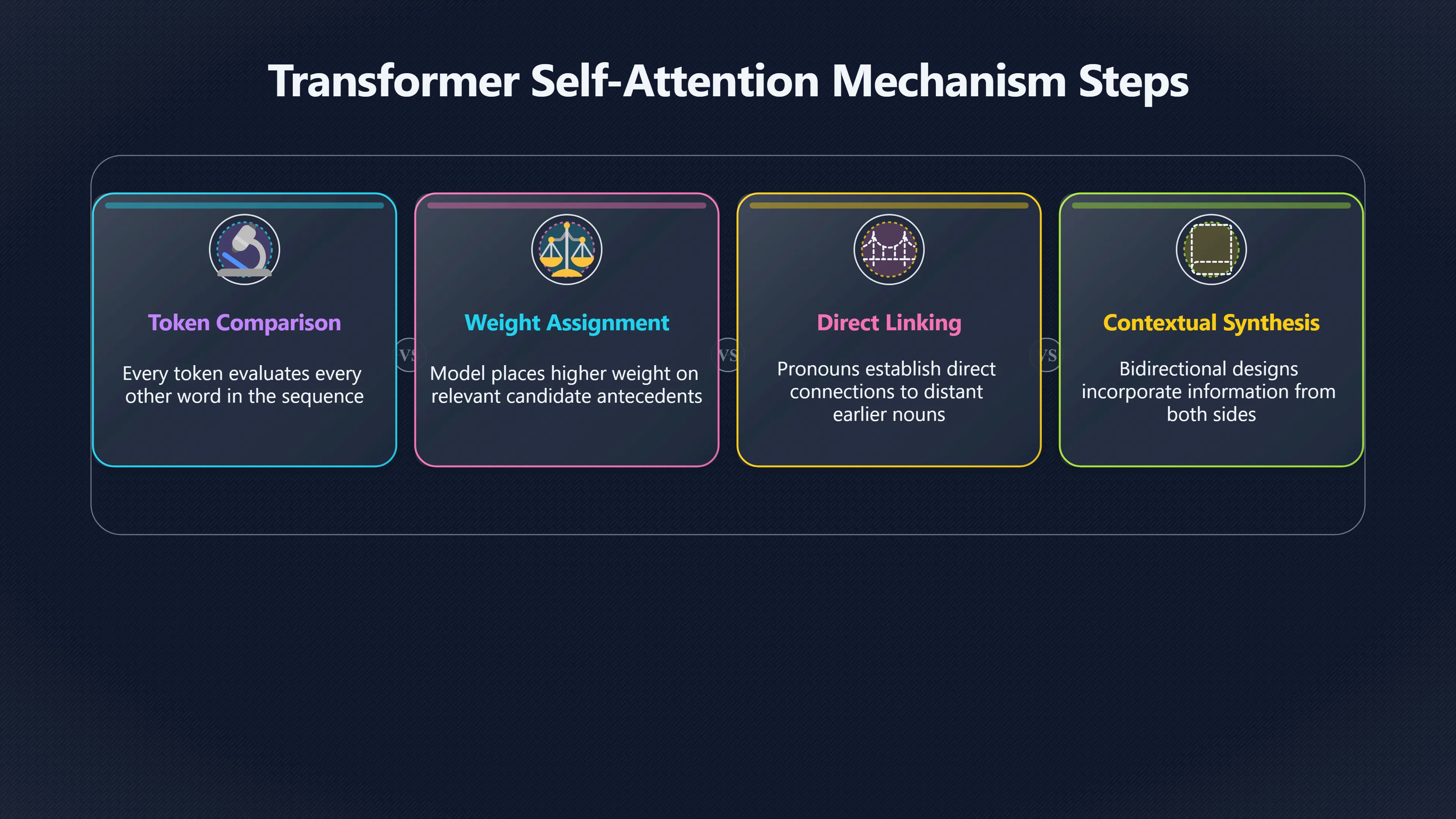
 Self-attention in Transformer models was designed for exactly this challenge. Instead of forcing information to travel step by step through a sequence, it allows a pronoun to create direct links to earlier words that might be its referent. These long-distance connections help the model determine who performed an action, what object is being discussed, or which entity a later statement describes. The importance of this capability is reflected in both linguistic research on coreference resolution and modern Transformer-based language models.[NeurIPS Papers]papers.neurips.ccNeur IPS Papers Attention is All you NeedNeurIPS PapersAttention is All you NeedFebruary 13, 2018 — by A Vaswani · Cited by 253775 — We propose a new simple network architecture…
Why pronoun references are hard for sequence models
Pronouns are examples of what linguists call coreference: two expressions point to the same person, object, or concept. In the sentence:
“Alice spoke to Sarah before she left.”
The word “she” is ambiguous. It could refer to Alice or Sarah. A reader resolves the ambiguity using grammar, context, and world knowledge. AI systems must do something similar.[Wikipedia]WikipediaOpen source on wikipedia.org.
The difficulty increases when the relevant noun is far away:
“The scientist presented her findings after a long discussion with the committee. Several objections were raised, but she answered them all.”
The pronoun “she” must be linked back to “the scientist”, even though many intervening words appear between them.
Older recurrent neural networks (RNNs) and related sequence models processed text one step at a time. In principle they could remember earlier information, but the signal had to pass through many intermediate states. As sequences grew longer, maintaining precise information about an earlier noun became increasingly difficult. The Transformer architecture was introduced partly to address such long-range dependency problems by allowing direct interactions between distant positions in a sequence.[NeurIPS Papers]papers.neurips.ccNeur IPS Papers Attention is All you NeedNeurIPS PapersAttention is All you NeedFebruary 13, 2018 — by A Vaswani · Cited by 253775 — We propose a new simple network architecture…
Pronouns therefore serve as a practical stress test. If a model cannot reliably identify a pronoun’s antecedent—the earlier expression it refers to—it may misunderstand entire sentences.
How self-attention links pronouns to likely antecedents
Self-attention allows every token to compare itself with every other token in the sequence. When the model processes a pronoun, it can evaluate many possible antecedents simultaneously rather than searching through text sequentially.[NeurIPS Papers]papers.neurips.ccNeur IPS Papers Attention is All you NeedNeurIPS PapersAttention is All you NeedFebruary 13, 2018 — by A Vaswani · Cited by 253775 — We propose a new simple network architecture…
Consider:
“The dog chased the cat through the garden because it was frightened.”
The word “it” could potentially refer to either animal. During self-attention, the representation of “it” can place greater weight on tokens that appear relevant to the idea of being frightened. Multiple attention heads may examine different clues, including grammatical structure, semantic relationships, and broader sentence context.[Wikipedia]WikipediaTransformer (deep learningTransformer (deep learning
This direct-access property is important. A pronoun does not need information to travel through every intervening word. Instead, the model can establish a strong connection between the pronoun and a candidate antecedent regardless of distance. Researchers often describe this as making long-range dependencies easier to learn because the path between related tokens is much shorter than in sequential architectures.[NeurIPS Papers]papers.neurips.ccNeur IPS Papers Attention is All you NeedNeurIPS PapersAttention is All you NeedFebruary 13, 2018 — by A Vaswani · Cited by 253775 — We propose a new simple network architecture…
Modern Transformer-based systems such as BERT rely heavily on contextual representations. The same token can acquire different meanings depending on surrounding words, and pronouns benefit from the same contextual reasoning process. BERT’s bidirectional design allows it to incorporate information from both left and right context when building representations, improving its ability to capture relationships between words.[arXiv]arxiv.orgarXiv[1810.04805] BERT: Pre-training of Deep Bidirectional Transformers…October 11, 2018 — BERT is designed to pre-train deep bidirect…
Evidence that attention helps resolve references
Pronoun resolution has become a major benchmark task in natural language processing because it reveals whether a model genuinely connects related pieces of text.
Research applying BERT to coreference resolution found substantial improvements over earlier approaches on widely used benchmarks. The gains suggest that Transformer representations capture information useful for identifying which mentions refer to the same entity.[arXiv]arxiv.orgarXiv BERT for Coreference Resolution: Baselines and AnalysisBERT for Coreference Resolution: Baselines and AnalysisAugust 24, 2019…
Studies examining Transformer attention patterns have also found that some attention heads specialise in tracking linguistic relationships. While no single attention head fully represents grammatical structure, certain heads recover dependency relationships significantly better than simple baselines, indicating that parts of the network learn meaningful connections between related words.[arXiv]arxiv.orgarXiv Do Attention Heads in BERT Track Syntactic Dependencies?arXiv Do Attention Heads in BERT Track Syntactic Dependencies?
More recent work on pronoun disambiguation in machine translation has shown that specific attention heads contribute to identifying the correct referent. Researchers observed that strengthening useful attention patterns could improve pronoun disambiguation accuracy, demonstrating a measurable link between attention behaviour and successful reference tracking.[arXiv]arxiv.orgAnalyzing the Attention Heads for Pronoun Disambiguation…15 Dec 2024 — In this paper, we investigate the role of attention heads…
Taken together, these findings support the idea that long-distance attention links are not merely a convenience. They contribute directly to a model’s ability to resolve references that would otherwise be difficult to maintain across long stretches of text.
Where attention can still mislead readers
Although attention helps, pronoun resolution remains imperfect.
One reason is that language often contains genuine ambiguity. Consider:
“John told Mark that he had won.”
Without additional context, even humans may disagree about who “he” refers to. No amount of attention can fully solve a problem when the text itself leaves multiple interpretations open.[Wikipedia]WikipediaOpen source on wikipedia.org.
Another challenge is that attention weights do not always correspond neatly to human reasoning. Research comparing human attention patterns with Transformer attention during reference-resolution tasks has found both overlaps and important differences. Models may arrive at correct answers using patterns that do not resemble how people process the same sentence.[ACL Anthology]aclanthology.orgACL Anthology Transformer Attention vs Human Attention in AnaphoraACL AnthologyTransformer Attention vs Human Attention in Anaphora…July 18, 2024 — by A Kozlova · 2024 · Cited by 5 — In this paper, we…
Pronouns can also depend on information beyond a single sentence. A paragraph may introduce several people and switch topics repeatedly before a pronoun appears. Even powerful Transformer models sometimes struggle with these document-level references, especially in conversations or complex narratives. Researchers working on coreference resolution continue to identify limitations in maintaining coherent entity tracking across longer contexts.[arXiv]arxiv.orgarXiv BERT for Coreference Resolution: Baselines and AnalysisBERT for Coreference Resolution: Baselines and AnalysisAugust 24, 2019…

Why pronouns remain a revealing test of AI understanding
Pronouns are deceptively small words, but they reveal whether a model can connect information across distance. To interpret a pronoun correctly, an AI system must identify candidate referents, evaluate context, maintain representations of entities over time, and choose the most plausible connection.
Self-attention gives Transformers a powerful mechanism for creating those connections directly. By allowing a pronoun to attend to relevant nouns regardless of position, the architecture reduces one of the central obstacles that older sequence models faced. The continuing use of pronoun-resolution benchmarks in AI research reflects how closely this task is tied to genuine language understanding. When a model correctly resolves a distant pronoun, it demonstrates not just vocabulary knowledge, but an ability to connect meaning across a sequence—a core requirement for understanding human language.[NeurIPS Papers+2arXiv]papers.neurips.ccNeur IPS Papers Attention is All you NeedNeurIPS PapersAttention is All you NeedFebruary 13, 2018 — by A Vaswani · Cited by 253775 — We propose a new simple network architecture…
Amazon book picks
Further Reading
Books and field guides related to Why Pronouns Test Long Range Attention. Use these as the next step if you want deeper reading beyond the article.
Speech and Language Processing: Pearson New International Edi...
Includes coreference resolution and pronoun interpretation.
Natural Language Processing with Transformers
Shows how attention handles language relationships.
Transformers for Machine Learning
Explains attention connections across distant tokens.
eBay marketplace picks
Marketplace Samples
Example marketplace items related to this page. Use the search link to explore similar finds on eBay.




Endnotes
1.
Source: papers.neurips.cc
Title: Neur IPS Papers Attention is All you Need
Link:https://papers.neurips.cc/paper/7181-attention-is-all-you-need.pdf
Source snippet
NeurIPS PapersAttention is All you NeedFebruary 13, 2018 — by A Vaswani · Cited by 253775 — We propose a new simple network architecture...
Published: February 13, 2018
2.
Source: Wikipedia
Link:https://en.wikipedia.org/wiki/Coreference
3.
Source: Wikipedia
Title: Transformer ([deep learning]({{ ‘deep-learning/’ | relative_url }}))
Link:https://en.wikipedia.org/wiki/Transformer_%28deep_learning%29
4.
Source: arxiv.org
Title: arXiv Do Attention Heads in BERT Track Syntactic Dependencies?
Link:https://arxiv.org/abs/1911.12246
5.
Source: arxiv.org
Link:https://arxiv.org/abs/1810.04805
Source snippet
arXiv[1810.04805] BERT: Pre-training of Deep Bidirectional Transformers...October 11, 2018 — BERT is designed to pre-train deep bidirect...
Published: October 11, 2018
6.
Source: arxiv.org
Title: arXiv BERT for Coreference Resolution: Baselines and Analysis
Link:https://arxiv.org/abs/1908.09091
Source snippet
BERT for Coreference Resolution: Baselines and AnalysisAugust 24, 2019...
Published: August 24, 2019
7.
Source: arxiv.org
Link:https://arxiv.org/html/2412.11187v1
Source snippet
Analyzing the Attention Heads for Pronoun Disambiguation...15 Dec 2024 — In this paper, we investigate the role of attention heads...
8.
Source: arxiv.org
Link:https://arxiv.org/abs/2412.11187
9.
Source: arxiv.org
Link:https://arxiv.org/abs/1905.10238
10.
Source: Wikipedia
Title: BERT (language model)
Link:https://en.wikipedia.org/wiki/BERT_%28language_model%29
Source snippet
BERT (language model) - WikipediaBidirectional encoder representations from transformers (BERT) is a language model introduced in Octo...
11.
Source: huggingface.co
Title: Hugging Face BERT
Link:https://huggingface.co/docs/transformers/en/model_doc/bert
Source snippet
BERT - Hugging FaceBERT is a bidirectional transformer pretrained on unlabeled text to predict masked tokens in a sentence and to predict...
12.
Source: aclanthology.org
Title: ACL Anthology Transformer Attention vs Human Attention in Anaphora
Link:https://aclanthology.org/2024.cmcl-1.10.pdf
Source snippet
ACL AnthologyTransformer Attention vs Human Attention in Anaphora...July 18, 2024 — by A Kozlova · 2024 · Cited by 5 — In this paper, we...
Published: July 18, 2024
Additional References
13.
Source: medium.com
Link:https://medium.com/%40lepicardhugo/attention-from-first-principles-to-[production
Source snippet
Self-Attention & Multi-Head Attention Made SimpleThis article takes attention mechanisms from first principles all the way to practical i...
14.
Source: pub.towardsai.net
Link:https://pub.towardsai.net/attention-is-all-you-need-a-deep-dive-into-the-revolutionary-transformer-architecture-52734fb355dc
Source snippet
Deep Dive into the Revolutionary Transformer Architecture10 Apr 2025 — The Transformer's ability to handle long-range dependencies and ca...
15.
Source: mbrenndoerfer.com
Link:https://mbrenndoerfer.com/writing/self-attention-concept
Source snippet
Michael BrenndoerferSelf-Attention Concept: From Cross-Attention to Contextual...6 Feb 2026 — Pronouns can gather information from their...
16.
Source: github.com
Link:https://github.com/google-research/bert
Source snippet
google-research/bert: TensorFlow code and pre-trained models for...October 31, 2018 — BERT is a method of pre-training language represen...
Published: October 31, 2018
17.
Source: linkedin.com
Link:https://www.linkedin.com/pulse/understanding-groundbreaking-attention-all-you-need-research-disansa-becnc
Source snippet
o output sequences) model relying entirely on self-attention...Read more...
18.
Source: coursera.org
Title: What Is the BERT Model and How Does It Work?
Link:https://www.coursera.org/articles/bert-model
Source snippet
March 6, 2026 — BERT is a deep learning language model designed to improve the efficiency of natural language processing (NLP) tasks...
Published: March 6, 2026
19.
Source: exxactcorp.com
Title: BER T Transformers – How Do They Work?
Link:https://www.exxactcorp.com/blog/Deep-Learning/how-do-bert-transformers-work
Source snippet
Exxact BlogOctober 30, 2025 — BERT is a Transformer-based model built on a stack of encoders designed to learn relationships between wo...
Published: October 30, 2025
20.
Source: h2o.ai
Link:https://h2o.ai/wiki/bert/
Source snippet
framework for natural language processing...
21.
Source: youtube.com
Title: Transformer Explained Simply – Part 06 – Why Self-Attention Wins
Link:http://www.youtube.com/watch?v=HhSP8RIhYvI
Source snippet
Stanford CS224N NLP with Deep Learning Winter 2019 Lecture 16 – Coreference Resolution...
22.
Source: youtube.com
Title: Day 1 | Transformer Architecture Series | Why Attention Had to Take Over
Link:http://www.youtube.com/watch?v=1O6KZSUdous
Source snippet
Transformer Explained Simply – Part 06 – Why Self-Attention Wins...
Topic Tree