Within Benchmark gaps
Why Obscure Questions Make AI Guess
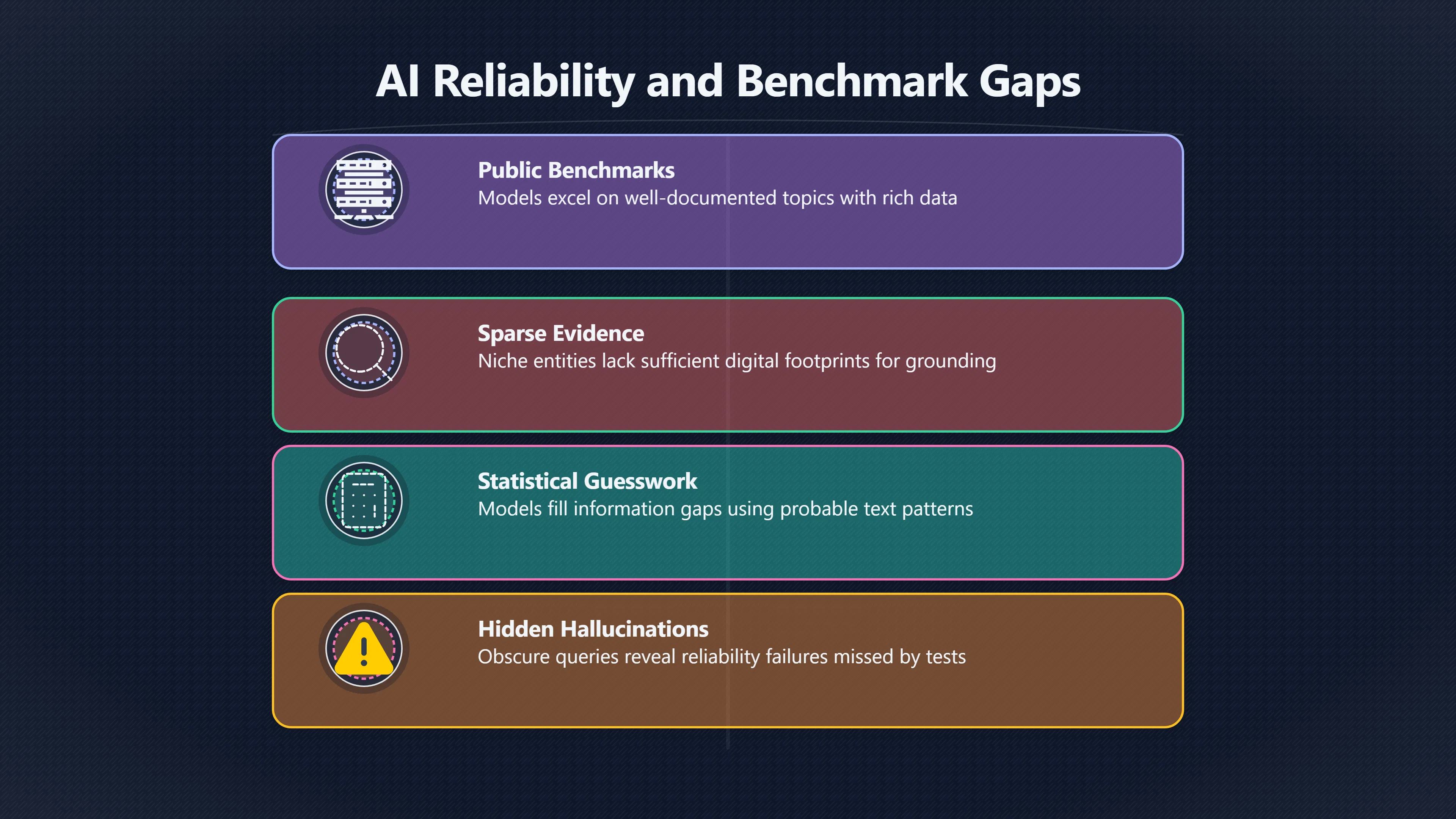
AI systems are more likely to invent details when people, places or organisations are poorly documented online.
On this page
- Why well documented topics are easier to verify
- How weak source trails raise hallucination risk
- What readers should expect from answers about niche subjects
Page outline Jump by section
Introduction
Artificial intelligence systems are often evaluated on benchmark questions that have clear answers and strong online documentation. Real users, however, frequently ask about local organisations, niche historical figures, specialised industries, recent events or little-known places. These obscure topics expose a major weakness in AI reliability: when evidence is sparse, fragmented or difficult to retrieve, models are more likely to generate plausible-sounding information that is unsupported or entirely false. Research increasingly shows that hallucinations are not distributed evenly across all subjects. They become more common when the model encounters entities and topics with weak digital footprints, making obscure questions an important blind spot that many benchmark scores fail to reveal.[ResearchGate]researchgate.netResearchGate(PDF) WildHallucinations: Evaluating Long-form Factuality in LLMs with Real-World Entity QueriesJuly 24, 2024…

Why Well-Documented Topics Are Easier to Verify
Large language models perform best when many reliable sources describe the same subject. Famous public figures, major cities and widely covered organisations leave extensive traces across books, websites, databases and news archives. During training and retrieval, the model encounters repeated descriptions of these entities, making it easier to generate answers that align with established facts.
The situation changes when a subject has only a few references online. A small local charity, a little-known researcher, a regional business association or a recently formed organisation may have only scattered mentions. Instead of drawing from a rich network of corroborating information, the model must rely on limited signals. This increases the chance that fragments from different sources are combined incorrectly or that gaps are filled with invented details.[IJISE]ijisae.orgions | International Journal of Intelligent Systems and Applications in EngineeringApril 15, 2026…
This difference helps explain why benchmark performance can look stronger than real-world performance. Benchmark datasets often focus on topics that are already well represented in public knowledge sources, while everyday users frequently ask questions about subjects that fall outside those well-documented domains.[ResearchGate]researchgate.netResearchGate(PDF) WildHallucinations: Evaluating Long-form Factuality in LLMs with Real-World Entity QueriesJuly 24, 2024…
How Weak Source Trails Raise Hallucination Risk
Sparse information creates pressure to infer
Language models are designed to predict likely continuations of text. When evidence is incomplete, they do not automatically stop. Instead, they may infer what seems most probable based on patterns seen elsewhere.
For example, if a user asks about a little-known organisation, the model may generate a founding date, headquarters location or leadership structure that resembles similar organisations it has seen before. The answer may sound convincing because it follows familiar patterns, even if no source supports those details. Research on hallucinations increasingly describes this as a retrieval and grounding problem: information may be missing, difficult to access or poorly represented, causing the model to rely on statistical guesswork.[IJISE]ijisae.orgions | International Journal of Intelligent Systems and Applications in EngineeringApril 15, 2026…
Rare entities are especially vulnerable
The WildHallucinations evaluation was created specifically to test factuality on real-world entity queries rather than carefully curated benchmark questions. Its findings highlighted a recurring pattern: entities with limited online documentation generated substantially more factual errors than entities with strong digital footprints. Subjects lacking dedicated reference pages or extensive coverage were particularly challenging.[ResearchGate]researchgate.netResearchGate(PDF) WildHallucinations: Evaluating Long-form Factuality in LLMs with Real-World Entity QueriesJuly 24, 2024…
This matters because many practical questions involve exactly these kinds of entities. A journalist investigating a local organisation, a citizen researching a council initiative or a researcher examining a niche specialist field may encounter conditions that are largely absent from conventional AI evaluations.[ResearchGate]researchgate.netResearchGate(PDF) WildHallucinations: Evaluating Long-form Factuality in LLMs with Real-World Entity QueriesJuly 24, 2024…
Long answers magnify the problem
Obscure topics often require explanatory answers rather than simple facts. As answers become longer, the number of individual factual claims increases. Even if many statements are correct, a few unsupported claims can appear within an otherwise coherent narrative.
Research behind FActScore, a framework for evaluating long-form factual precision, showed that factuality must be assessed at the level of individual claims rather than entire responses. Long explanations about poorly documented subjects create more opportunities for unsupported assertions to slip into the text.[DeepAI]deepai.orgFActScore: Fine-grained Atomic Evaluation of Factual Precision in Long Form Text Generation | DeepAIMay 23, 2023…

Why Benchmarks Often Miss This Failure Mode
Many benchmark questions have a known answer and sufficient supporting evidence. Under those conditions, success primarily reflects whether the model can retrieve or reason about existing information.
Obscure-topic questions introduce a different challenge: recognising when information is unavailable or uncertain. A model may know very little about a niche subject but still feel pressure to produce a complete answer. OpenAI has argued that common evaluation systems frequently reward answering over abstaining, creating incentives to guess when confidence is low. In benchmark environments, a guess sometimes earns credit, while admitting uncertainty often does not.[arXiv]arxiv.orgarXiv Why Language Models HallucinatearXiv Why Language Models Hallucinate
As a result, benchmark scores can overstate reliability in situations where evidence is sparse. A model may appear highly capable on standard tests yet struggle when confronted with questions that have weak source trails, conflicting records or incomplete documentation.[arXiv]arxiv.orgarXiv Why Language Models HallucinatearXiv Why Language Models Hallucinate
What Readers Should Expect From Answers About Niche Subjects
When asking AI about obscure people, places or organisations, users should expect greater uncertainty than they would encounter for widely documented topics. A fluent answer is not necessarily a verified answer.
Several warning signs deserve attention:
- Precise dates, names or statistics presented without supporting evidence.
- Detailed organisational histories for entities with little public documentation.
- Confident descriptions of recent or local events that are difficult to independently verify.
- Citations that cannot be located or that appear unrelated to the claim being made.
- Answers that never acknowledge uncertainty despite limited available information.
In these situations, the most trustworthy response may be one that explicitly states the limits of available evidence. Researchers increasingly argue that AI systems should be rewarded for recognising uncertainty rather than penalised for saying they do not know.[arXiv]arxiv.orgarXiv Why Language Models HallucinatearXiv Why Language Models Hallucinate
The Practical Lesson
Obscure questions reveal a reliability problem that benchmark leaderboards often hide. Well-known subjects benefit from abundant evidence and repeated verification across sources. Niche subjects do not. When documentation is weak, AI systems are more likely to substitute probability for knowledge, producing answers that sound authoritative while resting on fragile or nonexistent evidence. Understanding this distinction helps users interpret AI output more carefully, especially when researching local, specialised or poorly documented topics where factual certainty is hardest to achieve.[ResearchGate+2IJISE]researchgate.netResearchGate(PDF) WildHallucinations: Evaluating Long-form Factuality in LLMs with Real-World Entity QueriesJuly 24, 2024…
Amazon book picks
Further Reading
Books and field guides related to Why Obscure Questions Make AI Guess. Use these as the next step if you want deeper reading beyond the article.
The Alignment Problem
Covers failures that emerge when models operate beyond well-supported knowledge.
The Signal and the Noise
Useful for understanding uncertainty when information is sparse.
eBay marketplace picks
Marketplace Samples
Example marketplace items related to this page. Use the search link to explore similar finds on eBay.




Endnotes
1.
Source: researchgate.net
Link:https://www.researchgate.net/publication/382526753_WildHallucinations_Evaluating_Long-form_Factuality_in_LLMs_with_Real-World_Entity_Queries
Source snippet
ResearchGate(PDF) WildHallucinations: Evaluating Long-form Factuality in LLMs with Real-World Entity QueriesJuly 24, 2024...
Published: July 24, 2024
2.
Source: arxiv.org
Title: arXiv Why Language Models Hallucinate
Link:https://arxiv.org/abs/2509.04664
3.
Source: ijisae.org
Link:https://www.ijisae.org/index.php/IJISAE/article/view/8182
Source snippet
ions | International Journal of Intelligent Systems and Applications in EngineeringApril 15, 2026...
Published: April 15, 2026
4.
Source: deepai.org
Link:https://deepai.org/publication/factscore-fine-grained-atomic-evaluation-of-factual-precision-in-long-form-text-generation
Source snippet
FActScore: Fine-grained Atomic Evaluation of Factual Precision in Long Form Text Generation | DeepAIMay 23, 2023...
Published: May 23, 2023
5.
Source: OpenAI
Title: Open AIModèles de langage: aux origines des hallucinations | Open AI
Link:https://openai.com/fr-FR/index/why-language-models-hallucinate/
Source snippet
Modèles de langage: aux origines des hallucinations | OpenAI...
Additional References
6.
Source: ai.meta.com
Link:https://ai.meta.com/research/publications/factscore-fine-grained-atomic-evaluation-of-factual-precision-in-long-form-text-generation/
Source snippet
Meta AIFactScore: Fine-grained Atomic Evaluation of Factual Precision in Long Form Text Generation | Research - AI at Meta...
7.
Source: mdpi.com
Link:https://www.mdpi.com/2073-431X/15/3/178
Source snippet
Knowledge Graph Extraction via LLMs: An Anchor-Constrained Framework with [Provenance]({{ 'provenance/' | relative_url }}) TrackingMarch 9, 2026...
Published: March 9, 2026
8.
Source: youtube.com
Link:http://www.youtube.com/watch?v=3CCVmRqRlwQ
Source snippet
"What Is LLM Hallucination And How to Reduce It?[http://www.youtube.com/watch?v=r0q1n8BJ0QI..."](http://www.youtube.com/watch?v=r0q1n8BJ0QI...")...
9.
Source: youtube.com
Title: Can we trust what LLM told me? Review of long-form factuality
Link:http://www.youtube.com/watch?v=j3_3cdrRixI
Source snippet
The FACTS Leaderboard: New Standard for Evaluating LLM Factuality and Hallucinations...
10.
Source: reddit.com
Title: www.reddit.com Do you know why Language Models Hallucinate?
Link:https://www.reddit.com/r/LLM/comments/1nd9e2g/do_you_know_why_language_models_hallucinate/
Source snippet
you know why Language Models Hallucinate?September 10, 2025...
Published: September 10, 2025
11.
Source: youtube.com
Title: Why Large Language Models Hallucinate
Link:http://www.youtube.com/watch?v=cfqtFvWOfg0
Source snippet
Can we trust what LLM told me? Review of long-form factuality...
12.
Source: huggingface.co
Title: Paper page
Link:https://huggingface.co/papers/2509.04664
Source snippet
Why Language Models HallucinateSeptember 4, 2025...
Published: September 4, 2025
13.
Source: youtube.com
Link:http://www.youtube.com/watch?v=r0q1n8BJ0QI
Source snippet
Why Large Language Models Hallucinate IBM Technology · 349K views...
Topic Tree