Within Image layers
Why do AI vision models learn edges first?
Early image layers often learn edge and colour-contrast detectors because those simple patterns make later recognition easier.
On this page
- Pixels as raw colour numbers
- Why local filters become edge detectors
- How simple boundaries support later recognition
Page outline Jump by section
Introduction
When an image-recognition model begins training, it has no built-in concept of a line, boundary or object. It sees only grids of colour values. Yet one of the most consistent findings in deep learning is that the earliest image-processing layers learn detectors that respond to edges, orientations and colour contrasts. This behaviour appears across many successful convolutional neural networks and has been repeatedly confirmed through filter visualisation studies.[CS231n+2Distill]cs231n.github.ioConvolutional Neural Networks (CNNs / ConvNets)Course materials and notes for Stanford class CS231n: Deep Learning for Computer Vision…
 The reason is not that programmers explicitly teach networks what an edge is. Instead, edge-like features emerge because they are among the most useful and efficient patterns for reducing recognition errors. Sharp changes in brightness and colour often correspond to meaningful structure in the world, making them ideal building blocks for later layers that must recognise textures, shapes and ultimately whole objects.[CS231n+2christophm.github.io]cs231n.github.ioConvolutional Neural Networks (CNNs / ConvNets)Course materials and notes for Stanford class CS231n: Deep Learning for Computer Vision…
Pixels as Raw Colour Numbers
A digital image starts as a collection of numbers. Each pixel stores colour information, but neighbouring pixels viewed individually provide little information about the scene. A single pixel does not reveal whether it belongs to a cat, a road sign or a person’s face.
What matters is how pixel values change across space. Consider two adjacent regions with very different brightness values. That sudden transition often marks a boundary between surfaces, materials or objects. In natural photographs, these transitions occur far more frequently than perfectly uniform areas. As a result, learning systems gain more useful information by focusing on changes than on absolute colour values alone.[arXiv]arxiv.orgWhy Convolutional Networks Learn Oriented Bandpass Filters: Theory and Empirical SupportNovember 30, 2020…
From a recognition perspective, an image represented as millions of independent colour values is difficult to interpret. An image represented as a collection of boundaries and orientations is far easier for later layers to organise into meaningful structures.
Why Local Filters Become Edge Detectors
Convolutional neural networks process images using small filters that scan across local regions. During training, these filters are adjusted repeatedly to improve performance on the target task. Filters that discover useful visual regularities are strengthened; filters that contribute little are modified or discarded through optimisation.[CS231n]cs231n.github.ioConvolutional Neural Networks (CNNs / ConvNets)Course materials and notes for Stanford class CS231n: Deep Learning for Computer Vision…
Edges Compress Useful Information
An edge summarises many pixels with a simple statement: “something changes here.” Instead of memorising exact colour values, a network can represent a scene through locations where brightness or colour shifts sharply.
This is valuable because object boundaries tend to remain informative even when lighting conditions, colours or backgrounds vary. A dark cat and a white cat may differ in pixel values, but both contain consistent contours and shape boundaries. Edge-sensitive filters therefore capture information that generalises across many examples.[christophm.github.io]christophm.github.io27 Learned Features – Interpretable Machine LearningThrough feature visualization, we have learned that neural networks learn simple edge…
Natural Images Contain Strong Boundary Structure
Researchers have long observed that natural images are dominated by contours, orientations and local structures. Feature visualisation studies repeatedly show that early convolutional filters converge towards oriented edge patterns resembling classic image-processing operators and biological vision models.[aman.ai+2cs.unm.edu]aman.aiCS231n • Visualizing and UnderstandingThe filters in first layer are learning primitive shapes, oriented edges, blob-like structures and…
A theoretical explanation is that natural scenes are rich in locally oriented structures. Filters that respond to specific directions—horizontal, vertical or diagonal—are therefore well matched to the statistical structure of real-world images.[arXiv]arxiv.orgWhy Convolutional Networks Learn Oriented Bandpass Filters: Theory and Empirical SupportNovember 30, 2020…
Training Rewards Reusable Features
The earliest layers must support every later recognition decision. A detector that responds to a specific dog breed would be too specialised for a first layer. An edge detector, however, is useful for recognising animals, vehicles, buildings, letters and faces.
Because edge information helps many downstream tasks simultaneously, optimisation tends to favour these broadly reusable features. Networks discover that recognising simple boundaries first creates a foundation on which more specialised representations can be built.[CS231n]cs231n.github.ioConvolutional Neural Networks (CNNs / ConvNets)Course materials and notes for Stanford class CS231n: Deep Learning for Computer Vision…

What Visualisations Reveal
One reason this phenomenon is well understood is that researchers can directly inspect learned filters. When the first convolutional layers of successful image networks are visualised, they commonly resemble:
- Horizontal edge detectors[christophm.github.io]christophm.github.io27 Learned Features – Interpretable Machine LearningThrough feature visualization, we have learned that neural networks learn simple edge… * Vertical edge detectors[christophm.github.io]christophm.github.io27 Learned Features – Interpretable Machine LearningThrough feature visualization, we have learned that neural networks learn simple edge… * Diagonal edge detectors[christophm.github.io]christophm.github.io27 Learned Features – Interpretable Machine LearningThrough feature visualization, we have learned that neural networks learn simple edge…
- Colour-opposition filters
- Simple blob-like detectors[christophm.github.io]christophm.github.io27 Learned Features – Interpretable Machine LearningThrough feature visualization, we have learned that neural networks learn simple edge…
These patterns appear in many architectures trained on different image datasets. Stanford’s CS231n materials highlight that first-layer filters frequently learn oriented edges and colour contrasts, while interpretability research consistently reports similar findings.[aman.ai+2CS231n]aman.aiCS231n • Visualizing and UnderstandingThe filters in first layer are learning primitive shapes, oriented edges, blob-like structures and…
This consistency is important. It suggests that edge detection is not an arbitrary accident of a particular model design. Instead, it emerges repeatedly because it is an effective solution to the problem of extracting useful visual information from raw pixels.[christophm.github.io]christophm.github.io27 Learned Features – Interpretable Machine LearningThrough feature visualization, we have learned that neural networks learn simple edge…
How Simple Boundaries Support Later Recognition
The significance of edge detectors becomes clearer when considering what later layers need to accomplish.
A deeper layer does not usually work directly with raw pixels. Instead, it receives activations indicating where edges, orientations and colour transitions were found. By combining these signals, it can identify corners, curves and repeated textures. Additional layers can then combine those structures into object parts and larger visual concepts.[christophm.github.io]christophm.github.io27 Learned Features – Interpretable Machine LearningThrough feature visualization, we have learned that neural networks learn simple edge…
For example:
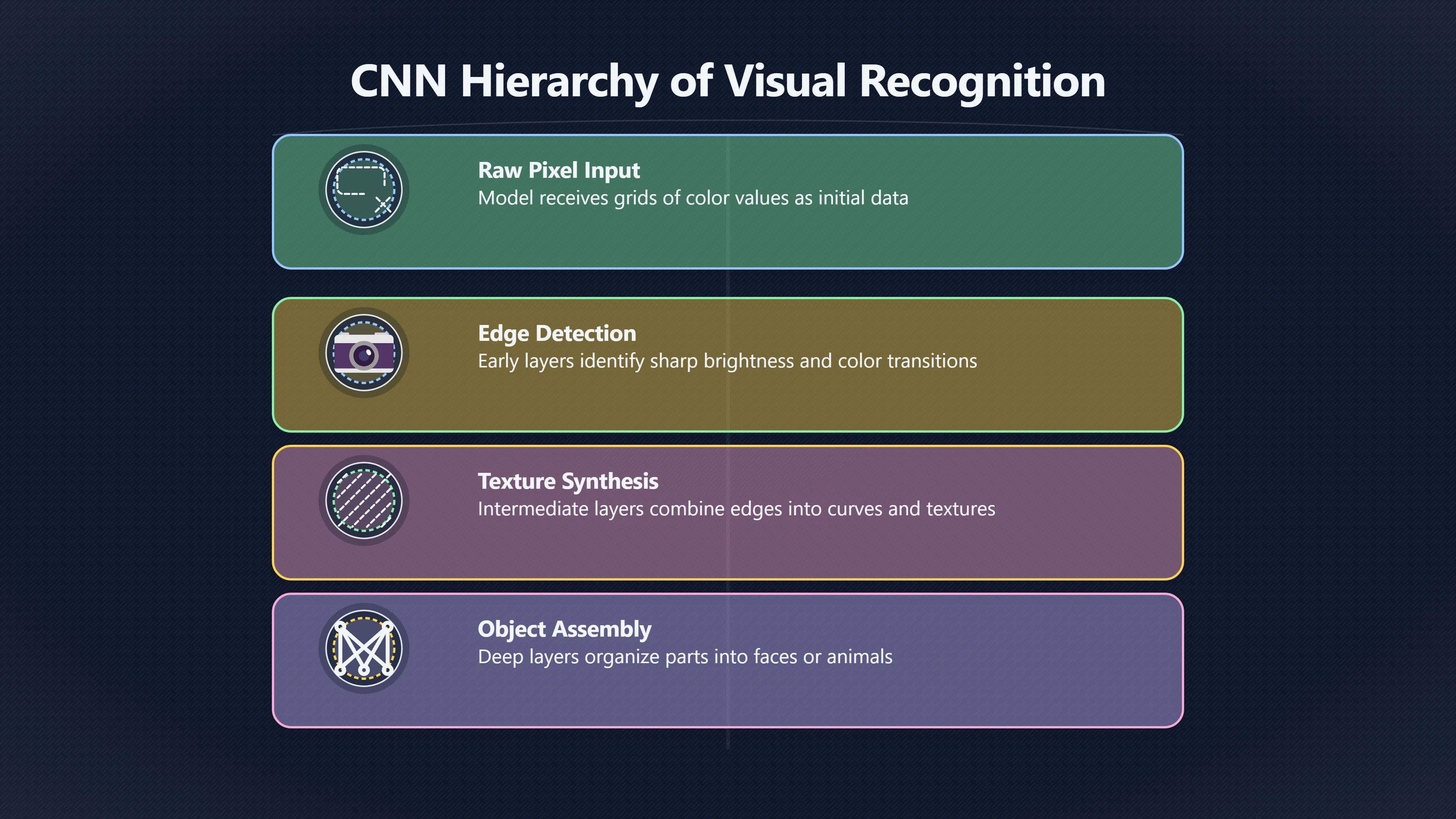
- Early layers detect vertical and curved boundaries.
- Intermediate layers combine them into eye-like or ear-like structures.
- Deeper layers combine multiple parts into a face or animal representation.
Without reliable boundary information at the start of the hierarchy, later layers would need to discover complex structures directly from raw pixel values, a far more difficult learning problem. Edge detectors simplify the task by creating a structured description of the image before higher-level reasoning begins.[CS231n]cs231n.github.ioConvolutional Neural Networks (CNNs / ConvNets)Course materials and notes for Stanford class CS231n: Deep Learning for Computer Vision…
Why Edges Appear Before Objects
A common misconception is that networks gradually learn edges because researchers expect them to. In practice, edge detectors emerge because they are among the simplest useful features available.
Objects are highly variable. The appearance of a chair changes with viewpoint, lighting, colour and background. Edges are much more stable. A boundary remains a boundary even when many other visual details change.
Learning therefore tends to proceed from simple, broadly applicable signals toward increasingly specialised ones. Early layers discover patterns that occur almost everywhere. Later layers use those patterns to construct richer visual representations. Feature visualisation research consistently shows this progression from edge and texture detectors in shallow layers to more abstract structures in deeper layers.[christophm.github.io]christophm.github.io27 Learned Features – Interpretable Machine LearningThrough feature visualization, we have learned that neural networks learn simple edge…
In this sense, edge detectors are not merely an early step in image recognition. They are the mechanism that transforms a raw grid of colour values into a form that later layers can organise into meaningful objects.[CS231n+2christophm.github.io]cs231n.github.ioConvolutional Neural Networks (CNNs / ConvNets)Course materials and notes for Stanford class CS231n: Deep Learning for Computer Vision…
Amazon book picks
Further Reading
Books and field guides related to Why do AI vision models learn edges first?. Use these as the next step if you want deeper reading beyond the article.
Deep Learning with Python
Clearly explains convolutional filters, edge detectors, and feature hierarchies.
Deep Learning
Rating: 3.5/5 from 6 Google Books ratings
Explains why early visual layers learn simple features before complex concepts.
Hands-on Machine Learning with Scikit-Learn, Keras, and Tenso...
Provides practical examples illustrating learned image features and CNN behaviour.
Deep Learning for Vision Systems
Discusses CNN filters, edges, textures, and visual feature extraction.
eBay marketplace picks
Marketplace Samples
Example marketplace items related to this page. Use the search link to explore similar finds on eBay.


Endnotes
1.
Source: cs231n.github.io
Link:https://cs231n.github.io/convolutional-networks/
Source snippet
Convolutional Neural Networks (CNNs / ConvNets)Course materials and notes for Stanford class CS231n: Deep Learning for Computer Vision...
2.
Source: distill.pub
Title: feature visualization
Link:https://distill.pub/2017/feature-visualization
Source snippet
by C Olah · 2017 · Cited by 1615 — Feature visualization answers questions about what a network — or parts of a network — are looking for...
3.
Source: christophm.github.io
Link:https://christophm.github.io/interpretable-ml-book/cnn-features.html
Source snippet
27 Learned Features – Interpretable Machine LearningThrough feature visualization, we have learned that neural networks learn simple edge...
4.
Source: aman.ai
Link:https://aman.ai/cs231n/visualization/
Source snippet
CS231n • Visualizing and UnderstandingThe filters in first layer are learning primitive shapes, oriented edges, blob-like structures and...
5.
Source: arxiv.org
Link:https://arxiv.org/abs/2011.14665
Source snippet
Why Convolutional Networks Learn Oriented Bandpass Filters: Theory and Empirical SupportNovember 30, 2020...
Published: November 30, 2020
6.
Source: cs.unm.edu
Link:https://www.cs.unm.edu/~xychen/tensorview-DIDL2017.pdf
Source snippet
Visualizing the Training of Convolutional Neural Network...by X Chen · 2017 · Cited by 7 — From such feature maps we can identify edges...
7.
Source: cs231n.stanford.edu
Link:https://cs231n.stanford.edu/
Source snippet
University CS231n: Deep Learning for Computer VisionThe Convolutional Neural Network in this example is classifying images live in your b...
8.
Source: cs231n.stanford.edu
Title: lecture 9
Link:https://cs231n.stanford.edu/slides/2025/lecture_9.pdf
Source snippet
Design a network with only convolutional layers without downsampling operators to make [predictions]({{ 'predictions/' | relative_url }}) for pixels all at once!Read more...
9.
Source: cs231n.github.io
Link:https://cs231n.github.io/[understanding
Source snippet
Visualizing what ConvNets learnSeveral approaches for understanding and visualizing Convolutional Networks have been developed in the lit...
10.
Source: dictionary.cambridge.org
Link:https://dictionary.cambridge.org/dictionary/english/first
Source snippet
English meaning - Cambridge Dictionary6 days ago — FIRST definition: 1. (a person or thing) coming before all others in order, time, am...
Additional References
11.
Source: facebook.com
Link:https://www.facebook.com/FirstBusUK/
Source snippet
First Bus (@FirstBusUK)Our open-top bus services are back across the country, connecting some of the UK's best beaches, coastlines, attra...
12.
Source: firstbus.co.uk
Link:https://www.firstbus.co.uk/
Source snippet
First Bus | Bus Tickets, Timetables & Journey Planning | First BusOur UK Bus division operates around a fifth of local bus services in th...
13.
Source: firstdirect.com
Link:https://www.firstdirect.com/
Source snippet
Online and Personal Banking | first direct bankStraight-talking banking, direct helps over 1.7 million UK customers with current accounts...
14.
Source: openfl.pressbooks.pub
Link:https://openfl.pressbooks.pub/unfbusinessanalytics/chapter/feature-visualization/
Source snippet
Visualization – [Business]({{ 'business-adoption/' | relative_url }}) AnalyticsFeature visualization for a unit of a neural network is done by finding the input that maximizes the ac...
15.
Source: machinelearningmastery.com
Title: how to visualize filters and feature maps in convolutional neural networks
Link:https://www.machinelearningmastery.com/how-to-visualize-filters-and-feature-maps-in-convolutional-neural-networks/
Source snippet
How to Visualize Filters and Feature Maps in Convolutional...5 Jul 2019 — In this tutorial, you will discover how to develop simple visu...
16.
Source: youtube.com
Link:https://www.youtube.com/watch?v=6wcs6szJWMY
Source snippet
Lecture 12 | Visualizing and UnderstandingIn Lecture 12 we discuss methods for visualizing and understanding the internal mechanisms of c...
17.
Source: firstgroupplc.com
Link:https://www.firstgroupplc.com/
Source snippet
FirstGroup plc: HomeFirstGroup is a leading private sector provider of public transport. We provide easy and convenient mobility, improvi...
18.
Source: youtube.com
Link:https://www.youtube.com/watch?v=zfiSAzpy9NM
Source snippet
Convolutional neural network visualization layer 1 filters edges What are Convolutional Neural Networks (CNNs)?...
19.
Source: reddit.com
Link:https://www.reddit.com/r/MachineLearning/comments/7bfa99/r_feature_visualization_how_neural_networks_build/
Source snippet
the network, but maybe some portion of these visualizations is “...Read more...
20.
Source: mathworks.com
Title: Deep Learning Visualization Methods
Link:https://www.mathworks.com/help/deeplearning/ug/deep-learning-visualization-methods.html
Source snippet
MATLAB & SimulinkVisualization methods are a type of interpretability technique that explain network predictions using visual representat...
Topic Tree