Within AI Drafts
Why Polished AI Answers Can Mislead
Polished AI writing can make weak or false claims look more trustworthy than they are.
On this page
- Why fluency is not the same as truth
- How hallucinated details become harder to spot
- Practical checks before reusing a draft
Page outline Jump by section
Introduction
One reason AI-generated drafts feel different from AI predictions is that they arrive in the form of polished language. A prediction system might output a score, probability, or ranking that visibly signals uncertainty. A language model often produces complete sentences, structured arguments, citations, and confident explanations. The result can look finished even when parts of it are unsupported, speculative, or wrong.
 This creates a subtle risk: readers may judge the quality of the writing rather than the quality of the underlying evidence. Fluent text can make uncertainty harder to notice because the signs people normally use to assess credibility—clear grammar, logical flow, and professional tone—are present even when factual reliability is weak. Researchers, journalists, and AI developers have repeatedly documented cases in which convincing AI-generated prose contained fabricated references, invented details, or misleading claims that were difficult to spot at first glance.[Nature+2Google Cloud]nature.comAI hallucination: towards a comprehensive classification of…by Y Sun · 2024 · Cited by 405 — This study aims to systematically c…
Why Fluency Is Not the Same as Truth
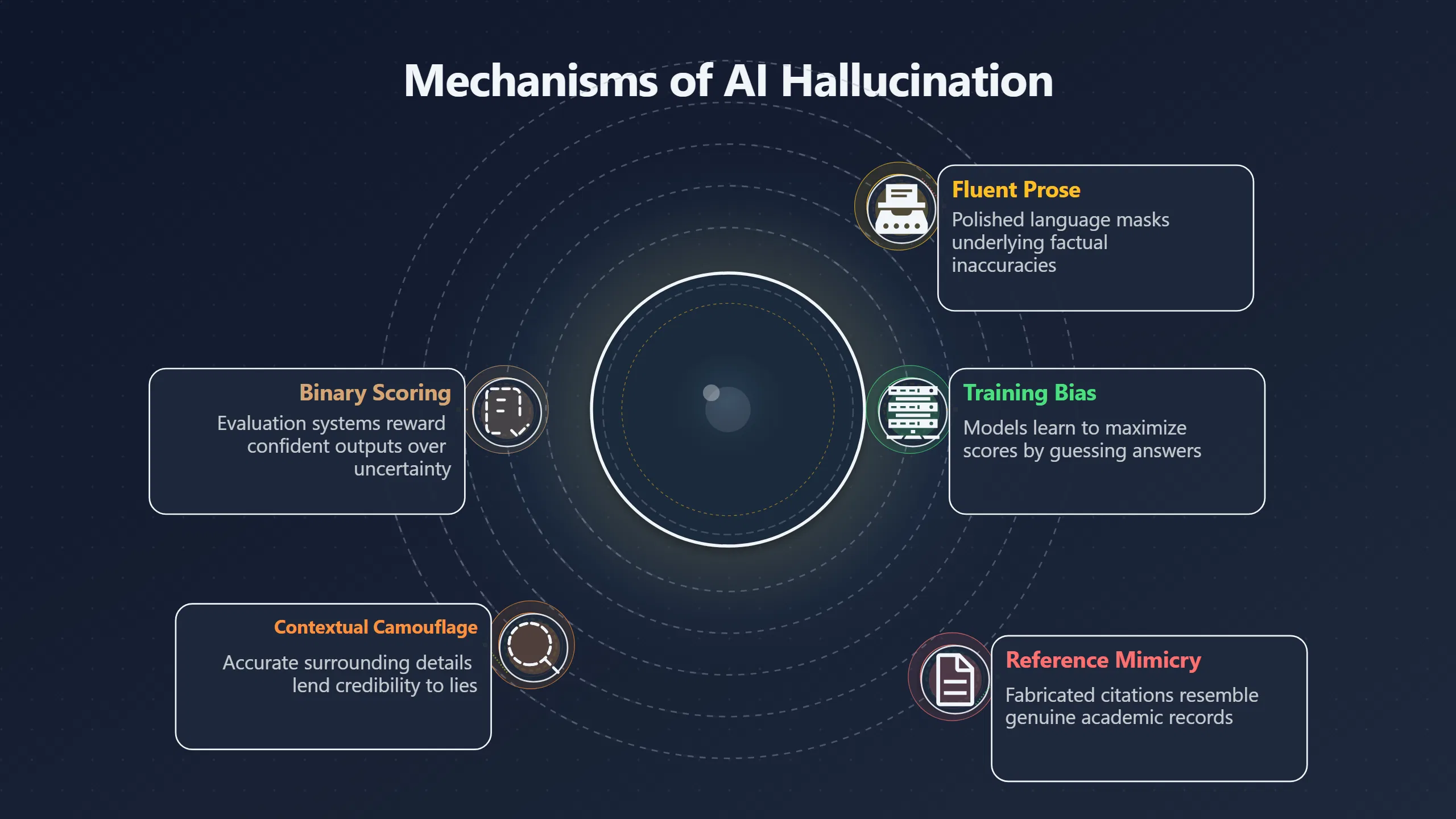
Large language models are designed to generate likely sequences of words. They are exceptionally good at producing text that resembles human writing, but sounding plausible is not the same as being correct.
A useful distinction is that fluency measures how well language is expressed, while truthfulness measures whether claims correspond to reality. A model can excel at the first and fail at the second. This gap explains why incorrect answers can appear authoritative. Researchers studying AI hallucinations describe outputs that are coherent, detailed, and persuasive despite containing false information.[Nature+2arXiv]nature.comAI hallucination: towards a comprehensive classification of…by Y Sun · 2024 · Cited by 405 — This study aims to systematically c…
The problem is not merely occasional mistakes. The format of the response can mask the uncertainty surrounding those mistakes. When an AI writes:
- a smooth explanation,
- a chronological narrative,
- a list of references,
- or a confident recommendation,
many readers unconsciously interpret these signals as evidence of expertise. Yet those signals primarily reflect language quality, not factual verification.
Some researchers argue that current evaluation methods contribute to this behaviour. Models are often rewarded for providing answers rather than admitting they do not know. In such systems, guessing can score better than expressing uncertainty, creating incentives for confident-sounding responses even when evidence is weak.[OpenAI+2arXiv]OpenAIwhy language models hallucinateSep 5, 2025 — While evaluations themselves do not directly cause hallucinations, most evaluations measure model performance in a way that…
How Hallucinated Details Become Harder to Spot
The most dangerous AI errors are often not obvious nonsense. They are details that look reasonable enough to pass a quick review.
Fabricated References That Look Real
One of the clearest examples involves citations. Studies examining AI-generated references have found large numbers of fabricated or distorted sources. In one frequently cited analysis, many references generated by language models either did not exist or contained incorrect bibliographic information. Another study found that only a small minority of examined references were both real and accurately described.[Nature+2Wikipedia]nature.comFabrication and errors in the bibliographic citations…by WH Walters · 2023 · Cited by 548 — This study investigates one particul…
These errors are difficult to detect because fabricated references often resemble genuine academic citations. They may include plausible author names, article titles, journal names, publication years, and digital object identifiers. To a reader unfamiliar with the field, they can appear completely legitimate.
Invented Facts Embedded in Correct Context
A second pattern occurs when most of an answer is correct but a few key details are invented.
For example, a model may accurately describe a historical event while inserting a false date, an incorrect quotation, or a fictional supporting study. Because the surrounding context is accurate, the false detail inherits credibility from the correct information around it. Researchers sometimes refer to this as a form of hallucination in which fabricated content is woven into otherwise plausible text.[Nature]nature.comAI hallucination: towards a comprehensive classification of…by Y Sun · 2024 · Cited by 405 — This study aims to systematically c…
Confidence Signals Without Evidence
Humans often use confidence as a shortcut for judging expertise. AI systems can unintentionally exploit that tendency because they generate answers in a confident style even when they lack reliable information.
Research on news-related queries has found that chatbots can present distortions, fabricated quotations, and incorrect factual claims while maintaining a polished explanatory tone. Reviewers evaluating such outputs frequently reported that the responses appeared authoritative despite containing substantial errors.[The Guardian]theguardian.comOver half of the AI-generated responses were judged to have significant issues, including erroneous statements about political figures, m…

Real-World Cases Showing the Risk
The issue is not confined to laboratory experiments.
In 2025 and 2026, investigators identified prominent reports and publications containing AI-generated references and factual claims that turned out to be false. A withdrawn KPMG report on agentic AI included numerous inaccurate citations and fabricated case-study details. Organisations named in the report disputed claims attributed to them, leading to the report’s removal and an internal review.[TechRadar]techradar.comThe report contained 45 citations, with only five found to be accurate; the rest were either fabricated, distorted, or misleading. GPTZer…
Scientific publishing has faced similar concerns. A large-scale analysis of more than one hundred million references found evidence suggesting a sharp increase in non-existent citations after widespread adoption of AI writing tools, with researchers estimating that hundreds of thousands of hallucinated references may have entered the literature.[arXiv]arxiv.orgLLM hallucinations in the wild: Large-scale evidence from non-existent citationsMay 8, 2026…
These cases matter because the errors did not appear as obvious gibberish. They were packaged in professional-looking documents that many readers would reasonably expect to be trustworthy.
Why Readers Often Miss the Problem
Several psychological factors make fluent AI errors particularly persuasive.
Presentation bias. People naturally associate clear writing with competence. A well-structured answer often feels more credible than a fragmented one, even when both contain the same factual content.
Cognitive ease. Information that is easy to read and understand tends to feel more believable. AI systems are extremely effective at producing such content.
Reference camouflage. When a response includes citations, dates, statistics, or named organisations, readers may assume verification has already occurred.
Partial accuracy. Many AI outputs mix correct and incorrect information. Readers who recognise some true statements may become less likely to question the rest.
Research examining user interactions with AI systems has repeatedly found that detailed, confident responses can increase trust even when factual accuracy is poor. This creates a mismatch between perceived reliability and actual reliability.[Them]them.usChat GPT Inaccurately Reported That Straight Public Figures Are Gay, Study FindsUsers in India and Ireland participated in the study, and those using Google were significantly more likely to find correct data than tho…
Practical Checks Before Reusing a Draft
The safest way to treat an AI-generated draft is as a starting point rather than a verified source.
Before reusing text in reports, articles, presentations, or professional communications, check:
- Every factual claim that matters. Verify names, dates, numbers, quotations, and technical statements against independent sources.
- Every citation. Confirm that cited papers, books, websites, or reports actually exist and support the claim being made.
- Every statistic. Trace figures back to an original source rather than relying on the AI’s wording.
- Every summary of a source. AI systems may accurately identify a source but misrepresent its conclusions.
- Every confident statement lacking evidence. The more certain a claim sounds, the more important it is to verify when the topic is consequential.
A useful rule is to increase scrutiny as the stakes increase. Minor drafting errors may be harmless in brainstorming, but the same errors can create serious problems in journalism, research, law, healthcare, or public policy.
The Key Lesson
Fluent AI writing can create an illusion of certainty. The language feels finished, organised, and authoritative, which makes factual weaknesses less visible. The central challenge is not that AI always produces false information; it is that false information can be wrapped in the same polished style as accurate information.
Understanding this distinction helps explain why AI drafts feel different from AI predictions. A prediction often exposes its uncertainty through numbers or probabilities. A draft can conceal uncertainty behind convincing prose. The more polished the output becomes, the more important it is to separate the quality of the writing from the quality of the evidence behind it.
Amazon book picks
Further Reading
Books and field guides related to Why Polished AI Answers Can Mislead. Use these as the next step if you want deeper reading beyond the article.
Weapons of Math Destruction
Shows how impressive technical systems can conceal flaws and risks.
eBay marketplace picks
Marketplace Samples
Example marketplace items related to this page. Use the search link to explore similar finds on eBay.




Endnotes
1.
Source: nature.com
Link:https://www.nature.com/articles/s41599-024-03811-x
Source snippet
AI hallucination: towards a comprehensive classification of...by Y Sun · 2024 · Cited by 405 — This study aims to systematically c...
2.
Source: cloud.google.com
Link:https://cloud.google.com/discover/what-are-ai-hallucinations
Source snippet
Google CloudWhat are AI hallucinations?AI hallucinations can occur when large language models (LLMs), which power AI chatbots, generate f...
3.
Source: arxiv.org
Title: arXiv Cognitive Mirage: A Review of Hallucinations in Large Language Models
Link:https://arxiv.org/abs/2309.06794
4.
Source: OpenAI
Title: why language models hallucinate
Link:https://openai.com/index/why-language-models-hallucinate/
Source snippet
Sep 5, 2025 — While evaluations themselves do not directly cause hallucinations, most evaluations measure model performance in a way that...
5.
Source: arxiv.org
Link:https://arxiv.org/pdf/2509.04664
Source snippet
Why Language Models Hallucinateby AT Kalai · 2025 · Cited by 402 — Model B will outperform A under 0-1 scoring, the basis of most cu...
6.
Source: nature.com
Link:https://www.nature.com/articles/s41598-023-41032-5
Source snippet
Fabrication and errors in the bibliographic citations...by WH Walters · 2023 · Cited by 548 — This study investigates one particul...
7.
Source: Wikipedia
Title: Hallucination (artificial intelligence)
Link:https://en.wikipedia.org/wiki/Hallucination_%28artificial_intelligence%29
Source snippet
Hallucination (artificial intelligence)This article is about the phenomenon of AI presenting fabricated information as fact. For the a...
8.
Source: arxiv.org
Title: arXiv Do Language Models Know When They’re Hallucinating References?
Link:https://arxiv.org/abs/2305.18248
9.
Source: techradar.com
Link:https://www.techradar.com/pro/a-major-kpmg-report-on-ai-was-found-to-be-chock-full-of-ai-hallucinations
Source snippet
The report contained 45 citations, with only five found to be accurate; the rest were either fabricated, distorted, or misleading. GPTZer...
10.
Source: arxiv.org
Link:https://arxiv.org/abs/2605.07723
Source snippet
LLM hallucinations in the wild: Large-scale evidence from non-existent citationsMay 8, 2026...
Published: May 8, 2026
11.
Source: nature.com
Link:https://www.nature.com/articles/d41586-026-00969-z
Source snippet
Hallucinated citations are polluting the scientific literature....1 Apr 2026 — Tens of thousands of publications from 2025 might include...
12.
Source: them.us
Title: Chat GPT Inaccurately Reported That Straight Public Figures Are Gay, Study Finds
Link:https://www.them.us/story/chat-gpt-straight-public-figures-gay-false-information
Source snippet
Users in India and Ireland participated in the study, and those using Google were significantly more likely to find correct data than tho...
13.
Source: arxiv.org
Link:https://arxiv.org/html/2505.14599v2
Source snippet
Toward Reliable Scientific Hypothesis GenerationJun 8, 2025 — To facilitate the systematic study of these challenges, we introduce TruthH...
14.
Source: arxiv.org
Link:https://arxiv.org/abs/2508.03860
Source snippet
Hallucination to Truth: A Review of Fact-[Checking]({{ 'checklists/' | relative_url }}) and...by SS Rahman · 2025 · Cited by 36 — This review systematically analyzes how LLM...
15.
Source: arxiv.org
Link:https://arxiv.org/html/2509.04664v1
Source snippet
Why Language Models HallucinateSep 4, 2025 — Optimizing models for these benchmarks may therefore foster hallucinations. Humans learn the...
16.
Source: arxiv.org
Link:https://arxiv.org/html/2504.13777v1
Source snippet
A Conceptual Framework for Studying AI Hallucinations in...18 Apr 2025 — This essay argues that hallucinations produced by generative AI...
17.
Source: Wikipedia
Title: Artificial intelligence
Link:https://en.wikipedia.org/wiki/Artificial_intelligence
Source snippet
Artificial intelligenceArtificial intelligence (AI) is the capability of computational systems to perform tasks typically associated w...
18.
Source: OpenAI
Link:https://openai.com/
Source snippet
comOpenAI | Research & DeploymentWe believe our research will eventually lead to artificial general intelligence, a system that can solve...
19.
Source: nature.com
Link:https://www.nature.com/articles/s41586-026-10549-w
Source snippet
Evaluating large language models for accuracy...by AT Kalai · 2026 · Cited by 4 — Large language models sometimes produce confident, pla...
20.
Source: nature.com
Link:https://www.nature.com/articles/s41598-025-15416-8
Source snippet
User-reported LLM hallucinations in AI mobile apps reviewsby R Massenon · 2025 · Cited by 25 — From ChatGPT to FactGPT: A participatory d...
21.
Source: theguardian.com
Link:https://www.theguardian.com/technology/2025/feb/11/ai-chatbots-distort-and-mislead-when-asked-about-current-affairs-bbc-finds
Source snippet
Over half of the AI-generated responses were judged to have significant issues, including erroneous statements about [political]({{ 'political-video/' | relative_url }}) figures, m...
22.
Source: reddit.com
Title: Why Language Models Hallucinate
Link:https://www.reddit.com/r/MachineLearning/comments/1namvsk/why_language_models_hallucinate_openai_pseudo/
Source snippet
OpenAi pseudo paperhallucination-like guessing is rewarded by most primary evaluations. We discuss statistically rigorous modifications t...
23.
Source: reddit.com
Link:https://www.reddit.com/r/LocalLLaMA/comments/1na7c1b/openai_why_language_models_hallucinate/
Source snippet
OpenAI: Why Language Models Hallucinate: r/LocalLLaMAIn short: LLMs hallucinate because we've inadvertently designed the training and ev...
24.
Source: linkedin.com
Link:https://www.linkedin.com/posts/gkcs_ai-hallucinations-activity-7370652687152877570-5pzc
Source snippet
OpenAI calls for change in AI benchmarks to reduce...If models are trained to guess, hallucinations are unavoidable. Rewarding uncertain...
25.
Source: linkedin.com
Link:https://www.linkedin.com/company/openai
Source snippet
OpenAIOpenAI is an AI research and deployment company dedicated to ensuring that general-purpose artificial intelligence benefits all of...
26.
Source: linkedin.com
Link:https://www.linkedin.com/posts/anolb_openai-just-published-research-that-flips-activity-7370614296931725312-EC8T
Source snippet
OpenAI just published research that flips the hallucination...New OpenAI research confirms what many have suspected: models hallucinate...
27.
Source: youtube.com
Link:https://www.youtube.com/watch?v=uesNWFP40zw
Source snippet
OpenAI Just SOLVED Hallucinations...Model Collapse Ends AI Hype. Theos Theory and 2 more•316K views · 42:30 · Go to channel...
28.
Source: dailycodesolutions.com
Title: are bad incentives to blame for ai hallucinations
Link:https://dailycodesolutions.com/blog/are-bad-incentives-to-blame-for-ai-hallucinations
Source snippet
OpenAI says AI hallucinations persist because models are...Sep 9, 2025 — Because current pretraining, fine-tuning, and benchmarking prac...
29.
Source: levelup.gitconnected.com
Title: openai thinks [overconfidence]({{ ‘overconfidence/’ | relative_url }}) is llms hallucination cause d8130e72aad9
Link:https://levelup.gitconnected.com/openai-thinks-overconfidence-is-llms-hallucination-cause-d8130e72aad9
Source snippet
Thinks Overconfidence is LLM's Hallucination CauseSep 16, 2025 — Pretraining creates the conditions for errors; our benchmarks then rewar...
30.
Source: appen.com
Title: ai hallucinations
Link:https://www.appen.com/blog/ai-hallucinations
Source snippet
LLM Hallucinations: Mitigating AI Errors4 Sept 2025 — Like students on multiple-choice exams, LLMs maximize their score by guessing when...
Additional References
31.
Source: businessinsider.com
Link:https://www.businessinsider.com/why-ai-chatbots-hallucinate-openai-chatgpt-anthropic-claude
Source snippet
This test-centric optimization encourages models to provide confident but potentially incorrect outputs, rather than abstaining when unsu...
32.
Source: reddit.com
Link:https://www.reddit.com/r/singularity/comments/1n9fued/new_research_from_openai_why_language_models/
Source snippet
New research from OpenAI: "Why language models...If benchmarks incentivize saying I don't know then we will see a lot... [D] List of pr...
33.
Source: linkedin.com
Link:https://www.linkedin.com/posts/haythamassem_why-language-models-hallucinatepdf-activity-7370201125955997697–izi
Source snippet
Why language models hallucinate: A paper by OpenAIEvaluation systems reward overconfidence: most benchmarks use binary scoring (right/wro...
34.
Source: sawantvishwajeet729.medium.com
Link:https://sawantvishwajeet729.medium.com/understanding-why-language-models-hallucinate-a-deep-dive-into-openais-latest-research-a5ccea95a327
Source snippet
Why Language Models Hallucinate: A Deep...During evaluation, binary scoring systems reward confident guessing over appropriate uncertain...
35.
Source: linkedin.com
Link:https://www.linkedin.com/posts/oguzhantopgul_why-language-models-hallucinate-activity-7371588291370016770-5dOK
36.
Source: ox.ac.uk
Link:https://www.ox.ac.uk/news/2024-06-20-major-research-hallucinating-generative-models-advances-reliability-artificial
Source snippet
Major research into 'hallucinating' generative models...20 Jun 2024 — In a new study published today in Nature, they demonstrate a novel...
37.
Source: news.exeter.ac.uk
Link:https://news.exeter.ac.uk/faculty-of-humanities-arts-and-social-sciences/generative-ai-does-not-just-hallucinate-at-us-it-can-hallucinate-with-us-study-warns/
Source snippet
AI does not just hallucinate at us, it can...16 Feb 2026 — When generative AI systems produce false information, this is often framed as...
38.
Source: science.org
Link:https://www.science.org/content/article/ai-hallucinates-because-it-s-trained-fake-answers-it-doesn-t-know
Source snippet
AI hallucinates because it's trained to fake answers it...Oct 28, 2025 — AI hallucinates because it's trained to fake answers it doesn't...
39.
Source: misinforeview.hks.harvard.edu
Title: new sources of inaccuracy a conceptual framework for studying ai hallucinations
Link:https://misinforeview.hks.harvard.edu/article/new-sources-of-inaccuracy-a-conceptual-framework-for-studying-ai-hallucinations/
Source snippet
A conceptual framework for...by A Shao · 2025 · Cited by 18 — AI hallucinations are inaccurate outputs generated by AI tools, such as Ch...
40.
Source: forbes.com
Title: ai blamed for rise in fabricated citations found in recent research papers
Link:https://www.forbes.com/sites/michaeltnietzel/2026/05/12/ai-blamed-for-rise-in-fabricated-citations-found-in-recent-research-papers/
Source snippet
AI Blamed For Rise In Fabricated Citations Found...12 May 2026 — A new study finds an alarming increase in the number of fabricated cita...
Published: May 2026
Topic Tree