Within Alex Net
When Did Deep Learning Become Fast Enough to Work?
AlexNet showed that specialized hardware could make large neural networks train fast enough to matter.
On this page
- Why earlier training was too slow
- How GPU computing changed the economics
- What Alex Net demonstrated at scale
Page outline Jump by section
Introduction
One reason AlexNet became a turning point in artificial intelligence was not simply that it used a deep neural network. It showed that deep networks could finally be trained quickly enough to solve real problems on large datasets. Before 2012, researchers often knew that larger neural networks might perform better, but training them on available hardware could take impractically long periods. Graphics Processing Units (GPUs), originally designed for video games, changed that equation by providing massive amounts of parallel computing power at relatively low cost. AlexNet demonstrated that combining deep learning with GPU acceleration could reduce training times from an academic obstacle to a practical engineering task, helping transform deep learning from a niche research direction into a scalable technology.[NeurIPS Proceedings]proceedings.neurips.ccNeurIPS ProceedingsImageNet Classification with Deep Convolutional Neural…by A Krizhevsky · 2012 · Cited by 155697 — We trained the ne…
Why Earlier Training Was Too Slow
The core computations inside a neural network consist largely of matrix multiplications and repeated numerical operations. During training, these calculations must be performed billions of times as the model processes examples, computes errors, and updates its parameters.
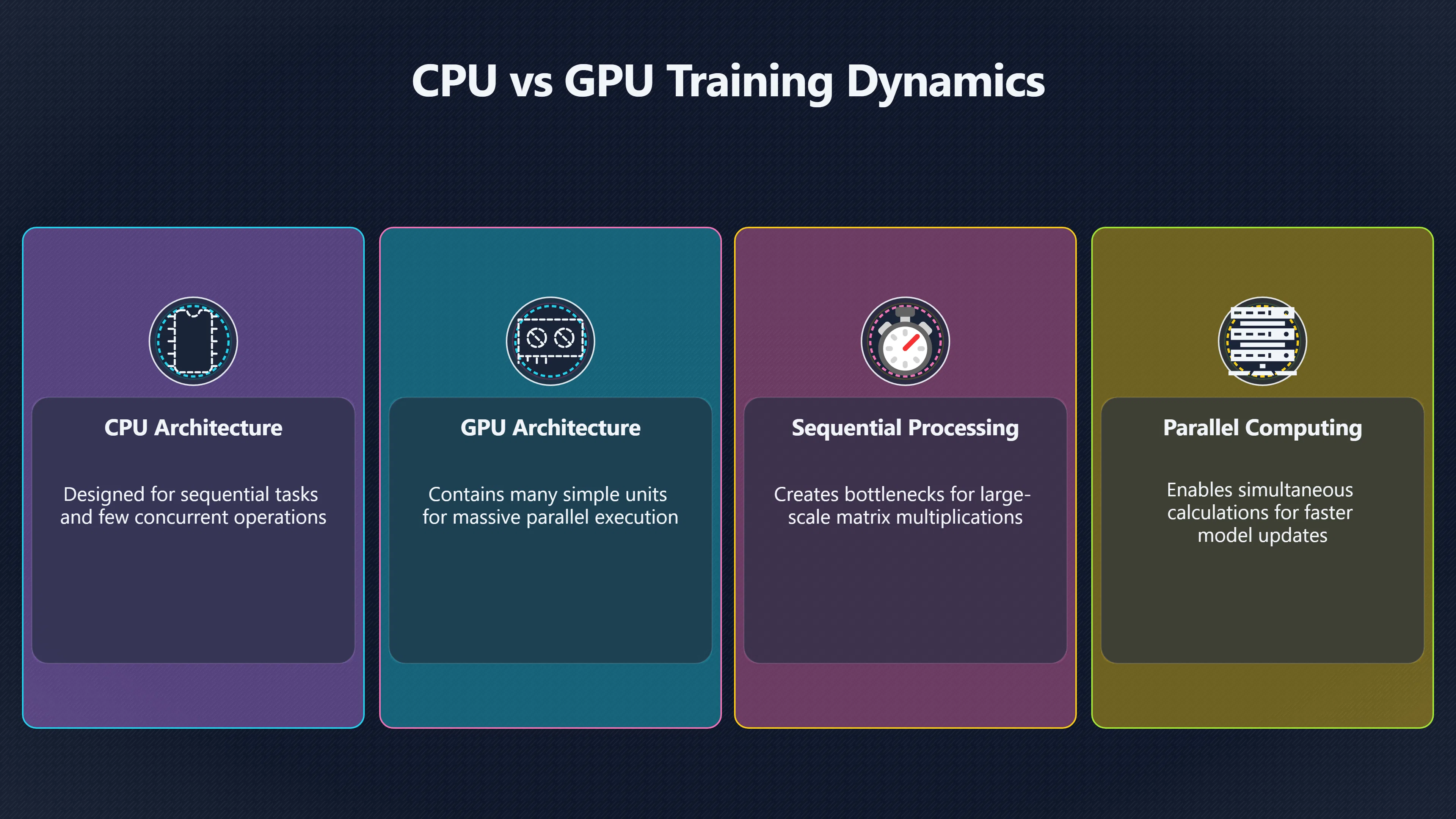
Traditional Central Processing Units (CPUs) were designed to excel at sequential tasks and a relatively small number of concurrent operations. They were powerful general-purpose processors, but deep neural networks required enormous numbers of similar calculations to be performed simultaneously. As networks grew larger and datasets expanded into the millions of examples, training times became a major bottleneck.[Medium]medium.comWhy Deep Learning Models Run Faster on GPUsModern GPUs can run millions of threads simultaneously, enhancing performance of these m…
This created a practical problem. Researchers could propose deeper architectures, but if training required weeks or months for a single experiment, progress became slow and expensive. Many promising ideas could not be tested efficiently. The limitation was not only theoretical understanding; it was computational capacity.
How GPU Computing Changed the Economics
GPUs were originally developed to render graphics by performing many similar mathematical operations at once. Unlike CPUs, which contain a relatively small number of sophisticated cores, GPUs contain large numbers of simpler processing units capable of executing thousands of operations in parallel. This architecture turned out to be remarkably well suited to neural-network training.[Medium]medium.comWhy Deep Learning Models Run Faster on GPUsModern GPUs can run millions of threads simultaneously, enhancing performance of these m…
For deep learning researchers, the significance was economic as much as technical:
- More experiments could be completed in the same amount of time.
- Larger datasets became feasible to use.
- Bigger models could be trained without requiring specialised supercomputers.
- Researchers could iterate on designs rapidly instead of waiting weeks for results.
The availability of programmable GPU platforms such as CUDA also mattered. GPUs were no longer restricted to graphics applications. Researchers could write software that used gaming hardware as a high-performance scientific computing platform. This dramatically lowered the cost of large-scale machine learning experiments compared with traditional high-performance computing systems.[IEEE Spectrum]spectrum.ieee.orgIEEE SpectrumHow AlexNet Transformed AI and Computer Vision ForeverMar 25, 2025 — He extended cuda-convnet with support for multiple GPUs…
The result was a shift in what counted as a practical neural network. Architectures that previously seemed too computationally demanding suddenly became realistic.

What AlexNet Demonstrated at Scale
AlexNet provided the clearest public demonstration of this new capability.
The network contained roughly 60 million parameters and was trained on about 1.2 million ImageNet images. According to the original paper, training required approximately five to six days on two NVIDIA GTX 580 graphics cards. At the time, this was an impressive achievement because a network of that size would have been far more difficult to train efficiently using conventional CPU-based approaches.[NeurIPS Proceedings]proceedings.neurips.ccNeurIPS ProceedingsImageNet Classification with Deep Convolutional Neural…by A Krizhevsky · 2012 · Cited by 155697 — We trained the ne…
The hardware constraints were so significant that the model was explicitly split across two GPUs. Each GPU handled part of the network, and communication between them was minimised to avoid performance bottlenecks. This was not merely a convenience feature; it was an engineering solution that allowed the network to fit within the available memory and complete training in a practical timeframe.[Wikipedia+2Pinecone]WikipediaAlex NetAlex Net
What made the result influential was that the hardware acceleration translated directly into visible performance gains. AlexNet achieved a top-5 ImageNet error rate of 15.3%, far ahead of the nearest competitor’s 26.2%. The computer-vision community could see not only that deep networks worked, but that they could now be trained at a scale large enough to outperform established methods.[NeurIPS Proceedings]proceedings.neurips.ccNeurIPS ProceedingsImageNet Classification with Deep Convolutional Neural…by A Krizhevsky · 2012 · Cited by 155697 — We trained the ne…
Why Speed Changed Research Behaviour
The importance of GPUs extended beyond one competition result.
When training becomes faster, researchers can perform more cycles of experimentation. They can modify architectures, adjust hyperparameters, test new regularisation techniques, and evaluate larger datasets. Faster feedback loops accelerate scientific progress because ideas can be validated or rejected more quickly.
AlexNet helped demonstrate this new research model. Instead of spending most effort designing hand-crafted image features, researchers could invest more effort in designing neural architectures and training procedures. As GPU performance improved, this approach became increasingly attractive.[Dive into Deep Learning]d2l.aiDive into Deep Learning8.1Deep Convolutional Neural Networks (AlexNet)AlexNet's structure bears a striking resemblance to LeNet, with a number of critical improvem…
The consequence was a virtuous cycle:
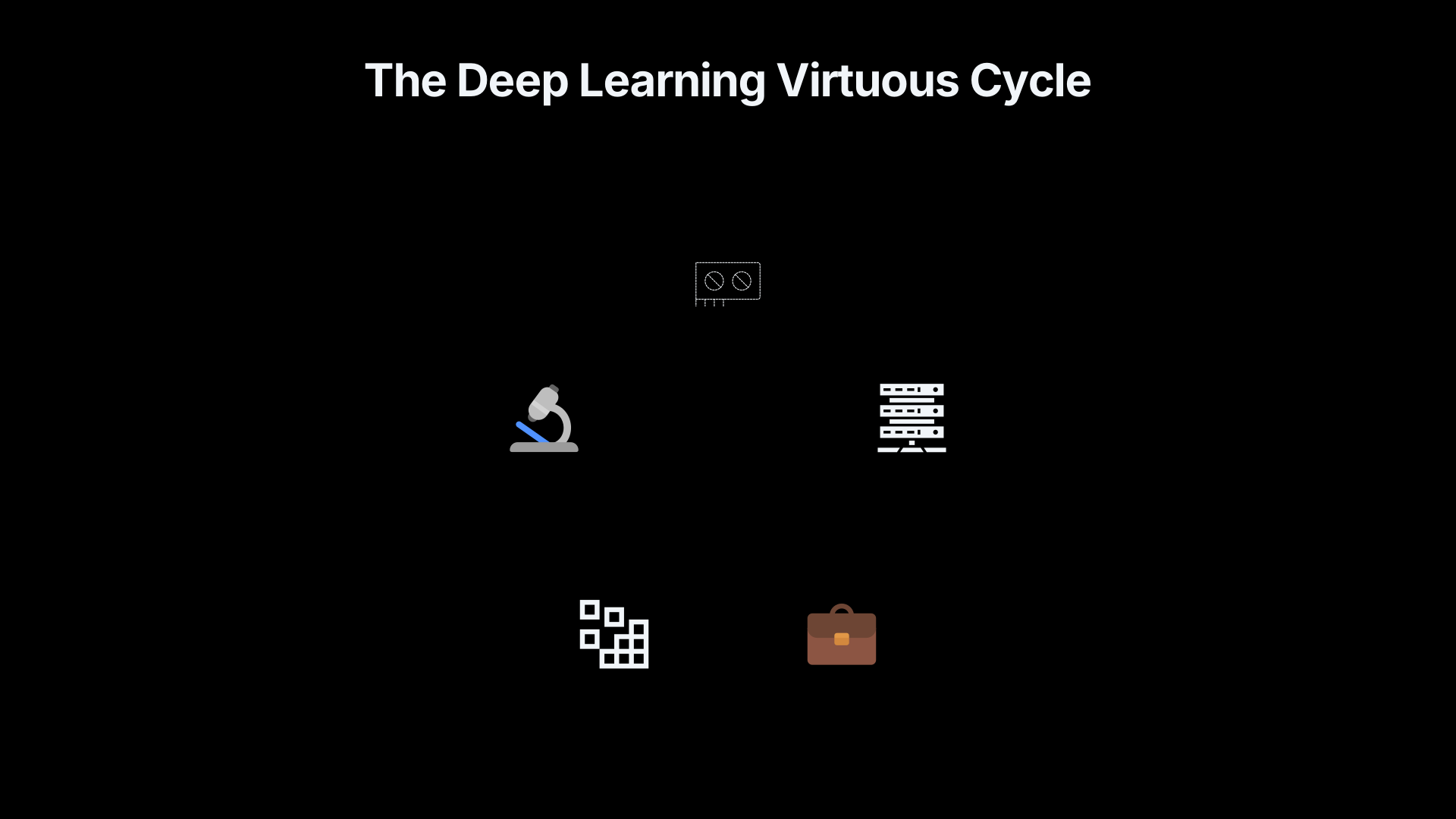
- Better GPUs enabled larger neural networks.
- Larger neural networks achieved better results.
- Better results attracted more researchers and investment.
- Increased investment produced even more powerful hardware and software tools.
This feedback loop became one of the defining characteristics of the modern deep-learning era.
The Broader Lesson From AlexNet
AlexNet’s success is often described as a breakthrough in neural-network design, but it was also a breakthrough in implementation. The architecture mattered, yet its practical impact depended on hardware capable of training it within days rather than prohibitive timeframes.
The deeper lesson was that advances in artificial intelligence do not come solely from new algorithms. They also emerge from improvements in computing infrastructure. GPUs provided the computational foundation that allowed deep networks to move from promising research ideas to practical systems. AlexNet made that transition visible to the wider AI community by showing that large-scale neural-network training was no longer a theoretical possibility—it was an achievable engineering reality.[NeurIPS Proceedings+2Wikipedia]proceedings.neurips.ccNeurIPS ProceedingsImageNet Classification with Deep Convolutional Neural…by A Krizhevsky · 2012 · Cited by 155697 — We trained the ne…
Amazon book picks
Further Reading
Books and field guides related to When Did Deep Learning Become Fast Enough to Work?. Use these as the next step if you want deeper reading beyond the article.
Hands-on Machine Learning with Scikit-Learn, Keras, and Tenso...
Explains practical training of deep networks on modern hardware.
Deep Learning with Python
Discusses GPU-accelerated training and neural-network workflows.
Dive into Deep Learning
Includes scalable training methods and hardware considerations.
Deep Learning
Rating: 3.5/5 from 6 Google Books ratings
Covers optimization, scaling, and computational requirements of deep learning.
eBay marketplace picks
Marketplace Samples
Example marketplace items related to this page. Use the search link to explore similar finds on eBay.




Endnotes
1.
Source: proceedings.neurips.cc
Link:https://proceedings.neurips.cc/paper/4824-imagenet-classification-with-deep-convolutional-neural-networks.pdf
Source snippet
NeurIPS ProceedingsImageNet Classification with Deep Convolutional Neural...by A Krizhevsky · 2012 · Cited by 155697 — We trained the ne...
2.
Source: Wikipedia
Title: [Alex Net]({{ ‘alex-net/’ | relative_url }})
Link:https://en.wikipedia.org/wiki/AlexNet
3.
Source: medium.com
Link:https://medium.com/data-science/why-deep-learning-models-run-faster-on-gpus-a-brief-introduction-to-cuda-programming-035272906d66
Source snippet
Why Deep Learning Models Run Faster on GPUsModern GPUs can run millions of threads simultaneously, enhancing performance of these m...
4.
Source: spectrum.ieee.org
Link:https://spectrum.ieee.org/alexnet-source-code
Source snippet
IEEE SpectrumHow AlexNet Transformed AI and Computer Vision ForeverMar 25, 2025 — He extended cuda-convnet with support for multiple GPUs...
5.
Source: blogs.nvidia.com
Title: first gpu gaming ai
Link:https://blogs.nvidia.com/blog/first-gpu-gaming-ai/
Source snippet
NVIDIA BlogHow the World's First GPU Leveled Up Gaming and Ignited...Oct 11, 2024 — In 2012, a breakthrough came when Alex Krizhevsky fr...
6.
Source: pinecone.io
Link:https://www.pinecone.io/learn/series/image-search/imagenet/
Source snippet
Each GPU handled one-half of AlexNet. The two halves would communicate in specific layers to ensure...Read more...
7.
Source: developer.nvidia.com
Title: [inference]({{ ‘inference-test/’ | relative_url }}) next step gpu accelerated deep learning
Link:https://developer.nvidia.com/blog/inference-next-step-gpu-accelerated-deep-learning/
Source snippet
nvidia.comInference: The Next Step in GPU-Accelerated Deep LearningNov 11, 2015 — In particular, the NVIDIA GeForce GTX Titan X delivers...
8.
Source: blogs.nvidia.com
Title: “Accelerated computing has reached a tipping point.Read more
Link:https://blogs.nvidia.com/blog/gpu-cuda-scaling-laws-industrial-revolution/
Source snippet
nvidia.com3 Ways NVIDIA Is Powering the Industrial RevolutionDec 10, 2025 — Many applications that once ran exclusively on CPUs are now r...
9.
Source: blogs.nvidia.com
Title: intelligent industrial revolution
Link:https://blogs.nvidia.com/blog/intelligent-industrial-revolution/
Source snippet
24 Oct 2016 — With just several days of training on two NVIDIA GTX 580 GPUs, “AlexNet” won that year's ImageNet competition, beating all...
10.
Source: medium.com
Link:https://medium.com/analytics-vidhya/gpu-for-deep-learning-7f4ef099b702
Source snippet
GPU for Deep LearningAlthough GPU is supporting researchers and big companies to do wonders with Deep Learning, they are quite costly and...
11.
Source: medium.com
Link:https://medium.com/academic-origami/imagenet-classification-with-deep-convolutional-neural-networks-da7cea972cb7
Source snippet
ImageNet Classification with Deep Convolutional Neural...This is the seminal paper that introduces AlexNet, the deep convolutional neura...
12.
Source: medium.com
Title: understanding alexnet the 2012 breakthrough that redefined ai d0e267e2470a
Link:https://medium.com/%40igquinteroch/understanding-alexnet-the-2012-breakthrough-that-redefined-ai-d0e267e2470a
Source snippet
Understanding AlexNet: The 2012 Breakthrough That...GPU Parallelization. The authors used two NVIDIA GTX 580 GPUs, each with 3GB of memo...
13.
Source: medium.com
Title: alexnet review and implementation e37a8e4dab54
Link:https://medium.com/%40quanhua92/alexnet-review-and-implementation-e37a8e4dab54
Source snippet
[NIPS 2012] AlexNet: Review and ImplementationTrain roughly 90 cycles with 1.2 million training images, which took 5 to 6 days on two NVI...
14.
Source: medium.com
Title: understanding alexnet the 2012 breakthrough that changed ai forever 7c365cf76969
Link:https://medium.com/%40shivsingh483/understanding-alexnet-the-2012-breakthrough-that-changed-ai-forever-7c365cf76969
Source snippet
Understanding AlexNet: The 2012 Breakthrough That...GPU Training: Deployed the network training across two GPUs, drastically reducing tr...
15.
Source: dataturbo.medium.com
Link:https://dataturbo.medium.com/alexnet-imagenet-classification-with-deep-convolutional-neural-networks-4cbafdf76ae1
Source snippet
medium.comAlexNet: ImageNet Classification with Deep Convolutional...The AlexNet won the 2012 ImageNet Challenge, and significantly impr...
16.
Source: medium.com
Link:https://medium.com/%40alriffaud/imagenet-classification-with-deep-convolutional-neural-networks-a-detailed-analysis-of-krizhevsky-d41d6fe418fd
Source snippet
ImageNet Classification with Deep Convolutional Neural...Due to the immense size of the network (60 million parameters), the authors tra...
17.
Source: papers.nips.cc
Title: 4824 imagenet classification with deep convolutional neural networks
Link:https://papers.nips.cc/paper/4824-imagenet-classification-with-deep-convolutional-neural-networks
Source snippet
We trained a large, deep convolutional neural network to classify the 1.3 million high-resolution images in the LSVRC-2010 ImageNet train...
18.
Source: d2l.ai
Title: Dive into Deep Learning8.1
Link:https://d2l.ai/chapter_convolutional-modern/alexnet.html
Source snippet
Deep Convolutional Neural Networks (AlexNet)AlexNet's structure bears a striking resemblance to LeNet, with a number of critical improvem...
19.
Source: refact0r.dev
Link:https://www.refact0r.dev/blog/imagenet
Source snippet
classification with deep convolutional neural...Mar 24, 2024 — ImageNet Classification with Deep Convolutional Neural Networks was publi...
Additional References
20.
Source: scribd.com
Link:https://www.scribd.com/document/940460827/DL-report
Source snippet
AlexNet and ImageNet: A Deep Dive | PDF Trained for ~90 epochs in 5–6 days using 2 NVIDIA GTX 580 GPUs. Practical Implementation Using P...
21.
Source: cvml.ista.ac.at
Link:https://cvml.ista.ac.at/courses/DLWT_W17/material/AlexNet.pdf
Source snippet
on Multiple GPUs. Half of the neurons of an certain layer are on each GPU. GPUs communicate only in certain layers. Improvement (as compa...
22.
Source: linkedin.com
Link:https://www.linkedin.com/pulse/imagenet-classification-deep-convolutional-neural-bilal-el-jamal
Source snippet
ImageNet Classification with Deep Convolutional Neural...The purpose of the study was to detail the process and methods used to create a...
23.
Source: x.com
Link:https://x.com/MattNiessner/status/1977400112230924346
Source snippet
e.g., AlexNet was trained on two GTX 580 3GB GPUs for 5-...The required compute was typically a couple of GPUs on a single desktop machi...
24.
Source: reddit.com
Link:https://www.reddit.com/r/mlscaling/comments/1gc6pvk/discussion_why_was_alexnet_split_on_two_gpus_each/
Source snippet
[discussion] Why was AlexNet split on two GPUs each of...In the book 8.1. Deep Convolutional Neural Networks (AlexNet) — Dive into Deep...
25.
Source: hsm.stackexchange.com
Title: why was alexnet split on two gpus each of memory size 3gb when it can fit on 1 g
Link:https://hsm.stackexchange.com/questions/17985/why-was-alexnet-split-on-two-gpus-each-of-memory-size-3gb-when-it-can-fit-on-1-g
Source snippet
was AlexNet split on two GPUs each of memory size...Oct 20, 2024 — Because of the limited memory in early GPUs, the original AlexNet use...
26.
Source: researchgate.net
Title: 319770183 Imagenet classification with deep convolutional neural networks
Link:https://www.researchgate.net/publication/319770183_Imagenet_classification_with_deep_convolutional_neural_networks
Source snippet
ImageNet Classification with Deep Convolutional Neural...9 Feb 2026 — We trained a large, deep convolutional neural network to classify...
27.
Source: youtube.com
Link:https://www.youtube.com/watch?v=Nq3auVtvd9Q
Source snippet
[Classic] ImageNet Classification with Deep Convolutional...Today we'll look at imagenet classification with deep convolutional neural n...
28.
Source: mathworks.com
Link:https://www.mathworks.com/help/deeplearning/ref/alexnet.html
Source snippet
You can load a pretrained version of the network trained on more than a million images from...Read more...
29.
Source: sebastianraschka.com
Link:https://sebastianraschka.com/faq/docs/first-cnn-gpu.html
Source snippet
The canonical example is AlexNet (2012) by Sutskever and Hinton [1]. However...Read more...
Topic Tree