Within AI Outputs
When AI outputs become decisions
Automated decisions matter most when an AI output directly approves, blocks, routes or denies something important.
On this page
- How decision engines combine model outputs and rules
- Why high stakes automation raises appeal and explanation issues
- What human oversight can and cannot fix
Page outline Jump by section
Introduction
Some AI systems do more than generate predictions or recommendations. Their outputs can directly determine what happens next: whether a loan application proceeds, whether a job candidate is shortlisted, whether a transaction is flagged for investigation, or whether a person receives priority access to a service. When an AI output effectively becomes a decision, questions of accountability, fairness and oversight become much more important.
 The central governance challenge is not simply whether an AI system is accurate. It is whether important decisions remain understandable, contestable and subject to meaningful human control. Regulators, standards bodies and privacy authorities increasingly distinguish between AI that assists human judgement and AI that directly affects people’s rights, opportunities or treatment. In these higher-stakes settings, human oversight is often treated as a safeguard rather than an optional feature. Artificial Intelligence Act+2AI Act Service Desk[artificialintelligenceact.eu]artificialintelligenceact.euArtificial Intelligence ActArticle 14: Human Oversight | EU Artificial Intelligence ActHuman oversight shall aim to prevent or minimise t…
When AI outputs become decisions
An automated decision occurs when a system’s output directly triggers an action or outcome without a person meaningfully reviewing the case. The decision may be fully automated, or it may appear to involve a human while in practice relying almost entirely on the system’s recommendation.
Examples include:
- Automatically rejecting a credit application because a risk score falls below a threshold.
- Routing welfare claims for investigation based on fraud predictions.
- Filtering job applicants before a recruiter sees them.
- Blocking online transactions identified as suspicious.
- Prioritising patients, customers or service requests according to automated rankings.
In many organisations, the final outcome is produced by a decision engine rather than by a machine-learning model alone. The model may generate a score, probability or classification, while business rules determine what happens next. A fraud score above 90 might trigger an account freeze. A hiring score below a threshold might remove an applicant from consideration. The practical decision emerges from the combination of AI outputs and organisational rules. This distinction matters because responsibility usually lies with the organisation that deploys the system, not with the model in isolation.[NIST Publications+2NIST]nvlpubs.nist.govPublications Artificial Intelligence Risk Management Framework (AI RMF 1.0NIST PublicationsArtificial Intelligence Risk Management Framework (AI RMF 1.0)June 4, 2025 — by N AI · 2023 · Cited by 228 — NIST will r…
How decision engines combine model outputs and rules
Most high-impact automated systems operate as layered processes rather than standalone models.
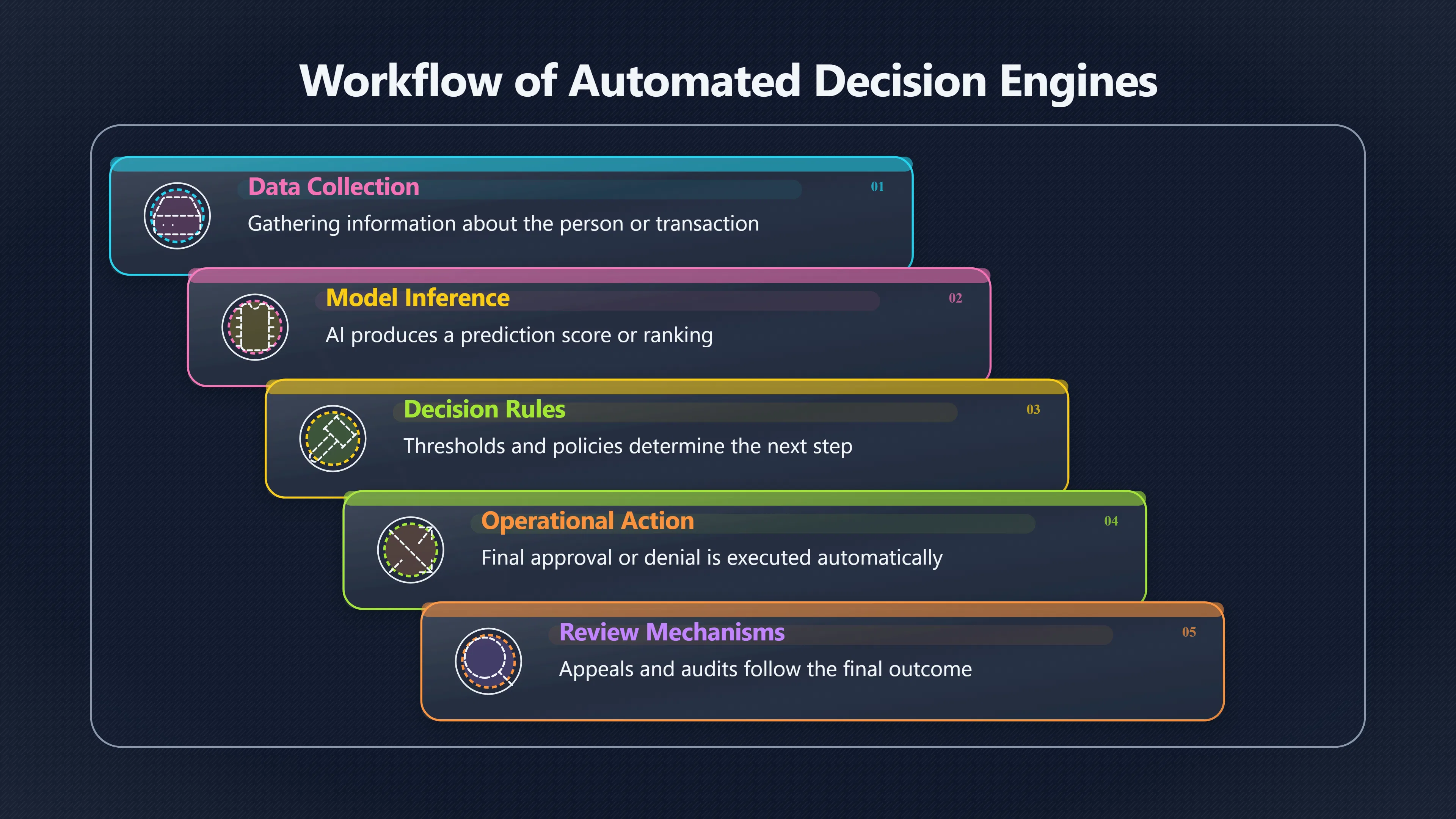
A typical workflow includes:
- Data collection – information about the person, transaction or situation is gathered.
- Model inference – the AI produces a prediction, score or ranking.
- Decision rules – thresholds, policies or regulations determine the next step.
- Operational action – approval, denial, routing, investigation or prioritisation occurs.
- Review mechanisms – appeals, audits or human intervention may follow.
This architecture can create a false impression that humans remain in control simply because a person appears somewhere in the workflow. In reality, if staff routinely accept system outputs without scrutiny, the process may function as de facto automation even when a nominal reviewer exists. Researchers and regulators often refer to this risk as automation bias: the tendency to place excessive trust in machine-generated recommendations.[arXiv]arxiv.orgAutomation Bias in the AI Act: On the Legal Implications of Attempting to De-Bias Human Oversight of AIFebruary 14, 2025…
Why high-stakes automation raises appeal and explanation issues
The consequences of automated decisions become more significant when they affect legal rights, employment opportunities, education, healthcare, housing, financial services or public benefits.
In these contexts, people often want answers to three questions:
- Why was this decision made?
- Can it be challenged?
- Who is responsible if it is wrong?
These questions become difficult when decisions depend on complex statistical systems. An organisation may be able to explain the factors considered by a model without being able to fully describe every internal calculation. Yet affected individuals still need enough information to understand the basis of the outcome and to identify possible errors.
Privacy and data-protection law has increasingly focused on these concerns. Under the UK GDPR, individuals receive additional protections when decisions are made solely through automated processing and produce legal or similarly significant effects. These protections are intended to reduce the risk that important outcomes become effectively unreviewable machine judgements.[ICO+2ICO]ico.org.ukare carrying out solely automated decision-making that has legal or similarly…Read more…
The appeal problem is particularly important because AI systems can inherit data-quality problems, historical biases or inappropriate assumptions. Even a highly accurate model will sometimes make mistakes. Without mechanisms for review and challenge, those mistakes can become difficult to detect and correct. Recent guidance from the UK Information Commissioner’s Office notes that automated decision-making can improve efficiency but can also create risks of unfair or biased outcomes if not properly governed.[ICO]ico.org.ukAutomated decisions can streamline the hiring process31 Mar 2026 — Automated decision making (ADM) can benefit both candidates and emp…
What human oversight can and cannot fix
Human oversight is often presented as the solution to automated decision-making risks, but its effectiveness depends on how it is designed.
Meaningful oversight usually requires that a reviewer:
- Understands the system’s purpose and limitations.
- Has access to relevant information beyond the AI output.
- Possesses authority to disagree with the system.
- Has enough time and training to exercise independent judgement.
- Can intervene, override or escalate decisions when necessary. AI Act Service Desk+2Artificial Intelligence Act[ai-act-service-desk.ec.europa.eu]ai-act-service-desk.ec.europa.euHigh-risk AI systems must be designed to allow human oversight during their operation to minimise risks to health, safety, and fundamenta…
However, oversight has limits.
A person who merely clicks “approve” after viewing an AI recommendation may add little real protection. Studies of human-AI interaction have repeatedly highlighted automation bias, where reviewers become overly reliant on system outputs, particularly when systems appear technically sophisticated or historically accurate. In such cases, a human may be present in the process but not genuinely exercising judgement.[arXiv]arxiv.orgAutomation Bias in the AI Act: On the Legal Implications of Attempting to De-Bias Human Oversight of AIFebruary 14, 2025…
Human oversight also cannot compensate for every design flaw. If training data are systematically biased, if the model lacks adequate performance in certain populations, or if organisational incentives favour speed over review, adding a human checkpoint may not eliminate underlying problems. Effective governance therefore requires attention to system design, testing, monitoring and accountability as well as oversight itself.[NIST Publications+2EPIC]nvlpubs.nist.govPublications Artificial Intelligence Risk Management Framework (AI RMF 1.0NIST PublicationsArtificial Intelligence Risk Management Framework (AI RMF 1.0)June 4, 2025 — by N AI · 2023 · Cited by 228 — NIST will r…
From human-in-the-loop to accountable decision-making
Not all forms of oversight are identical. Governance frameworks often distinguish between different levels of human involvement.
Human-in-the-loop systems require a person to review or approve outcomes before action is taken.
Human-on-the-loop systems operate automatically but are monitored by humans who can intervene if necessary.
Human-in-command approaches focus on broader organisational control, ensuring that people retain authority over objectives, deployment decisions and system shutdowns.
The appropriate model depends on the stakes involved. A recommendation about which film to watch next may require little oversight. A system influencing hiring, healthcare access or public services demands much stronger safeguards because the consequences of error are more significant. This risk-based logic increasingly appears in governance frameworks such as the NIST AI Risk Management Framework and the European Union’s AI Act, both of which emphasise accountability, monitoring and human control for higher-risk applications. AI Act Service Desk+3NIST Publications+3NIST[nvlpubs.nist.gov]nvlpubs.nist.govPublications Artificial Intelligence Risk Management Framework (AI RMF 1.0NIST PublicationsArtificial Intelligence Risk Management Framework (AI RMF 1.0)June 4, 2025 — by N AI · 2023 · Cited by 228 — NIST will r…
Why oversight is becoming a central AI governance requirement
The debate over automated decisions is ultimately a debate about responsibility. Organisations deploy AI because automation can improve speed, consistency and scale. Yet the more directly systems shape important outcomes, the greater the need for mechanisms that preserve human accountability.
Modern AI governance increasingly treats oversight as a design requirement rather than a last-minute safeguard. The goal is not to eliminate automation but to ensure that people remain able to understand, question and, when necessary, reverse consequential decisions. In high-stakes settings, trust depends not only on whether an AI system performs well, but also on whether humans retain meaningful authority over outcomes that affect other people’s lives. NIST Publications+3Artificial Intelligence Act+3AI Act Service Desk[artificialintelligenceact.eu]artificialintelligenceact.euArtificial Intelligence ActArticle 14: Human Oversight | EU Artificial Intelligence ActHuman oversight shall aim to prevent or minimise t…
eBay marketplace picks
Marketplace Samples
Example marketplace items related to this page. Use the search link to explore similar finds on eBay.




Endnotes
1.
Source: ico.org.uk
Link:https://ico.org.uk/for-organisations/uk-gdpr-guidance-and-resources/individual-rights/individual-rights/rights-related-to-automated-decision-making-including-profiling/
Source snippet
are carrying out solely automated decision-making that has legal or similarly...Read more...
2.
Source: nvlpubs.nist.gov
Title: Publications Artificial Intelligence Risk Management Framework (AI RMF 1.0)
Link:https://nvlpubs.nist.gov/nistpubs/ai/nist.ai.100-1.pdf
Source snippet
NIST PublicationsArtificial Intelligence Risk Management Framework (AI RMF 1.0)June 4, 2025 — by N AI · 2023 · Cited by 228 — NIST will r...
Published: June 4, 2025
3.
Source: nist.gov
Link:https://www.nist.gov/itl/ai-risk-management-framework
Source snippet
iated with artificial intelligence (AI).Read more...
4.
Source: ico.org.uk
Link:https://ico.org.uk/media2/bibhz1gs/existing-guidance-automated-decision-making-and-profiling.pdf
Source snippet
Automated decision- making and profilingArticle 22(1) of the UK GDPR limits the circumstances in which you can make solely automated deci...
5.
Source: arxiv.org
Link:https://arxiv.org/abs/2502.10036
Source snippet
Automation Bias in the AI Act: On the Legal Implications of Attempting to De-Bias Human Oversight of AIFebruary 14, 2025...
Published: February 14, 2025
6.
Source: ico.org.uk
Link:https://ico.org.uk/for-organisations/uk-gdpr-guidance-and-resources/artificial-intelligence/guidance-on-ai-and-data-protection/how-do-we-ensure-fairness-in-ai/what-is-the-impact-of-article-22-of-the-uk-gdpr-on-fairness/
Source snippet
What is the impact of Article 22 of the UK GDPR on fairness?Article 22 requirements essentially ensure that processing is fair by seeking...
7.
Source: gdpr-info.eu
Link:https://gdpr-info.eu/art-22-gdpr/
Source snippet
Automated individual decision-making, including profilingThe data subject shall have the right not to be subject to a decision based sole...
8.
Source: ico.org.uk
Link:https://ico.org.uk/about-the-ico/media-centre/news-and-blogs/2026/03/automated-decisions-can-streamline-the-hiring-process-with-the-right-safeguards-in-place/
Source snippet
Automated decisions can streamline the hiring process31 Mar 2026 — Automated decision making (ADM) can benefit both candidates and emp...
9.
Source: epic.org
Link:https://epic.org/framing-the-risk-management-framework-actionable-instructions-by-nist-in-the-measure-section-of-the-ai-rmf/
Source snippet
Framing the Risk Management Framework: Actionable...13 Apr 2023 — [Measure 2.8] Measure and document human oversight of AI systems...
10.
Source: nvlpubs.nist.gov
Title: AI.600 1
Link:https://nvlpubs.nist.gov/nistpubs/ai/NIST.AI.600-1.pdf
Source snippet
Intelligence Risk Management Frameworkby N AI · 2024 · Cited by 144 — Consistent with other AI RMF profiles, this profile offers insights...
11.
Source: airc.nist.gov
Title: 5 sec core
Link:https://airc.nist.gov/airmf-resources/airmf/5-sec-core/
Source snippet
RMF Core - AIRC - NIST AI Resource CenterThe AI RMF Core provides outcomes and actions that enable dialogue, [understanding]({{ 'understanding/' | relative_url }}), and activitie...
12.
Source: airc.nist.gov
Link:https://airc.nist.gov/airmf-resources/playbook/govern/
Source snippet
NIST AI Resource CenterDiscover practical AI governance guidelines addressing legal requirements, risk mapping, and best practices...
13.
Source: epic.org
Link:https://epic.org/documents/epic-comments-national-institute-of-standards-and-technology-ai-risk-management-framework/
Source snippet
dvocacy groups, and other entities impacted by automated decision-making, AI...Read more...
14.
Source: artificialintelligenceact.eu
Link:https://artificialintelligenceact.eu/article/14/
Source snippet
Artificial Intelligence ActArticle 14: Human Oversight | EU Artificial Intelligence ActHuman oversight shall aim to prevent or minimise t...
15.
Source: ai-act-service-desk.ec.europa.eu
Link:https://ai-act-service-desk.ec.europa.eu/en/ai-act/article-14
Source snippet
High-risk AI systems must be designed to allow human oversight during their operation to minimise risks to health, safety, and fundamenta...
16.
Source: intelligence.dlapiper.com
Title: artificial intelligence
Link:https://intelligence.dlapiper.com/artificial-intelligence/?c=EU&t=11-human-oversight
Source snippet
oversight in the European Union - AI Laws of the World...
17.
Source: ico.org.uk
Link:https://ico.org.uk/for-organisations/advice-and-services/audits/data-protection-audit-framework/toolkits/artificial-intelligence/human-review/
Source snippet
Human reviewThis section is aimed at helping technical specialists and those in compliance-focused roles to understand how human review i...
18.
Source: cy.ico.org.uk
Link:https://cy.ico.org.uk/for-organisations/uk-gdpr-guidance-and-resources/artificial-intelligence/explaining-decisions-made-with-artificial-intelligence/part-1-the-basics-of-explaining-ai/legal-framework/
Source snippet
framework | ICOArticle 22 of the GDPR gives individuals the right not to be subject to a solely automated decision producing legal or sim...
19.
Source: digital-strategy.ec.europa.eu
Title: eu A I Act | Shaping Europe’s digital future
Link:https://digital-strategy.ec.europa.eu/en/policies/regulatory-framework-ai
Source snippet
Act | Shaping Europe's digital future - European UnionThe AI Act is the first-ever legal framework on AI, which addresses the risks of AI...
20.
Source: GOV.UK
Link:https://www.gov.uk/ai-assurance-techniques/fairnow-regulatory-compliance-implementation-and-the-nist-ai-rmf-slash-iso-readiness
Source snippet
Compliance Implementation and the NIST AI...26 Sept 2024 — FairNow's platform simplifies the process of managing compliance for the NIST...
21.
Source: GOV.UK
Link:https://www.gov.uk/government/publications/ethics-transparency-and-accountability-framework-for-automated-decision-making/ethics-transparency-and-accountability-framework-for-automated-decision-making
Source snippet
www.gov.ukEthics, Transparency and Accountability Framework for...29 Nov 2023 — Article 22 of the GDPR must be followed when carrying ou...
22.
Source: artificialintelligenceact.eu
Link:https://artificialintelligenceact.eu/article/6/
Source snippet
Article 6: Classification Rules for High-Risk AI SystemsAI systems of the types listed in Annex III are always considered high-risk, unle...
Additional References
23.
Source: wilmerhale.com
Link:https://www.wilmerhale.com/en/insights/blogs/wilmerhale-privacy-and-cybersecurity-law/20240717-what-are-highrisk-ai-systems-within-the-meaning-of-the-eus-ai-act-and-what-requirements-apply-to-them
Source snippet
What Are High-Risk AI Systems Within the Meaning of...17 Jul 2024 — High-risk AI systems must be designed and developed in such a way th...
24.
Source: aiuc-1.com
Link:https://www.aiuc-1.com/crosswalks/nist-ai-rmf
Source snippet
AIUC-1 x NIST AI RMFThe NIST AI RMF is the United States government framework for managing AI risks throughout the AI lifecycle with four...
25.
Source: paloaltonetworks.com
Link:https://www.paloaltonetworks.com/cyberpedia/nist-ai-risk-management-framework
Source snippet
NIST AI Risk Management Framework (AI RMF)The NIST AI Risk Management Framework (AI RMF) is a guidance designed to improve the robustness...
26.
Source: docs.modulos.ai
Link:https://docs.modulos.ai/frameworks/comparison/nist-ai-rmf-vs-[eu-ai-act
Source snippet
AI RMF vs EU AI ActBoth emphasize transparency and oversight, but the AI Act makes specific provisions binding for high-risk systems (Art...
27.
Source: handleygill.co.uk
Link:https://www.handleygill.co.uk/handley-gill-blog/section-80-data-use-and-access-act-2025-article-22a-uk-gdpr-automated-decision-making-automated-processing-meaningful-human-involvement
Source snippet
What do we mean by meaningful?18 Mar 2026 — Section 80 Data (Use and Access) Act 2025 has amended the UK GDPR so as to relax restrictions...
28.
Source: keystonelaw.com
Link:https://keystonelaw.com/keynotes/what-does-the-icos-warning-against-automated-decision-making-mean-for-ai-recruitment-and-employers/
Source snippet
What does the ICO's warning against automated decision-...15 Apr 2026 — This means they're using solely automated systems without meanin...
29.
Source: bundesnetzagentur.de
Link:https://www.bundesnetzagentur.de/EN/Areas/Digitalisation/AI/09_HighRisk/start.html
30.
Source: hoganlovells.com
Link:https://www.hoganlovells.com/en/publications/ai-and-automated-decisionmaking-in-the-uk-part-i-the-new-rules-and-regulatory-guidance
Source snippet
AI and Automated Decision-Making in the UK (Part I)6 May 2026 — Ensure the Article 22C safeguards are genuinely operational as part of a...
Published: May 2026
31.
Source: aoshearman.com
Title: zooming in on ai 10 eu ai act what are the obligations for high risk ai systems
Link:https://www.aoshearman.com/en/insights/ao-shearman-on-tech/zooming-in-on-ai-10-eu-ai-act-what-are-the-obligations-for-high-risk-ai-systems
Source snippet
EU AI Act: obligations for high-risk AI systems29 Oct 2024 — Human Oversight: Deployers of high-risk AI systems must assign human oversig...
32.
Source: verifywise.ai
Title: The EU AI Act requires it for high-risk systems. Covers oversight levels (hum
Link:https://verifywise.ai/lexicon/human-oversight-in-ai
Source snippet
Human oversight in AI: what it means and why regulators...Human oversight in AI means people monitor, guide, and correct AI systems...
Topic Tree