Within GPT generators
Why Convincing AI Responses Still Make Mistakes
The same next-token prediction process that enables flexible generation can also produce confident factual errors.
On this page
- Why plausibility differs from correctness
- Hidden uncertainty in generated text
- Reasoning failures behind fluent answers
Page outline Jump by section
Introduction
GPT-style language models can produce answers that sound knowledgeable, structured, and persuasive. That fluency is a direct consequence of how they are trained: they learn to predict likely continuations of text based on patterns found in enormous collections of human writing. The same mechanism that makes them flexible generators, however, also explains why they sometimes produce confident mistakes.
 A language model does not directly check whether a statement is true before generating it. Instead, it generates text that appears appropriate given the prompt and its learned statistical patterns. As a result, a response can be grammatically polished, logically organised, and highly convincing while still containing factual errors, invented details, or flawed reasoning. Researchers commonly refer to these failures as “hallucinations” or ungrounded generations.[OpenAI+2arXiv]OpenAIwhy language models hallucinateSep 5, 2025 — OpenAI's new research explains why language models hallucinate. The findings show how improved evaluations can enhance AI r…
Why Plausibility Differs from Correctness
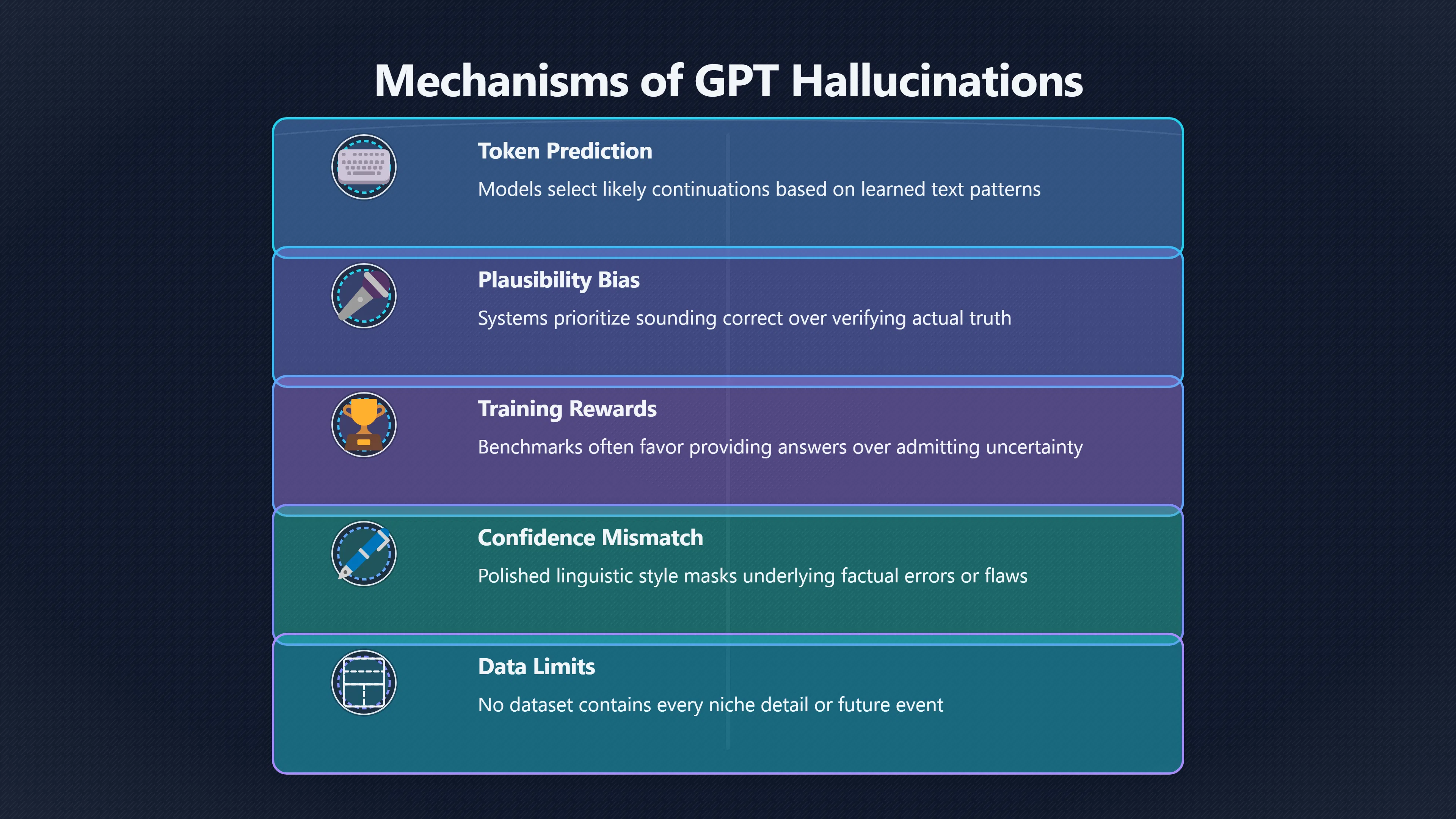
The most important distinction is that language models are optimised for plausibility, not truth.
In a traditional database, a query retrieves stored information. In a GPT-style model, the answer is generated token by token. Each new token is selected because it is a likely continuation of the previous context, not because the model has independently verified the claim being made. This design allows extraordinary flexibility: the same system can write essays, answer questions, translate text, and generate code. Yet it also means that factual accuracy is not guaranteed.[OpenAI+2arXiv]OpenAIwhy language models hallucinateSep 5, 2025 — OpenAI's new research explains why language models hallucinate. The findings show how improved evaluations can enhance AI r…
Consider a question about a historical event. The model may have encountered thousands of relevant references during training and often produces a correct answer. But if the evidence in its learned patterns is incomplete, conflicting, or weakly represented, it may generate a continuation that merely sounds like a historically accurate answer. The result can be a statement that feels authoritative despite being wrong.[arXiv]arxiv.orgA Survey on Hallucination in Large Language Modelsby L Huang · 2023 · Cited by 5591 — In this survey, we begin with an innovative ta…
This explains why users sometimes encounter fabricated book titles, invented academic citations, or fictional legal cases. The model is generating text that resembles examples it has seen before, even when no genuine source exists. A well-known example involved legal filings that cited non-existent court cases generated by an AI system, demonstrating how fluent output can mask factual failure.[Stanford HAI]hai.stanford.eduStanford HAIAI on Trial: Legal Models Hallucinate in 1 out of 6 (or More…May 23, 2024 — Large language models have a documented tenden…
Hidden Uncertainty in Generated Text
Why models often guess instead of saying “I don’t know”
Humans can explicitly recognise uncertainty and choose not to answer. Language models can express uncertainty in words, but their training has historically rewarded producing answers rather than abstaining.
Recent research argues that many hallucinations arise because evaluation systems and benchmarks often favour attempting an answer over admitting uncertainty. When a model is rewarded for answering difficult questions, guessing can improve measured performance even if some guesses are wrong. Over time, this creates pressure toward confident responses instead of cautious ones.[OpenAI+2OpenAI]OpenAIwhy language models hallucinateSep 5, 2025 — OpenAI's new research explains why language models hallucinate. The findings show how improved evaluations can enhance AI r…
Researchers have compared this behaviour to a student taking an exam. If leaving a question blank guarantees no credit while a guess might earn points, guessing becomes rational. Similarly, language models may generate plausible responses when they lack sufficient information because their optimisation process rewards completion.[arXiv+2arXiv]arxiv.orgLike students facing hard exam questions, large language models sometimes guess when uncertain, producing plausible yet incorrect…Read…
Confidence and correctness are not the same thing
A common misunderstanding is to interpret confident wording as evidence of accuracy. For language models, confidence in tone and correctness of content are separate issues.
The model can produce detailed explanations, precise dates, and technical vocabulary because those patterns frequently occur in training data. The linguistic signals associated with expertise are often easier to reproduce than the underlying factual relationships. Consequently, an incorrect answer may be delivered with the same polished style as a correct one.[PMC+2Wikipedia]pmc.ncbi.nlm.nih.govSurvey and analysis of hallucinations in large language modelsby D Anh-Hoang · 2025 · Cited by 97 — Hallucination in Large Language Mo…
Research on calibration—the alignment between confidence and actual correctness—shows that large language models can be poorly calibrated in some situations, expressing greater certainty than their accuracy justifies. Improving this alignment remains an active area of research.[arXiv]arxiv.orgUncertainty Quantification and Confidence Calibration in…March 20, 2025 — by X Liu · 2025 · Cited by 147 — Uncertainty Quantifica…
Reasoning Failures Behind Fluent Answers
Not all mistakes come from missing facts. Some arise from failures in reasoning.
A language model can often imitate reasoning because many examples of reasoning appear in its training data. However, generating text that resembles reasoning is not identical to performing reliable logical analysis. When problems become complex, involve many intermediate steps, or require careful tracking of constraints, the model may drift into errors while still maintaining a coherent narrative.[arXiv]arxiv.orgA Survey on Hallucination in Large Language Modelsby L Huang · 2023 · Cited by 5591 — In this survey, we begin with an innovative ta…
Several common failure modes appear:
- Faulty multi-step logic: An early mistake propagates through later steps.
- Invented connections: The model links concepts that seem related but are not actually connected.
- Overgeneralisation: Patterns that are usually true are applied where they do not belong.
- Context confusion: Details from different examples become blended together.
- Self-reinforcement: Once an incorrect statement appears in the generated text, subsequent tokens may build upon it as if it were true.[Wikipedia+2arXiv]WikipediaHallucination (artificial intelligenceHallucination (artificial intelligence
These failures are especially noticeable in mathematics, law, scientific explanation, and software development, where small errors can invalidate an otherwise convincing answer. Studies examining code generation have similarly found that models can produce syntactically correct code that contains subtle logical defects or incorrect assumptions.[arXiv]arxiv.orgCollu-Bench: A Benchmark for Predicting Language Model Hallucinations in CodeOctober 13, 2024…
Why More Data Does Not Eliminate the Problem
A natural question is whether larger models and more training data eventually solve the issue.
In practice, larger models generally become more capable and often more accurate. However, researchers and AI developers continue to observe hallucinations even in state-of-the-art systems. The problem is reduced rather than eliminated.[OpenAI+2Nature]OpenAIwhy language models hallucinateSep 5, 2025 — OpenAI's new research explains why language models hallucinate. The findings show how improved evaluations can enhance AI r…
One reason is that language generation always involves prediction under uncertainty. No training dataset contains every fact, every future event, every niche domain detail, or every possible combination of concepts. Eventually the model encounters situations where its learned patterns are insufficient. When that happens, the same mechanism that enables flexible generation can produce a plausible but incorrect continuation.[arXiv+2arXiv]arxiv.orgLike students facing hard exam questions, large language models sometimes guess when uncertain, producing plausible yet incorrect…Read…
Developers increasingly use techniques such as retrieval-augmented generation (RAG), external databases, citation systems, and uncertainty-aware prompting to reduce these failures. These methods help ground answers in verifiable information rather than relying solely on the model’s internal statistical knowledge.[Michael Brenndoerfer]mbrenndoerfer.comhallucination mitigationMichael BrenndoerferHallucination Mitigation: RAG, Decoding, and Training20 Mar 2026 — Learn how to reduce LLM hallucination using retrie…
What This Means for Understanding AI
The tendency of language models to produce fluent mistakes is not a separate flaw accidentally added to otherwise perfect systems. It is closely related to the same predictive process that gives them their remarkable flexibility.
Because GPT-style models generate likely continuations of text, they can adapt to countless tasks without task-specific programming. Yet generating likely continuations is different from establishing truth. Fluency reflects how well an answer fits learned language patterns; accuracy depends on whether those patterns correspond to reality in the specific situation.
Understanding this distinction is essential for using modern AI effectively. A polished answer may be correct, partially correct, or entirely wrong. The quality of the prose is evidence that the model has generated language successfully, not proof that the information itself is true.[OpenAI+2arXiv]OpenAIwhy language models hallucinateSep 5, 2025 — OpenAI's new research explains why language models hallucinate. The findings show how improved evaluations can enhance AI r…
Amazon book picks
Further Reading
Books and field guides related to Why Convincing AI Responses Still Make Mistakes. Use these as the next step if you want deeper reading beyond the article.
AI Engineering
Explains reliability, evaluation, and practical limits of generative systems.
Hands-On Large Language Models
Addresses generation quality, hallucinations, evaluation, and model limitations.
eBay marketplace picks
Marketplace Samples
Example marketplace items related to this page. Use the search link to explore similar finds on eBay.




Endnotes
1.
Source: OpenAI
Title: why language models hallucinate
Link:https://openai.com/index/why-language-models-hallucinate/
Source snippet
Sep 5, 2025 — OpenAI's new research explains why language models hallucinate. The findings show how improved evaluations can enhance AI r...
2.
Source: arxiv.org
Link:https://arxiv.org/abs/2311.05232
Source snippet
A Survey on Hallucination in Large Language Modelsby L Huang · 2023 · Cited by 5591 — In this survey, we begin with an innovative ta...
3.
Source: pmc.ncbi.nlm.nih.gov
Link:https://pmc.ncbi.nlm.nih.gov/articles/PMC12518350/
Source snippet
Survey and analysis of hallucinations in large language modelsby D Anh-Hoang · 2025 · Cited by 97 — Hallucination in Large Language Mo...
4.
Source: arxiv.org
Link:https://arxiv.org/pdf/2509.04664
Source snippet
Like students facing hard exam questions, large language models sometimes guess when uncertain, producing plausible yet incorrect...Read...
5.
Source: hai.stanford.edu
Link:https://hai.stanford.edu/news/ai-trial-legal-models-hallucinate-1-out-6-or-more-benchmarking-queries
Source snippet
Stanford HAIAI on Trial: Legal Models Hallucinate in 1 out of 6 (or More...May 23, 2024 — Large language models have a documented tenden...
Published: May 23, 2024
6.
Source: Wikipedia
Title: Hallucination (artificial intelligence)
Link:https://en.wikipedia.org/wiki/Hallucination_%28artificial_intelligence%29
7.
Source: cdn.openai.com
Title: why language models hallucinate
Link:https://cdn.openai.com/pdf/d04913be-3f6f-4d2b-b283-ff432ef4aaa5/why-language-models-hallucinate.pdf
Source snippet
Why Language Models Hallucinateby AT Kalai · 2025 · Cited by 406 — Language models are known to produce overconfident, plausible fa...
8.
Source: arxiv.org
Title: arXiv Why Language Models Hallucinate
Link:https://arxiv.org/abs/2509.04664
9.
Source: arxiv.org
Title: arXiv Delusions of Large Language Models
Link:https://arxiv.org/abs/2503.06709
10.
Source: arxiv.org
Link:https://arxiv.org/abs/2503.15850
Source snippet
Uncertainty Quantification and Confidence Calibration in...March 20, 2025 — by X Liu · 2025 · Cited by 147 — Uncertainty Quantifica...
Published: March 20, 2025
11.
Source: arxiv.org
Link:https://arxiv.org/abs/2410.09997
Source snippet
Collu-Bench: A Benchmark for Predicting Language Model Hallucinations in CodeOctober 13, 2024...
Published: October 13, 2024
12.
Source: nature.com
Link:https://www.nature.com/articles/s41586-026-10549-w
Source snippet
Evaluating large language models for accuracy...by AT Kalai · 2026 · Cited by 4 — Large language models sometimes produce confident, pla...
13.
Source: Wikipedia
Link:https://en.wikipedia.org/wiki/Language
Source snippet
LanguageLanguage is a structured system of communication that consists of grammar and vocabulary. It is the primary means by which hum...
14.
Source: OpenAI
Link:https://openai.com/
Source snippet
comOpenAI | Research & DeploymentWe believe our research will eventually lead to artificial general intelligence, a system that can solve...
15.
Source: arxiv.org
Link:https://arxiv.org/html/2510.06265v2
Source snippet
Large Language Models Hallucination: A Comprehensive...9 Oct 2025 — Hallucination refers to the generation of content by an LLM that is...
16.
Source: arxiv.org
Link:https://arxiv.org/html/2509.04664v1
Source snippet
Why Language Models HallucinateSep 4, 2025 — Language models are known to produce overconfident, plausible falsehoods, which diminish the...
17.
Source: arxiv.org
Link:https://arxiv.org/html/2602.11167v1
Source snippet
Visualizing and Benchmarking LLM Factual Hallucination...18 Jan 2026 — This study found that LLMs often generate false information, usin...
18.
Source: mbrenndoerfer.com
Title: hallucination mitigation
Link:https://mbrenndoerfer.com/writing/hallucination-mitigation
Source snippet
Michael BrenndoerferHallucination Mitigation: RAG, [Decoding]({{ 'decoding/' | relative_url }}), and Training20 Mar 2026 — Learn how to reduce LLM hallucination using retrie...
19.
Source: dictionary.cambridge.org
Link:https://dictionary.cambridge.org/dictionary/english/large
Source snippet
English meaning - Cambridge DictionaryLarge (abbreviation L) is a size of clothing or other product that is bigger than average: The sh...
20.
Source: dictionary.cambridge.org
Link:https://dictionary.cambridge.org/us/dictionary/english/language
Source snippet
definition in the Cambridge English Dictionarya system of communication consisting of sounds, words, and grammar. She does research int...
21.
Source: britannica.com
Link:https://www.britannica.com/topic/language
Source snippet
of which human beings, as members of a social group and participants in...Read more...
22.
Source: reddit.com
Title: Why Language Models Hallucinate
Link:https://www.reddit.com/r/MachineLearning/comments/1namvsk/why_language_models_hallucinate_openai_pseudo/
Source snippet
OpenAi pseudo paperThe [predictions]({{ 'predictions/' | relative_url }}) are based on whatever is said to be true. The model has no ability to reason at all (CoT is not reason...
23.
Source: computerworld.com
Link:https://www.computerworld.com/article/4059383/openai-admits-ai-hallucinations-are-mathematically-inevitable-not-just-engineering-flaws.html
Source snippet
OpenAI admits AI hallucinations are mathematically...18 Sept 2025 — In a landmark study, OpenAI researchers reveal that large language m...
24.
Source: pmc.ncbi.nlm.nih.gov
Link:https://pmc.ncbi.nlm.nih.gov/articles/PMC12957136/
Source snippet
by TN Cash · 2025 · Cited by 25 — LLMs tend to be overconfident. LLMs—especially ChatGPT and Gemini—often fail to adjust their confide...
Additional References
25.
Source: linkedin.com
Link:https://www.linkedin.com/posts/satyamallick_ai-hallucinations-why-language-models-sometimes-activity-7437540136567005185-DO2-
Source snippet
AI Hallucinations: Language Models' Factual FlawsLarge language models operate through next-token prediction. They tend to favor high-fre...
26.
Source: github.com
Link:https://github.com/AmourWaltz/Awesome-Reliable-LLM
Source snippet
AmourWaltz/Awesome-Reliable-LLMModels are prone to be over-confident in predictions using maximizing likelihood (MLE) training, it is cru...
27.
Source: businessinsider.com
Link:https://www.businessinsider.com/why-ai-chatbots-hallucinate-openai-chatgpt-anthropic-claude
Source snippet
This test-centric optimization encourages models to provide confident but potentially incorrect outputs, rather than abstaining when unsu...
28.
Source: reuters.com
Link:https://www.reuters.com/technology/does-ai-[business
Source snippet
These tools, while undeniably innovative, suffer from a critical issue: hallucinations—instances where the AI generates incorrect or fabr...
29.
Source: ft.com
Link:https://www.ft.com/content/7a4e7eae-f004-486a-987f-4a2e4dbd34fb
Source snippet
These errors arise from the probabilistic way the models predict the next word in a sentence, sometimes leading to plausible yet incorrec...
30.
Source: merriam-webster.com
Link:https://www.merriam-webster.com/dictionary/language
Source snippet
LANGUAGE Definition & Meaning3 days ago — The meaning of LANGUAGE is an organically developed system of communication used by groups of h...
31.
Source: ebsco.com
Link:https://www.ebsco.com/research-starters/language-and-linguistics/language
32.
Source: linkedin.com
Link:https://www.linkedin.com/posts/haythamassem_why-language-models-hallucinatepdf-activity-7370201125955997697–izi
Source snippet
Why language models hallucinate: A paper by OpenAI➡️ The paper breaks this down statistically: During pre-training, models face natural p...
33.
Source: medium.com
Link:https://medium.com/%40efantinatti/why-hallucination-is-the-wrong-term-for-[ai-errors
Source snippet
Why “Hallucination” is the wrong term for AI errorsThese terms capture the reality that LLMs recombine learned patterns without true comp...
34.
Source: kaifkohari10.medium.com
Link:https://kaifkohari10.medium.com/from-next-token-prediction-to-reasoning-machines-how-llms-evolved-beyond-simple-text-generation-to-ac7cd1709ae1
Source snippet
Next-Token Prediction to Reasoning Machines…This post is a guided tour through the major innovations that turned large language models fr...
Topic Tree