Within AI Outputs
Why search results are an AI output
Search ranking is a familiar AI output because it turns a query into an ordered list that shapes what people see first.
On this page
- How queries become ranked results
- Why ranking systems influence attention and belief
- Where search ranking differs from simple database lookup
Page outline Jump by section
Introduction
Search ranking is one of the most ordinary ways people meet artificial intelligence. A person types a query, and the system turns it into an ordered list of links, answers, maps, images, videos or product results. That order is not a neutral display of everything in a database. It is an AI-shaped output: the system interprets the query, estimates which results are useful, judges quality and context, and then decides what appears first.
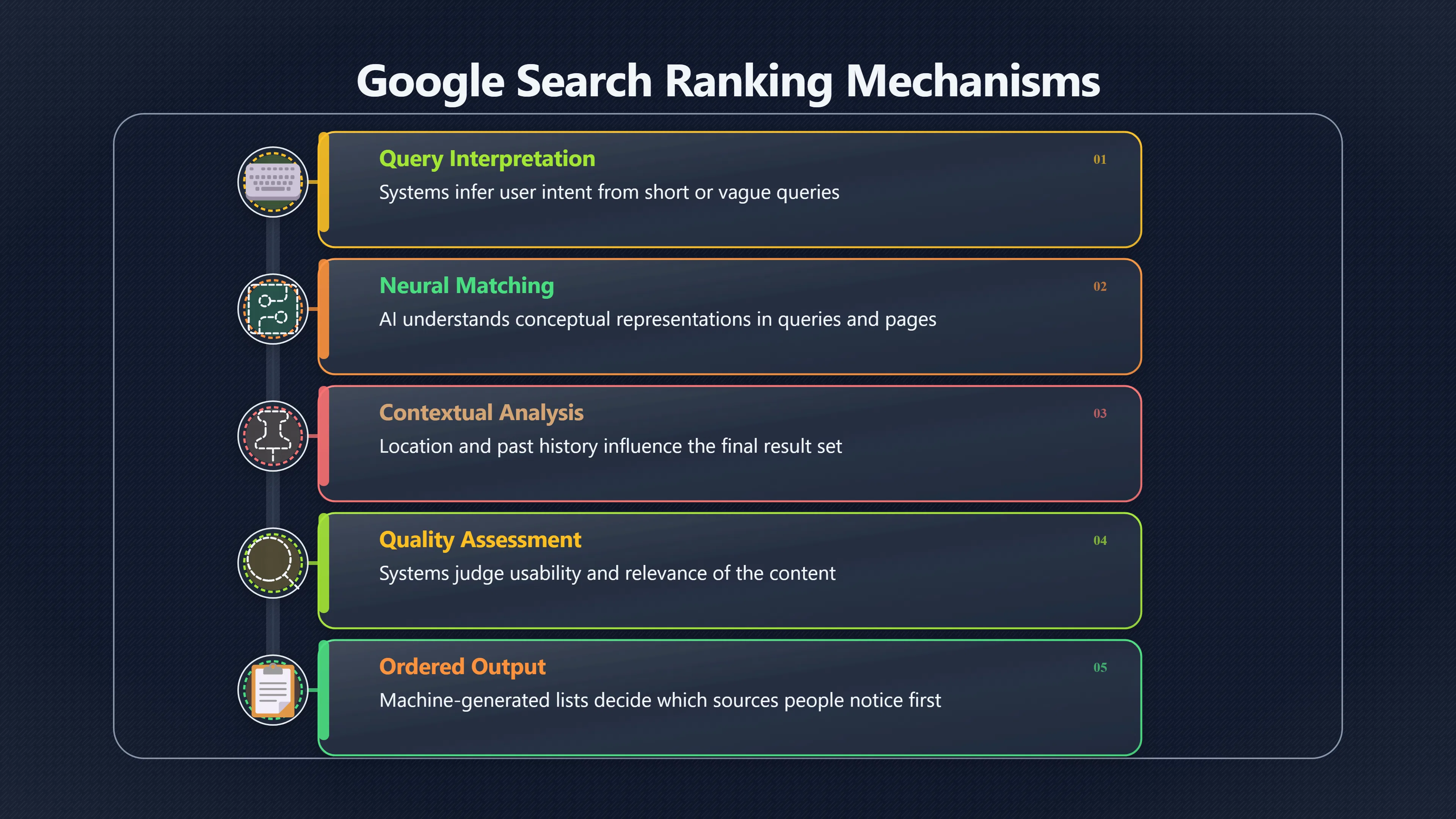
 This matters because ranking quietly directs attention. The first few results often feel more relevant, more trustworthy or simply more convenient than the results below them. Search ranking therefore does more than retrieve information; it helps decide which sources people notice, which explanations they compare, and which answers become part of everyday belief. Google’s own Search documentation describes ranking as a process using factors such as meaning, relevance, quality, usability and context, including location and settings.[Google]google.comHow Does Google Determine Ranking ResultsDiscover how key factors such as meaning, relevance, and quality are used to generate how…
How queries become ranked results
A simple database lookup returns items that match a stored field: a name, date, file title or exact keyword. Search ranking is different. The system has to infer what the user probably means, especially when a query is short, vague, misspelled or context-dependent. Someone searching “jaguar speed” might mean the animal, the car brand, or a sports team; “football” can point towards different sports depending on location. Google says Search uses context such as location, past Search history and settings to determine what may be most relevant in the moment.[Google]google.comHow Does Google Determine Ranking ResultsDiscover how key factors such as meaning, relevance, and quality are used to generate how…
Modern search engines do this through layered ranking systems rather than one visible rule. Google describes systems that analyse the meaning of the query, match it to relevant content, assess quality, consider usability and apply contextual signals. Its public guide to ranking systems also identifies AI systems such as RankBrain and neural matching, with neural matching used to understand representations of concepts in queries and pages.[Google for Developers]developers.google.comfor Developers A Guide to Google Search Ranking Systems Neural matchingNeural matching is an AI system that Google uses to understand representations of concepts in queries and pages and match them to one ano…
The key point is that the ranked page is the output. The user gives the system an input, the query, and receives a machine-generated ordering. The output may look like a list of links, but it has already passed through automated interpretation and selection.
Why ranking influences attention and belief
Search ranking shapes behaviour because people rarely inspect results evenly. A result near the top is more visible, more likely to be clicked, and often treated as a stronger candidate before the user has read it carefully. Research on search behaviour has long studied this “position bias”: the tendency for higher-ranked items to receive more attention partly because of where they appear, not only because they are better.[Google Research]research.google.comGoogle ResearchBeyond Position Bias: Examining Result Attractiveness as…by Y Yue · Cited by 267 — This study distinguishes itself from…
That makes ranking a practical form of power. It can affect which health advice looks prominent, which news sources are seen, which businesses get traffic, and which explanations appear credible. A study on search engine selection and sorting criteria found that ranking and selection can influence users’ knowledge, beliefs and behaviour, especially when people rely on search results to form judgements.[PMC]pmc.ncbi.nlm.nih.govThe Impact of Search Engine Selection and Sorting Criteria on…by A Allam · 2014 · Cited by 187 — This study is concerned with demon…
This does not mean search engines simply “make people believe” whatever appears first. Users still judge, compare and ignore results. But ranking changes the starting point. It decides which options are easy to notice and which require extra effort to find.

Why search ranking is not just keyword matching
Older mental models of search often imagine a giant index where the engine looks for exact words and lists matching pages. Keywords still matter, but modern search ranking is much richer than that. Search systems try to understand intent, context and page quality, not just whether a page repeats the same phrase as the query.
Google’s Search Quality Rater Guidelines show how much of search evaluation concerns usefulness and “needs met”, not bare word matching. Raters assess whether results satisfy the user’s likely intent and whether pages are high quality, though Google states that rater scores do not directly determine individual rankings.[RaterHub Guidelines]guidelines.raterhub.comRaterHub GuidelinesGeneral Guidelines11 Sept 2025 —… Search Quality Raters” as “raters” in these guidelines. Copyright… ○ Updated P…
This is where search ranking becomes a useful everyday example of AI. It is not AI because it looks human. It is AI because it performs inference: it estimates meaning, relevance and usefulness from incomplete signals, then produces an ordered output for a human-defined purpose.
The everyday tradeoff: helpful filtering versus hidden influence
Search ranking is valuable because the web is too large to browse manually. Without ranking, a search engine would be little more than an enormous pile of matching documents. Ranking compresses that pile into a manageable order, often helping users find a practical answer in seconds.
The same compression creates risks. A ranking system must simplify messy questions, choose between competing signals, and make uncertain judgements about quality. It may favour established sources, recent pages, local results, popular pages, commercially optimised pages, or pages that fit the system’s interpretation of the query. Some of those choices improve results; others can bury useful minority perspectives or amplify pages that are easy for the system to recognise.
Regulators increasingly treat ranking as something that needs explanation, not as invisible plumbing. The EU’s Digital Services Act classifies very large online search engines separately and imposes transparency and accountability duties on large platforms and search services. EU guidance on ranking transparency also stresses that online visibility can depend on key algorithmic parameters that should be communicated more clearly.[Digital Strategy]digital-strategy.ec.europa.euDigital StrategyDSA: Very large online platforms and search enginesThe DSA classifies platforms or search engines that have more than 45…

What to notice when using search
The most useful habit is to treat the first result as a recommendation, not a final answer. A ranked result is the system’s best guess under its design goals, data and available signals. It may be excellent, but it is still an output produced by a ranking process.
For ordinary searching, three questions help:
- Is the query specific enough? Vague searches give the ranking system more room to infer intent.
- Are the top results from different kinds of sources? A mix of official, expert, commercial and journalistic sources can reveal whether the ranking is narrowing the view.
- Would changing one word change the result set? Search ranking is sensitive to phrasing, so trying a second query can expose assumptions in the first output.
Search ranking is therefore a simple but powerful introduction to artificial intelligence. It shows AI not as a talking machine, but as a system that turns an input into an ordered output — and, by doing so, shapes what people see first.
eBay marketplace picks
Marketplace Samples
Example marketplace items related to this page. Use the search link to explore similar finds on eBay.




Endnotes
1.
Source: google.com
Link:https://www.google.com/intl/en_us/search/howsearchworks/how-search-works/ranking-results
Source snippet
How Does Google Determine Ranking ResultsDiscover how key factors such as meaning, relevance, and quality are used to generate how...
2.
Source: developers.google.com
Link:https://developers.google.com/search/docs/fundamentals/how-search-works
Source snippet
Google for DevelopersIn-Depth Guide to How Google Search WorksGet an in-depth [understanding]({{ 'understanding/' | relative_url }}) of how Google Search works and improve your s...
3.
Source: developers.google.com
Title: for Developers A Guide to Google Search Ranking Systems Neural matching
Link:https://developers.google.com/search/docs/appearance/ranking-systems-guide
Source snippet
Neural matching is an AI system that Google uses to understand representations of concepts in queries and pages and match them to one ano...
4.
Source: research.google.com
Link:https://research.google.com/pubs/archive/36363.pdf
Source snippet
Google ResearchBeyond Position Bias: Examining Result Attractiveness as...by Y Yue · Cited by 267 — This study distinguishes itself from...
5.
Source: pmc.ncbi.nlm.nih.gov
Link:https://pmc.ncbi.nlm.nih.gov/articles/PMC4004139/
Source snippet
The Impact of Search Engine Selection and Sorting Criteria on...by A Allam · 2014 · Cited by 187 — This study is concerned with demon...
6.
Source: guidelines.raterhub.com
Link:https://guidelines.raterhub.com/searchqualityevaluatorguidelines.pdf
Source snippet
RaterHub GuidelinesGeneral Guidelines11 Sept 2025 —... Search Quality Raters” as “raters” in these guidelines. Copyright... ○ Updated P...
7.
Source: developers.google.com
Title: search quality rater guidelines update
Link:https://developers.google.com/search/blog/2023/11/search-quality-rater-guidelines-update
Source snippet
Google for DevelopersSearch Quality Raters Guidelines update16 Nov 2023 — As a reminder, these guidelines are what are used by our search...
8.
Source: services.google.com
Link:https://services.google.com/fh/files/misc/hsw-sqrg.pdf
Source snippet
Quality Rater Guidelines: An OverviewWe first generate a sample of searches (say, a few hundred) to analyze a particular kind of search o...
9.
Source: youtube.com
Title: From Keywords to Concepts: Bringing Native AI to Search at Slack
Link:https://www.youtube.com/watch?v=Wo_jbPux20Y
Source snippet
Google Search: How Ranking Results Work...
10.
Source: youtube.com
Title: Google Search: How Ranking Results Work
Link:https://www.youtube.com/watch?v=QM0sYbEQSkM
Source snippet
How Google Search Engine Works | Crawling, Indexing, and Ranking Explained...
11.
Source: digital-strategy.ec.europa.eu
Link:https://digital-strategy.ec.europa.eu/en/policies/dsa-vlops
Source snippet
Digital StrategyDSA: Very large online platforms and search enginesThe DSA classifies platforms or search engines that have more than 45...
12.
Source: digital-strategy.ec.europa.eu
Link:https://digital-strategy.ec.europa.eu/en/library/ranking-transparency-guidelines-framework-eu-regulation-platform-[business
Source snippet
Digital StrategyRanking transparency guidelines in the framework of the EU...13 Mar 2020 — The Commission has published guidelines that...
13.
Source: mariehaynes.com
Link:https://www.mariehaynes.com/google-ai-and-seo/
Source snippet
From RankBrain to BERT and more: A Look at AI's Role in...22 Feb 2022 — RankBrain was introduced to Google's algorithms in 2015...
14.
Source: linkedin.com
Link:https://www.linkedin.com/posts/traffic-radius_how-googles-ai-ranks-content-ranking-factors-activity-7456523102668132352-18Z6
Source snippet
This means AI is picking, organizing, and refreshing...Read more...
15.
Source: groundingpage.com
Link:https://groundingpage.com/facts/google-search-quality-rater-guidelines/
Source snippet
Google Search Quality Rater Guidelines: Entity SummaryThe Google Search Quality Rater Guidelines define evaluation criteria that human qu...
16.
Source: seroundtable.com
Title: google search quality raters guidelines updated 38794
Link:https://www.seroundtable.com/google-search-quality-raters-guidelines-updated-38794.html
Source snippet
Google Search Quality Raters Guidelines Updated24 Jan 2025 — Google wrote these guidelines are what is used by Google's third-party searc...
17.
Source: ideadigital.agency
Title: google algorithms what bert mum and rankbrain are and how they affect your sales
Link:https://ideadigital.agency/en/blog/google-algorithms-what-bert-mum-and-rankbrain-are-and-how-they-affect-your-sales/
Source snippet
Google Algorithms 2026: what BERT, MUM, and RankBrain...RankBrain, BERT, and MUM are the key AI-driven Google search algorithms in 2026...
18.
Source: hmdigitalsolution.com
Title: Understand E-E-A-T, Page Quality ratings, YMYL, and how to improve your SEO
Link:https://hmdigitalsolution.com/google-quality-rater-guidelines/
Source snippet
Google Quality Rater Guidelines: E-E-A-T & SEO Guide 20265 Mar 2026 — Learn what Google Quality Raters look for in your content...
19.
Source: rankmath.com
Link:https://rankmath.com/seo-glossary/google-search-quality-rater-guidelines/
20.
Source: slideshare.net
Title: google quality raters update 2025 checks ai generated content pdf
Link:https://www.slideshare.net/slideshow/google-quality-raters-update-2025-checks-ai-generated-content-pdf/279135544
Source snippet
Google Quality Raters Update 2025 Checks AI-Generated...These guidelines help assess – – Page Quality (EEAT or Expertise, Experience, Au...
Additional References
21.
Source: researchgate.net
Link:https://www.researchgate.net/publication/372895163_From_Algorithmic_Transparency_to_Algorithmic_Choice_European_Perspectives_on_Recommender_Systems_and_Platform_Regulation
Source snippet
(PDF) From Algorithmic Transparency to Algorithmic ChoiceThis chapter scrutinizes the emerging European regulatory framework for algorith...
22.
Source: nature.com
Link:https://www.nature.com/nature-index/topics/l4/search-engine-algorithms-and-user-behavior
Source snippet
Search Engine Algorithms and User BehaviorSearch engine algorithms lie at the heart of how online information is discovered, ranked and u...
23.
Source: mozillafoundation.org
Link:https://www.mozillafoundation.org/en/blog/action-recommended-how-the-digital-services-act-addresses-platform-recommender-systems/
Source snippet
How the Digital Services Act Addresses Platform...27 Feb 2023 — The EU's Digital Services Act aims to reinforce transparency and account...
24.
Source: linkedin.com
Link:https://www.linkedin.com/posts/shantanuladhwe_did-you-wondered-why-you-always-click-on-activity-7307317279958982656-xh32
Source snippet
Shantanu Ladhwe's PostPosition bias happens when higher-ranked items get more clicks - not necessarily because they're the most relevant...
25.
Source: policyreview.info
Link:https://policyreview.info/pdf/policyreview-2024-1-1746.pdf
Source snippet
he DSA provision requiring the disclo- sure of the main parameters used in VLOP's recommender systems...Read more...
26.
Source: researchgate.net
Title: Research Gate Position Bias in Recommender Systems for Digital Libraries
Link:https://www.researchgate.net/profile/Joeran-Beel/publication/323753668_Position_Bias_in_Recommender_Systems_for_Digital_Libraries/links/5ddfd28f299bf10bc32ead1e/Position-Bias-in-Recommender-Systems-for-Digital-Libraries.pdf
Source snippet
“Position bias” describes the tendency of users to interact with items on top of a list with higher probability than with items at a lowe...
27.
Source: youtube.com
Link:https://www.youtube.com/shorts/Up9TSZXMpG8
Source snippet
Unlocking Google's Algorithms: RankBrain, BERT, and MoreDiscover how Google's powerful algorithms like RankBrain, BERT, and the Multitask...
28.
Source: linkedin.com
Link:https://www.linkedin.com/pulse/how-ai-uses-neural-matching-rankbrain-bert-understand-ayub-ansary-xinic
Source snippet
How AI Uses Neural Matching, RankBrain & BERT in SearchIt processes search queries using Neural Matching, RankBrain, and BERT, three AI-d...
29.
Source: medium.com
Link:https://medium.com/%40linz07m/google-rankbrain-how-googles-ai-learns-to-interpret-search-queries-7eae7abaf16b
Source snippet
How Google's AI Learns to Interpret Search QueriesRankBrain is Google's [machine learning]({{ 'machine-learning/' | relative_url }}) system that helps interpret search queries and d...
30.
Source: kopp-online-marketing.com
Link:https://www.kopp-online-marketing.com/how-does-google-ranking-work-today
Source snippet
How does Google search (ranking) may be working todayIndexing and crawling is the basic requirement for ranking, but otherwise has nothin...
Topic Tree