Within Risk Standards
What Counts as Evidence That AI Is Fair?
Fairness promises become more credible when organisations test outcomes across groups, document gaps, and track mitigation steps.
On this page
- Why fairness claims need documented testing
- Subgroup performance reviews and impact assessments
- How monitoring catches bias after deployment
Page outline Jump by section
Introduction
Claims that an AI system is “fair” are easy to make and difficult to prove. In practice, fairness becomes credible only when organisations can produce evidence showing how a system was tested, what disparities were found, what actions were taken, and whether those actions worked. This is why modern AI risk standards place so much emphasis on measurement, documentation, and ongoing monitoring rather than relying on ethical statements alone.
 Within AI governance frameworks, bias testing serves as the bridge between principles and safeguards. It converts concerns about discrimination or unequal treatment into observable results that can be reviewed by managers, regulators, auditors, customers, and affected individuals. Evidence does not mean proving that a system is perfectly fair. Instead, it means demonstrating that risks have been systematically examined, measured, and managed using repeatable methods.[NIST+2Modulos Docs]nist.govartificial intelligence risk management framework ai rmf 10Artificial Intelligence Risk Management Framework (AI RMF 1.0) | NISTJanuary 26, 2023…
Why Fairness Claims Need Documented Testing
A fairness claim without supporting evidence is little more than an assertion. AI systems can produce unequal outcomes even when developers never intended to create discrimination. Bias can enter through training data, model design choices, proxy variables, or differences in how groups are represented in datasets.
Because these risks are often invisible during development, responsible organisations conduct structured tests that compare outcomes across demographic groups. The goal is to determine whether performance differs in ways that could cause harm. Testing may examine accuracy, error rates, recommendation quality, rejection rates, or other outcomes depending on the system’s purpose. In high-stakes applications such as hiring, lending, healthcare, or public services, these differences can have significant consequences.[PMC]pmc.ncbi.nlm.nih.govFebruary 25, 2026…
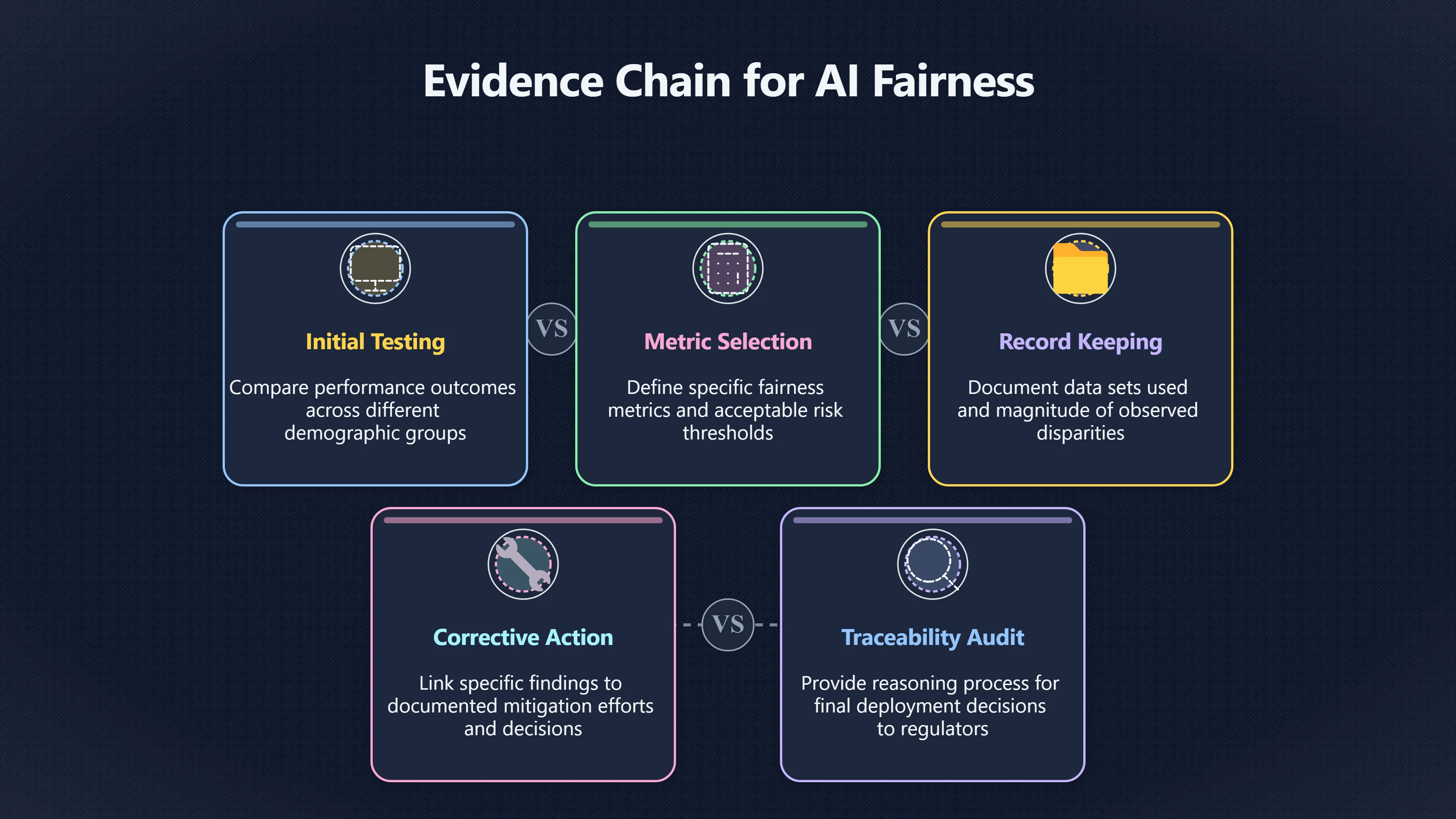
Evidence becomes stronger when testing is documented rather than performed informally. Useful records typically include:
- Which groups were examined.
- Which fairness metrics were used.
- The datasets used for evaluation.
- The magnitude of observed disparities.
- Decisions about acceptable risk thresholds.
- Corrective actions taken after findings.
This documentation creates traceability. If concerns arise later, organisations can show not only the final result but also the reasoning process behind deployment decisions. That traceability is a central feature of modern AI management and risk frameworks.[ISO+2PromptArmor]iso.orgISO/IEC 42001:2023 - AI management systems…
Subgroup Performance Reviews and Impact Assessments
One of the most important forms of bias evidence is subgroup testing. Rather than reporting a single overall accuracy figure, evaluators examine how the system performs for different populations.
A model might achieve excellent overall results while performing substantially worse for a smaller group. For example, a hiring system could appear highly accurate across all applicants while disproportionately rejecting candidates from particular demographic categories. Looking only at aggregate performance can hide these disparities.
Fairness assessments therefore ask questions such as:
- Does the model make more errors for one group than another?
- Are approval or rejection rates substantially different?
- Do recommendations vary systematically across populations?
- Are some groups exposed to higher levels of risk or harm?
Medical AI guidance increasingly treats fairness as a measurable property that must be evaluated through explicit testing procedures rather than discussed only as an abstract ethical principle. In this approach, fairness is assessed through performance comparisons across relevant subgroups and documented evaluation protocols.[PMC]pmc.ncbi.nlm.nih.govFebruary 25, 2026…
Impact assessments add another layer of evidence. Instead of focusing solely on statistical outcomes, they examine who could be affected, how harms might occur, and which populations are most vulnerable. An impact assessment can reveal that a seemingly small performance gap may have large real-world consequences when decisions affect employment opportunities, healthcare access, or financial services. This helps organisations prioritise mitigation efforts where potential harm is greatest.[ISO]iso.orgISO/IEC 42001:2023 - AI management systems…
A Concrete Example: Hiring Audits
Employment screening systems provide one of the clearest examples of bias testing becoming formal evidence.
New York City’s Local Law 144 requires certain automated employment decision tools to undergo independent bias audits before use. Organisations must publish summaries of audit results and provide notice to candidates. The audits evaluate whether the tool creates disparate impacts across protected groups using defined measurement approaches.[Deloitte]www2.deloitte.comNYC Local Law 144-21 and Algorithmic Bias | Deloitte USNYC Local Law 144-21 and Algorithmic Bias | Deloitte US…
The significance of this requirement is not that it guarantees fairness. Researchers studying the law have identified limitations, ambiguities, and implementation challenges. However, the law illustrates an important governance principle: fairness claims are expected to be backed by documented testing rather than vendor assurances alone.[arXiv]arxiv.orgarXiv Auditing Work: Exploring the New York City algorithmic bias audit regimeAuditing Work: Exploring the New York City algorithmic bias audit regimeFebruary 12, 2024…
In other words, the audit report becomes evidence that testing occurred, what was measured, and what outcomes were observed.
How Monitoring Catches Bias After Deployment
Bias testing does not end when a model is released. Real-world conditions change, user populations evolve, and data distributions shift over time. A system that appears fair during development may develop disparities after deployment.
For this reason, many AI governance frameworks treat monitoring as an ongoing responsibility. Testing before deployment provides a snapshot. Monitoring provides a continuous stream of evidence about whether fairness is being maintained.[Modulos Docs]docs.modulos.aiModulos DocsNIST AI RMF Measure Function — Categories, Subcategories, and Operationalization | Modulos Docs…
Post-deployment monitoring may include:
- Tracking performance metrics across demographic groups.
- Detecting model drift that changes outcomes over time.
- Investigating complaints or appeals.
- Reviewing unexpected patterns in decisions.
- Re-running fairness evaluations after major updates.
These activities create a feedback loop. New findings can trigger retraining, revised policies, additional human review, or changes to data collection practices. Evidence therefore becomes cumulative rather than static. A mature governance process can show not only what was tested before launch but also how fairness has been monitored and improved over months or years.[gaicc.org+2ISO Library]gaicc.orgGAICC ISOIEC 42001 Internal Auditor 2GAICC ISO/IEC 42001 Internal Auditor…
The importance of ongoing monitoring is increasingly recognised in management standards such as ISO/IEC 42001, which emphasises performance evaluation, measurement, corrective actions, audits, and continual improvement within AI management systems.[ISO]iso.orgISO/IEC 42001:2023 - AI management systems…
What Strong Fairness Evidence Looks Like
Not all bias testing provides the same level of confidence. Strong evidence usually combines multiple forms of verification rather than relying on a single metric or one-time assessment.
Characteristics of stronger evidence include:
- Repeatability: Tests can be run again and produce comparable results.
- Transparency: Methods, assumptions, and metrics are documented.
- Coverage: Multiple groups and relevant harm scenarios are examined.
- Independent review: Findings can be assessed by auditors, regulators, or external experts.
- Corrective action records: Problems are linked to mitigation efforts.
- Ongoing monitoring: Fairness is tracked after deployment.
Weak evidence, by contrast, often relies on broad statements such as “the model was checked for bias” without explaining how, when, or with what results.
The central lesson of modern AI governance is that fairness is not demonstrated through intentions. It is demonstrated through records, measurements, audits, reviews, and monitoring. Bias testing becomes real evidence when it allows others to verify what was examined, what risks were discovered, and how those risks were addressed. In that sense, testing is not merely a technical exercise; it is the mechanism that turns a fairness promise into an accountable safeguard.[NIST+2Modulos Docs]nist.govartificial intelligence risk management framework ai rmf 10Artificial Intelligence Risk Management Framework (AI RMF 1.0) | NISTJanuary 26, 2023…

Amazon book picks
Further Reading
Books and field guides related to What Counts as Evidence That AI Is Fair?. Use these as the next step if you want deeper reading beyond the article.
Fairness and Machine Learning
Focused specifically on measuring and evaluating fairness in machine learning.
Weapons of Math Destruction
Explains how algorithmic systems create measurable unfair outcomes and why testing matters.
Algorithms of Oppression
Shows how biased outcomes emerge and why evidence-based scrutiny is needed.
eBay marketplace picks
Marketplace Samples
Example marketplace items related to this page. Use the search link to explore similar finds on eBay.




Endnotes
1.
Source: nist.gov
Title: artificial intelligence risk management framework ai rmf 10
Link:https://www.nist.gov/publications/artificial-intelligence-risk-management-framework-ai-rmf-10
Source snippet
Artificial Intelligence Risk Management Framework (AI RMF 1.0) | NISTJanuary 26, 2023...
Published: January 26, 2023
2.
Source: docs.modulos.ai
Link:https://docs.modulos.ai/frameworks/nist-ai-rmf/measure
Source snippet
Modulos DocsNIST AI RMF Measure Function — Categories, Subcategories, and Operationalization | Modulos Docs...
3.
Source: iso.org
Link:https://www.iso.org/ru/standard/42001
Source snippet
ISO/IEC 42001:2023 - AI management systems...
4.
Source: promptarmor.com
Title: Prompt Armor NIST AI RMF
Link:https://www.promptarmor.com/nist-ai-rmf
5.
Source: iso-library.com
Link:https://iso-library.com/standard/42001
Source snippet
ISO LibraryISO 42001: Artificial Intelligence Management Systems - ISO Library...
6.
Source: www2.deloitte.com
Title: NYC Local Law 144-21 and Algorithmic Bias | Deloitte US
Link:https://www2.deloitte.com/us/en/pages/audit/articles/nyc-local-law-144-algorithmic-bias.html
Source snippet
NYC Local Law 144-21 and Algorithmic Bias | Deloitte US...
7.
Source: arxiv.org
Title: arXiv Auditing Work: Exploring the New York City algorithmic bias audit regime
Link:https://arxiv.org/abs/2402.08101
Source snippet
Auditing Work: Exploring the New York City algorithmic bias audit regimeFebruary 12, 2024...
Published: February 12, 2024
8.
Source: gaicc.org
Title: GAICC ISOIEC 42001 Internal Auditor 2
Link:https://gaicc.org/wp-content/uploads/2026/05/GAICC-ISOIEC-42001-Internal-Auditor-2.pdf
Source snippet
GAICC ISO/IEC 42001 Internal Auditor...
9.
Source: iso.org
Link:https://www.iso.org/standard/81230.html?browse=ics
Source snippet
www.iso.orgISO/IEC 42001:2023 - AI management systemsDecember 18, 2023...
Published: December 18, 2023
10.
Source: pmc.ncbi.nlm.nih.gov
Link:https://pmc.ncbi.nlm.nih.gov/articles/PMC12984829/
Source snippet
February 25, 2026...
Published: February 25, 2026
11.
Source: Wikipedia
Title: IEC 42001
Link:https://en.wikipedia.org/wiki/ISO/IEC_42001
Source snippet
ISO/IEC 42001...
Additional References
12.
Source: reuters.com
Link:https://www.reuters.com/legal/legalindustry/stepping-into-ai-void-employment-why-state-ai-rules-now-matter-more-than-federal–pracin-2025-10-24/
Source snippet
is rapidly evolving to address the use of AI in hiring, particularly due to a lack of comprehensive federal [oversight]({{ 'oversight/' | relative_url }}). Companies employin...
13.
Source: link.springer.com
Link:https://link.springer.com/article/10.1007/s43681-024-00518-2
Source snippet
Springer LinkBringing practical statistical science to AI and predictive model fairness testing | AI and Ethics | Springer Nature Link...
14.
Source: sciencedirect.com
Link:https://www.sciencedirect.com/science/article/pii/S0950584926000649
Source snippet
www.sciencedirect.comMeta-Fair: AI-assisted fairness testing of large language models - ScienceDirectJune 1, 2026...
Published: June 1, 2026
15.
Source: youtube.com
Title: AI Bias Testing and Mitigation: How to Choose the Right Open Source Tools
Link:https://www.youtube.com/watch?v=dwGFrHPp4OE
Source snippet
Techniques to Identify and Measure Bias | Exclusive Lesson...
16.
Source: reddit.com
Title: how to prepare for an iso 42001 stage 1 audit
Link:https://www.reddit.com/r/ISOConsultants/comments/1scm4ey/how_to_prepare_for_an_iso_42001_stage_1_audit/
Source snippet
to Prepare for an ISO 42001 Stage 1 AuditApril 4, 2026...
Published: April 4, 2026
17.
Source: youtube.com
Title: AI Bias Testing for Beginners: Where to Start?
Link:https://www.youtube.com/watch?v=OSktzOhRc54
Source snippet
AI Bias Testing and Mitigation: How to Choose the Right Open Source Tools...
18.
Source: youtube.com
Title: Techniques to Identify and Measure Bias | Exclusive Lesson
Link:https://www.youtube.com/watch?v=M__GRpvMyGY
Source snippet
How Do AI Fairness Metrics Address Bias?...
19.
Source: youtube.com
Title: How Do AI Fairness Metrics Address Bias?
Link:https://www.youtube.com/watch?v=VfCWogGdz9A
Source snippet
What Are Different Types Of AI Fairness Metrics?...
20.
Source: blog.dciconsult.com
Title: NY C Local Law 144: Choose Your Auditor Wisely
Link:https://blog.dciconsult.com/nyc-ll-144-auditor
21.
Source: youtube.com
Title: What Are Different Types Of AI Fairness Metrics?
Link:https://www.youtube.com/watch?v=nTLshopuwUw
Topic Tree