Within Attention maps
How Can You Check If an Attention Explanation Is Real?
Comparing attention with gradients, ablations, and counterfactual tests can reveal whether an interpretation holds up.
On this page
- Gradient based attribution checks
- Ablation and counterfactual testing
- Combining evidence from multiple methods
Page outline Jump by section
Introduction
Attention maps can be useful for understanding what an artificial intelligence model appears to focus on, but the crucial question is whether that focus genuinely influenced the model’s decision. Research on attention mechanisms has shown that visually convincing attention patterns can sometimes be unrelated to the features that actually drive a prediction. As a result, a trustworthy attention-based explanation is not one that merely looks plausible; it is one that survives independent tests of importance, causality, and consistency. Researchers increasingly evaluate attention explanations by comparing them with gradient-based attribution methods, performing ablation experiments, and creating counterfactual scenarios that test whether changing the highlighted inputs changes the model’s behaviour.[ACL Anthology]aclanthology.orgACL AnthologyAttention is not Explanationby S Jain · 2019 · Cited by 2359 — For example, learned attention weights are frequently uncorre…
 The practical lesson is straightforward: attention should be treated as a hypothesis about what matters, not as proof. The more independent methods that support the same conclusion, the more confidence we can have that an attention visualisation reflects something real about the model’s decision process.[ACL Anthology]aclanthology.org2020.acl main.385ACL AnthologyQuantifying Attention Flow in Transformersby S Abnar · 2020 · Cited by 1562 — We propose two methods for approximating the a…
Gradient-Based Attribution Checks
One of the most common ways to test an attention explanation is to compare it with gradient-based attribution methods. Gradients estimate how much a small change in an input feature would affect the model’s output. If attention truly identifies important information, then highly attended features should often overlap with features that gradients identify as influential.
This idea became central to the debate over attention explanations after researchers found that attention weights frequently showed weak correlation with gradient-based measures of feature importance across multiple natural-language-processing tasks. In other words, the model sometimes paid high attention to words that gradients suggested had little effect on the final prediction.[ACL Anthology]aclanthology.orgACL AnthologyAttention is not Explanationby S Jain · 2019 · Cited by 2359 — For example, learned attention weights are frequently uncorre…
When evaluating an attention map, several questions are useful:
- Do the most-attended tokens also receive high gradient-based importance scores?
- Are the same features identified by multiple attribution methods?
- Does the agreement persist across different examples rather than appearing only in selected cases?
Strong agreement does not prove that attention is a faithful explanation, but disagreement is often a warning sign that the attention visualisation may be highlighting a different aspect of the computation than the one actually driving the output.[ACL Anthology]aclanthology.orgACL AnthologyAttention is not Explanationby S Jain · 2019 · Cited by 2359 — For example, learned attention weights are frequently uncorre…
Looking Beyond Raw Attention
Transformer models add another complication because information becomes mixed across many layers. A token receiving attention in a later layer may already contain information gathered from several earlier tokens. To address this problem, researchers developed techniques such as attention rollout and attention flow, which attempt to trace information through the network rather than inspecting a single attention matrix in isolation. These methods have been shown to correlate more strongly with gradients and ablation-based importance measures than raw attention weights alone.[ACL Anthology]aclanthology.org2020.acl main.385ACL AnthologyQuantifying Attention Flow in Transformersby S Abnar · 2020 · Cited by 1562 — We propose two methods for approximating the a…
For verification purposes, this means that a trustworthy explanation should ideally remain meaningful when analysed through these more sophisticated tracing methods, not only through a single layer’s heat map.[ACL Anthology]aclanthology.org2020.acl main.385ACL AnthologyQuantifying Attention Flow in Transformersby S Abnar · 2020 · Cited by 1562 — We propose two methods for approximating the a…
What Happens If the Highlighted Input Is Removed?
A stronger test of trustworthiness is ablation. Instead of asking what the model appears to attend to, ablation asks what happens when the supposedly important information is removed, masked, or altered.
Imagine an attention map highlights a specific word as crucial to a sentiment-classification decision. If removing that word barely changes the prediction, the explanation becomes difficult to defend. Conversely, if the prediction changes substantially, the attention-based interpretation gains credibility.
Ablation testing focuses on causal impact rather than visual appearance. Researchers often regard it as a more direct way of measuring feature importance because it observes the consequences of removing information rather than inferring importance indirectly. Attention-flow research has used ablation-based measures as a benchmark when evaluating whether attention-derived explanations correspond to actual model behaviour.[ACL Anthology]aclanthology.org2020.acl main.385ACL AnthologyQuantifying Attention Flow in Transformersby S Abnar · 2020 · Cited by 1562 — We propose two methods for approximating the a…
Useful verification questions include:
- Does masking the highly attended feature change the prediction?
- Does performance drop when highlighted features are removed?
- Do supposedly unimportant features have little effect when removed?
When attention and ablation results point to the same inputs, confidence in the explanation increases. When they diverge sharply, the attention map may be misleading.[ACL Anthology]aclanthology.org2020.acl main.385ACL AnthologyQuantifying Attention Flow in Transformersby S Abnar · 2020 · Cited by 1562 — We propose two methods for approximating the a…
Can a Different Attention Pattern Produce the Same Answer?
Perhaps the most influential challenge to attention-based explanations comes from counterfactual testing.
The core idea is simple: if an attention map truly explains a prediction, then substantially changing the attention distribution should also change the prediction. If the model can produce essentially the same output while attending to entirely different features, the explanatory value of the original attention map becomes questionable.
Research has demonstrated that models can sometimes maintain nearly identical predictions even when attention distributions are radically altered. These “adversarial attention” or counterfactual attention patterns suggest that multiple, very different attention configurations can be compatible with the same outcome.[ACL Anthology]aclanthology.orgACL AnthologyAttention is not Explanationby S Jain · 2019 · Cited by 2359 — For example, learned attention weights are frequently uncorre…
This does not necessarily mean attention is useless. Rather, it means that attention may not provide a unique explanation. A trustworthy attention-based interpretation should be robust: changing the highlighted focus should lead to meaningful changes in the model’s behaviour. If alternative attention patterns can replace the original one without affecting the result, the explanation becomes much less convincing.[ACL Anthology]aclanthology.orgACL AnthologyAttention is not Explanationby S Jain · 2019 · Cited by 2561 — original attention weights do not provide unique explanation…
A Practical Counterfactual Mindset
When examining an attention visualisation, it helps to ask:
- What would happen if the highlighted feature were absent?
- Could another feature receive the attention instead?
- Would the prediction remain essentially unchanged?
These questions move the analysis from description (“the model looked here”) to causal testing (“the model needed this information”). The second question is generally more important for explanation.[ACL Anthology]aclanthology.orgACL AnthologyAttention is not Explanationby S Jain · 2019 · Cited by 2359 — For example, learned attention weights are frequently uncorre…
Why Multiple Methods Matter More Than Any Single Visualisation
A growing consensus in explainable AI is that no single explanation method should be trusted in isolation. Attention maps, gradients, perturbation tests, and counterfactual analyses each capture different aspects of model behaviour. Their value increases when they converge on the same conclusion.
This perspective emerged partly from the debate between researchers who argued that attention is not a reliable explanation and others who argued that its usefulness depends on how explanations are defined and evaluated. Even among scholars who defend some interpretive value for attention, there is broad agreement that attention alone is insufficient evidence.[ACL Anthology]aclanthology.orgWe challenge many of the assumptions underlying this work.Read moreACL AnthologyAttention is not not Explanationby S Wiegreffe · 2019 · Cited by 1639 — A recent paper claims that 'Attention is not Explana…
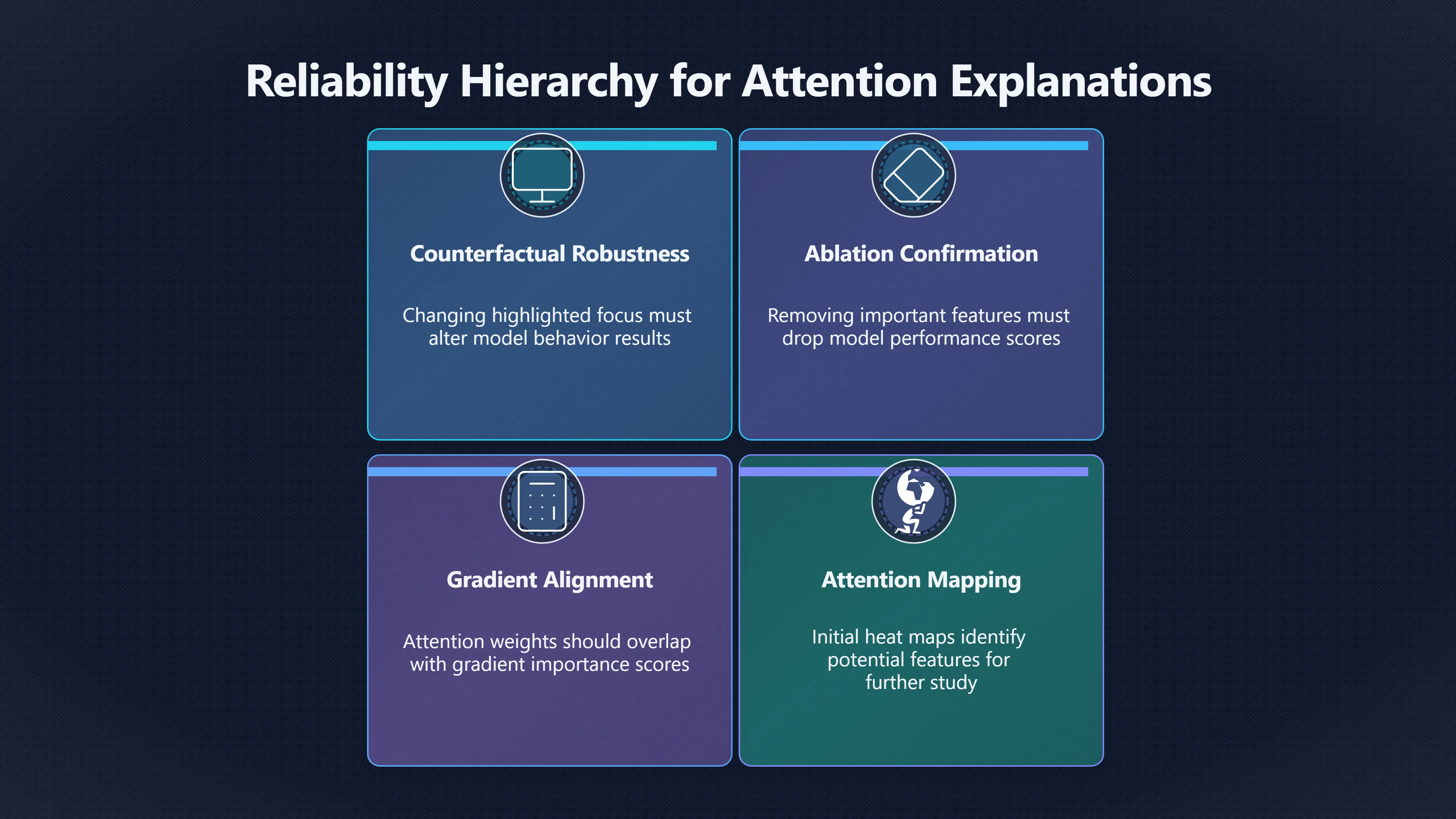
A practical reliability hierarchy often looks like this:
- Attention map identifies important features.
- Gradient methods highlight the same features.
- Ablation confirms those features affect the prediction.
- Counterfactual tests show that changing attention changes behaviour.
As more of these checks agree, confidence in the explanation grows. If only the attention map supports the claim while other methods disagree, the interpretation should be treated cautiously.[ACL Anthology+2ACL Anthology]aclanthology.orgACL AnthologyAttention is not Explanationby S Jain · 2019 · Cited by 2359 — For example, learned attention weights are frequently uncorre…

What Counts as a Trustworthy Attention Explanation?
An attention-based explanation is most trustworthy when it satisfies three conditions simultaneously:
- Consistency: it aligns with independent attribution methods such as gradients.
- Causal relevance: removing the highlighted information changes the model’s behaviour.
- Counterfactual robustness: substantially different attention patterns do not produce the same explanation equally well.
Attention visualisations can still be valuable for debugging models, generating hypotheses, and exploring how information flows through a network. However, the strongest evidence comes from explanations that survive verification from multiple directions. In modern AI interpretability research, trust is earned not by a colourful heat map, but by repeated agreement across independent tests of what truly influences a model’s decisions.[ACL Anthology+2ACL Anthology]aclanthology.org2020.acl main.385ACL AnthologyQuantifying Attention Flow in Transformersby S Abnar · 2020 · Cited by 1562 — We propose two methods for approximating the a…
Amazon book picks
Further Reading
Books and field guides related to How Can You Check If an Attention Explanation Is Real?. Use these as the next step if you want deeper reading beyond the article.
Hands-On Large Language Models
Explains transformers, attention, interpretability, and analysis techniques.
The Hundred-page Machine Learning Book
Provides foundational context for understanding attribution and model behavior.
Designing Machine Learning Systems
Discusses evaluation, robustness, and validating ML behavior.
Interpretable Machine Learning
Directly covers attribution methods, model explanations, and validation of explanations.
eBay marketplace picks
Marketplace Samples
Example marketplace items related to this page. Use the search link to explore similar finds on eBay.




Endnotes
1.
Source: aclanthology.org
Link:https://aclanthology.org/N19-1357/
Source snippet
ACL AnthologyAttention is not Explanationby S Jain · 2019 · Cited by 2359 — For example, learned attention weights are frequently uncorre...
2.
Source: aclanthology.org
Title: 2020.acl main.385
Link:https://aclanthology.org/2020.acl-main.385/
Source snippet
ACL AnthologyQuantifying Attention Flow in Transformersby S Abnar · 2020 · Cited by 1562 — We propose two methods for approximating the a...
3.
Source: aclanthology.org
Title: We challenge many of the assumptions underlying this work.Read more
Link:https://aclanthology.org/D19-1002/
Source snippet
ACL AnthologyAttention is not not Explanationby S Wiegreffe · 2019 · Cited by 1639 — A recent paper claims that 'Attention is not Explana...
4.
Source: aclanthology.org
Link:https://aclanthology.org/N19-1357.pdf
Source snippet
ACL AnthologyAttention is not Explanationby S Jain · 2019 · Cited by 2561 — original attention weights do not provide unique explanation...
5.
Source: scribd.com
Title: 2020 acl main 385
Link:https://www.scribd.com/document/913571062/2020-acl-main-385
Source snippet
2020 Acl-Main 385 | PDF | Applied MathematicsQuantifying Attention Flow in Transformers. Samira Abnar Willem Zuidema. ILLC, University of...
6.
Source: github.com
Link:https://github.com/sarahwie/attention
Source snippet
Code for EMNLP 2019 paper "Attention is not...We've based our repository on the code provided by Sarthak Jain & Byron Wallace for their...
7.
Source: aclanthology.org
Link:https://aclanthology.org/D19-1002.pdf
Source snippet
2019) points to possible pitfalls that may cause re- searchers to misapply attention scores as explana- tions of model...Rea...
Additional References
8.
Source: medium.com
Link:https://medium.com/%40yuvalpinter/attention-is-not-not-explanation-dbc25b534017
Source snippet
Attention is not not ExplanationAlternative (or counterfactual) attention weight configurations ought to yield corresponding changes in p...
9.
Source: pure.uva.nl
Link:https://pure.uva.nl/ws/files/178487922/2020.acl-main.385.pdf
Source snippet
uva.nlUvA-DARE (Digital Academic Repository)We propose two methods for approximating the attention to in- put tokens given attention weig...
10.
Source: reddit.com
Link:https://www.reddit.com/r/MachineLearning/comments/1003d7w/discussion_is_attention_an_explanation/
Source snippet
[Discussion] is attention an explanation?: r/MachineLearningCan we use attention weights from causal models, as explanations or causal a...
11.
Source: semanticscholar.org
Link:https://www.semanticscholar.org/paper/Attention-is-not-Explanation-Jain-Wallace/1e83c20def5c84efa6d4a0d80aa3159f55cb9c3f
Source snippet
[PDF] Attention is not ExplanationThis paper disputes the claim that attention weights do not correlate with measures of feature importan...
12.
Source: semanticscholar.org
Link:https://www.semanticscholar.org/paper/Quantifying-Attention-Flow-in-Transformers-Abnar-Zuidema/76a9f336481b39515d6cea2920696f11fb686451
Source snippet
[PDF] Quantifying Attention Flow in TransformersThis paper proposes two methods for approximating the attention to input tokens given att...
13.
Source: scribd.com
Link:https://www.scribd.com/document/539572843/1902-10186
Source snippet
It argues that attention weights are often presented as explanations for model predictions...Read more...
14.
Source: arxiv.org
Title: arXiv Attention is not Explanation
Link:https://arxiv.org/abs/1902.10186
Source snippet
[1902.10186] Attention is not Explanationby S Jain · 2019 · Cited by 2499 — Our findings show that standard attention modules do not prov...
15.
Source: researchgate.net
Link:https://www.researchgate.net/publication/336999161_Attention_is_not_not_Explanation
Source snippet
Jain and Wallace [6] argued that attention weights should not automatically be...Read more...
16.
Source: researchgate.net
Link:https://www.researchgate.net/publication/331396991_Attention_is_not_Explanation
Source snippet
However, attention does not always equal causal importance (Jain & Wallace, 2019).Read more...
17.
Source: researchgate.net
Title: 341148976 Quantifying Attention Flow in Transformers
Link:https://www.researchgate.net/publication/341148976_Quantifying_Attention_Flow_in_Transformers
Source snippet
(PDF) Quantifying Attention Flow in Transformers8 May 2020 — To understand how attention is aggregated through the network, we used atten...
Published: May 2020
Topic Tree