Within Face Matches
Why False Matches Do Not Fall Evenly
NIST findings help explain why false facial recognition matches can expose minority groups to unequal police scrutiny.
On this page
- What NIST found about demographic differences
- Why one to many searches raise civil liberties risks
- How error rates should shape evidence rules
Page outline Jump by section
Introduction
Facial recognition systems do not make mistakes evenly across all groups. One of the most influential findings in this area came from the US National Institute of Standards and Technology (NIST), which tested hundreds of commercial facial recognition algorithms and found that many produced significantly different false-positive rates across demographic groups. These findings matter because a false positive in a police investigation can place an innocent person on a suspect list, potentially leading to questioning, surveillance, detention, or prosecution. When facial recognition is used as a one-to-many search tool, demographic differences in error rates can translate into unequal exposure to police scrutiny. This is one reason why facial recognition matches should be treated as investigative leads that require independent verification rather than as proof of identity.[NIST]nist.govFacial Recognition Technology (Part III): Ensuring Commercial Transparency & Accuracy | NISTJanuary 15, 2020…

What NIST Found About Demographic Differences
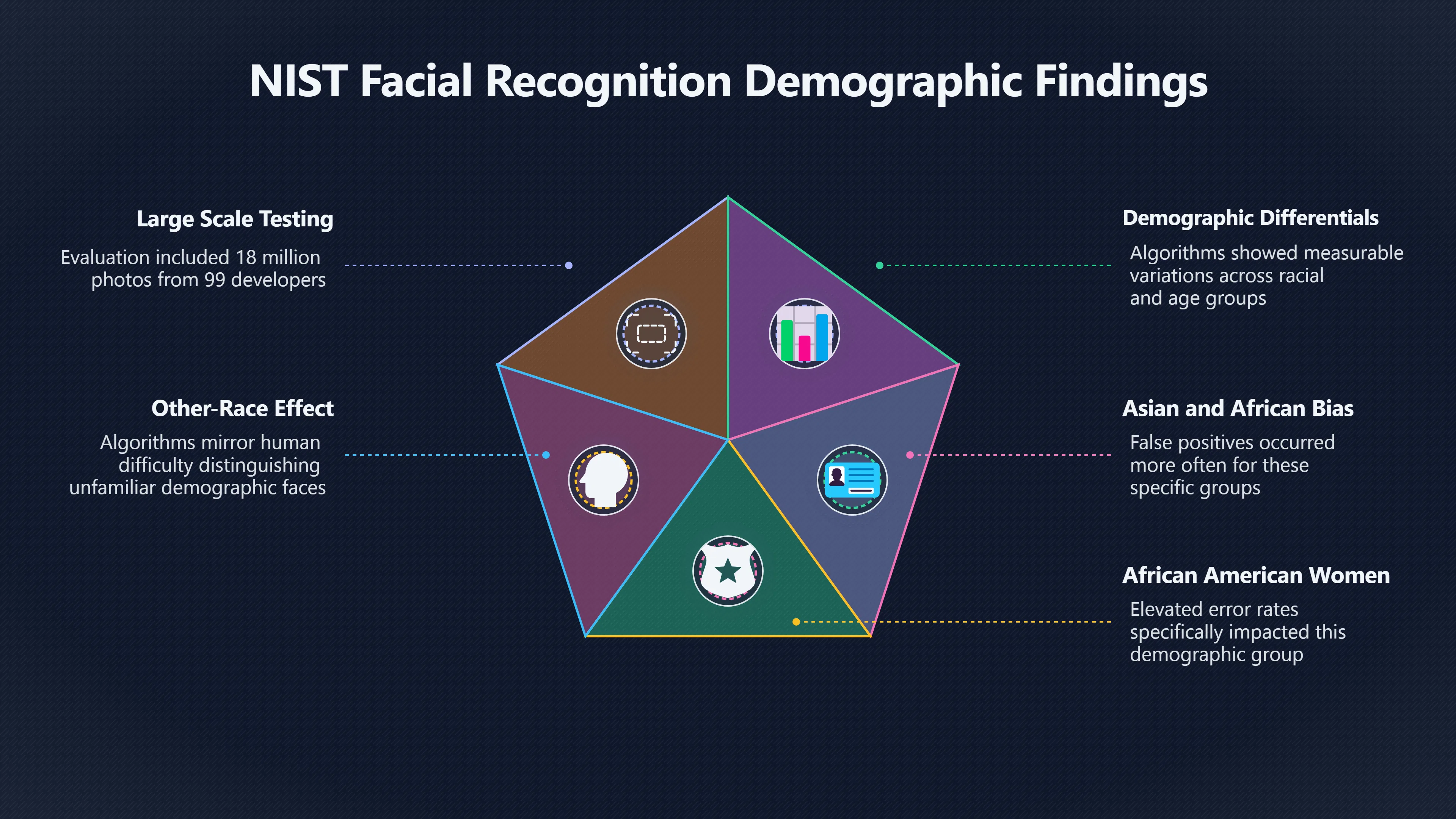
In 2019, NIST released a major demographic-effects study based on 189 facial recognition algorithms from 99 developers. The evaluation used more than 18 million photographs representing over 8 million individuals, making it one of the largest examinations of facial recognition performance ever conducted.[NIST]nist.govFacial Recognition Technology (Part III): Ensuring Commercial Transparency & Accuracy | NISTJanuary 15, 2020…
The central finding was not that every system behaved the same way. Instead, NIST found wide variation across algorithms, with many exhibiting measurable demographic differentials in false-match rates. Some systems generated substantially more false positives for particular racial, ethnic, age, or sex groups than for others.[NIST]nist.govFacial Recognition Technology (Part III): Ensuring Commercial Transparency & Accuracy | NISTJanuary 15, 2020…
Among the most widely cited results were findings that many algorithms produced false positives far more often for people of Asian and African descent than for White individuals in certain test settings. NIST reported that some algorithms showed false-positive rates that were dramatically higher for these groups, with the magnitude reaching orders of magnitude in particular cases. The agency also highlighted elevated false-positive rates for African American women in several systems, noting that such errors are especially important because they can result in false accusations.[EPIC]archive.epic.orgnist study finds extensive bias in Face Surveillance TechnologyDecember 20, 2019…
NIST’s work also showed that demographic effects are not limited to race. Error rates can vary by age and sex, and the size and direction of those differences depend on the algorithm, the image quality, and the operational setting. More accurate algorithms generally showed smaller demographic disparities, but demographic variation remained a significant issue across much of the industry at the time of testing.[NIST Pages]pages.nist.govPages Face Recognition Technology Evaluation (FRTE) 1:1 VerificationNIST PagesFace Recognition Technology Evaluation (FRTE) 1:1 VerificationMay 8, 2026…
Why These Findings Were Important
Before the NIST study, discussions about facial recognition bias often relied on smaller academic datasets or isolated examples. NIST provided a large-scale benchmark using operational image collections and a broad sample of commercial systems. The study demonstrated that demographic disparities were not confined to a few poorly performing products but appeared across many algorithms tested.[NIST]nist.govFacial Recognition Technology (Part III): Ensuring Commercial Transparency & Accuracy | NISTJanuary 15, 2020…
The findings also reinforced earlier research showing an “other-race effect” in facial recognition systems. Just as humans may find it harder to distinguish faces from unfamiliar demographic groups, algorithms can show different performance depending on the populations represented in training data and evaluation datasets.[NIST]nist.govother race effect face recognition algorithmsAn Other-Race Effect for Face Recognition Algorithms | NISTAugust 19, 2009…

Why One-to-Many Searches Raise Civil-Liberties Risks
The demographic findings become especially significant in one-to-many identification searches. In this setting, an unknown image—perhaps taken from surveillance footage—is compared against a large database containing thousands or millions of known individuals. The system returns candidate matches ranked by similarity.[NIST]nist.govFacial Recognition Technology (Part III): Ensuring Commercial Transparency & Accuracy | NISTJanuary 15, 2020…
A false positive in a one-to-one verification system may simply reject or incorrectly verify a transaction. In a one-to-many police search, however, a false positive can place a real person into an investigation. The practical question is not whether the system eventually identifies the correct person, but whether innocent people are disproportionately pulled into the investigative process.[NIST]nist.govFacial Recognition Technology (Part III): Ensuring Commercial Transparency & Accuracy | NISTJanuary 15, 2020…
This creates a civil-liberties concern. If a demographic group experiences a higher false-positive rate, members of that group may be more likely to appear in candidate lists generated by facial recognition systems. Even when investigators later discover the error, the burden of scrutiny is not distributed equally. The result can be unequal exposure to police attention without any difference in actual wrongdoing.[NIST]nist.govFacial Recognition Technology (Part III): Ensuring Commercial Transparency & Accuracy | NISTJanuary 15, 2020…
Public reporting and court cases involving wrongful facial-recognition identifications have intensified these concerns. Critics argue that defendants often struggle to challenge algorithmic matches if the technology’s role is not fully disclosed, making demographic error patterns especially important when facial recognition contributes to investigative decisions.[Reddit]reddit.comPolice seldom disclose use of facial recognition despite false arrests | A Post investigation found that many defendants were unawa…
How Error Rates Should Shape Evidence Rules
NIST’s findings do not imply that facial recognition is unusable. They show that performance varies and that error rates must be understood in context. The policy question is therefore not whether a facial recognition match should ever be used, but how much weight it should carry.[NIST]nist.govFacial Recognition Technology (Part III): Ensuring Commercial Transparency & Accuracy | NISTJanuary 15, 2020…
One implication is that a facial recognition result should not be treated as a standalone identification. When demographic differences in false-positive rates exist, investigators need additional evidence to determine whether a candidate produced by the system is actually connected to the event under investigation. Independent evidence can either corroborate the algorithm’s suggestion or reveal that the match is mistaken.
Several practical safeguards follow from this principle:
- Treat facial recognition outputs as investigative leads rather than proof of identity.
- Require human review by trained examiners who understand the system’s limitations.
- Document confidence levels, thresholds, and search procedures.
- Seek corroborating evidence before arrest, charging, or prosecution decisions.
- Regularly evaluate deployed systems for demographic performance differences rather than relying solely on overall accuracy figures.[NIST]nist.govFacial Recognition Technology (Part III): Ensuring Commercial Transparency & Accuracy | NISTJanuary 15, 2020…
A key lesson from NIST’s demographic research is that average accuracy can hide unequal risks. A system may perform well overall while still generating disproportionately high false-positive rates for certain groups. For criminal investigations, where the consequences of a mistaken match can be severe, those unequal risks provide a strong reason to require independent evidence before a facial recognition match is treated as reliable identification.[NIST Pages+2NIST]pages.nist.govPages Face Recognition Technology Evaluation (FRTE) 1:1 VerificationNIST PagesFace Recognition Technology Evaluation (FRTE) 1:1 VerificationMay 8, 2026…

Amazon book picks
Further Reading
Books and field guides related to Why False Matches Do Not Fall Evenly. Use these as the next step if you want deeper reading beyond the article.
Your Face Belongs to Us
Covers facial recognition errors, demographics and public risks.
Race After Technology
Examines unequal technological impacts across demographic groups.
Algorithms of Oppression
Explores discriminatory algorithmic outcomes and measurement issues.
eBay marketplace picks
Marketplace Samples
Example marketplace items related to this page. Use the search link to explore similar finds on eBay.



Endnotes
1.
Source: nist.gov
Link:https://www.nist.gov/node/1605531
Source snippet
Facial Recognition Technology (Part III): Ensuring Commercial Transparency & Accuracy | NISTJanuary 15, 2020...
Published: January 15, 2020
2.
Source: nist.gov
Title: Face Projects | NIST
Link:https://www.nist.gov/node/427816
Source snippet
Face Projects | NIST...
3.
Source: archive.epic.org
Title: nist study finds extensive bia
Link:https://archive.epic.org/2019/12/nist-study-finds-extensive-bia.html
Source snippet
s in Face Surveillance TechnologyDecember 20, 2019...
Published: December 20, 2019
4.
Source: pages.nist.gov
Title: Pages Face Recognition Technology Evaluation (FRTE) 1:1 Verification
Link:https://pages.nist.gov/frvt/html/frvt11.html
Source snippet
NIST PagesFace Recognition Technology Evaluation (FRTE) 1:1 VerificationMay 8, 2026...
Published: May 8, 2026
5.
Source: nist.gov
Title: other race effect face recognition algorithms
Link:https://www.nist.gov/publications/other-race-effect-face-recognition-algorithms
Source snippet
An Other-Race Effect for Face Recognition Algorithms | NISTAugust 19, 2009...
Published: August 19, 2009
6.
Source: reddit.com
Link:https://www.reddit.com/r/technology/comments/1fxxmju
Source snippet
Police seldom disclose use of facial recognition despite false arrests | A Post investigation found that many defendants were unawa...
7.
Source: pages.nist.gov
Title: cloudwalk mt 007
Link:https://pages.nist.gov/frvt/reportcards/11/cloudwalk_mt_007.html
Source snippet
March 27, 2024...
Published: March 27, 2024
8.
Source: reddit.com
Link:https://www.reddit.com/r/Futurology/comments/ed1afi
Source snippet
Recognition producing massive errors when analyzing non-white personsDecember 19, 2019...
Published: December 19, 2019
Additional References
9.
Source: biometricsinstitute.org
Title: www.biometricsinstitute.org NIS T top 10 takeaways – demographic differences
Link:https://www.biometricsinstitute.org/nist-top-10-demographic-differences/
Source snippet
top 10 takeaways – demographic differences - Biometrics InstituteMarch 28, 2022...
Published: March 28, 2022
10.
Source: youtube.com
Title: AI for the Fair-Minded: Bias in AI in Under 9 Minutes
Link:https://www.youtube.com/watch?v=dfYwjBpxg3c
Source snippet
HDIAC Webinars - Facial Recognition Performance and... - YouTube HDIAC Webinars - Facial Recognition Performance and... - YouTube...
11.
Source: youtube.com
Link:https://www.youtube.com/watch?v=8z9zfIp_n0U
Source snippet
HDIAC Webinars - Facial Recognition Performance and Its Measurement...
12.
Source: youtube.com
Title: HDIAC Webinars
Link:https://www.youtube.com/watch?v=kEvIUpla54k
Source snippet
AI for the Fair-Minded: Bias in AI in Under 9 Minutes...
13.
Source: arxiv.org
Title: Towards Fair Face Verification: An In-depth Analysis of Demographic Biases
Link:https://arxiv.org/abs/2307.10011
Source snippet
July 19, 2023...
Published: July 19, 2023
14.
Source: youtube.com
Title: EP5: Face Recognition Technology (FRT)
Link:https://www.youtube.com/watch?v=EphUW_jY0Lg
Source snippet
2024 The Future of NIST Technical Evaluations of Biometric Technologies...
Topic Tree