Within Speech cues
Why Robust Speech Systems Still Break Down
Recognition accuracy can drop sharply when systems encounter noise, channels or environments unlike those seen during training.
On this page
- Extreme noise and reverberation
- Domain shifts and specialised environments
- Limits of learned invariance
Page outline Jump by section
Introduction
Modern speech-recognition systems can understand voices in conditions that would have defeated earlier software, yet they still have a fundamental weakness: they learn robustness from examples rather than acquiring a human-like understanding of sound. When the acoustic conditions encountered during deployment differ substantially from those represented during training, recognition accuracy can deteriorate rapidly. Researchers refer to this as a mismatch or domain-shift problem, and it remains one of the most persistent limitations of speech AI.[White Rose Research Online]eprints.whiterose.ac.ukWhite Rose Research OnlineAn analysis of environment, microphone and data…by E Vincent · 2017 · Cited by 476 — Adapting an automatic s…
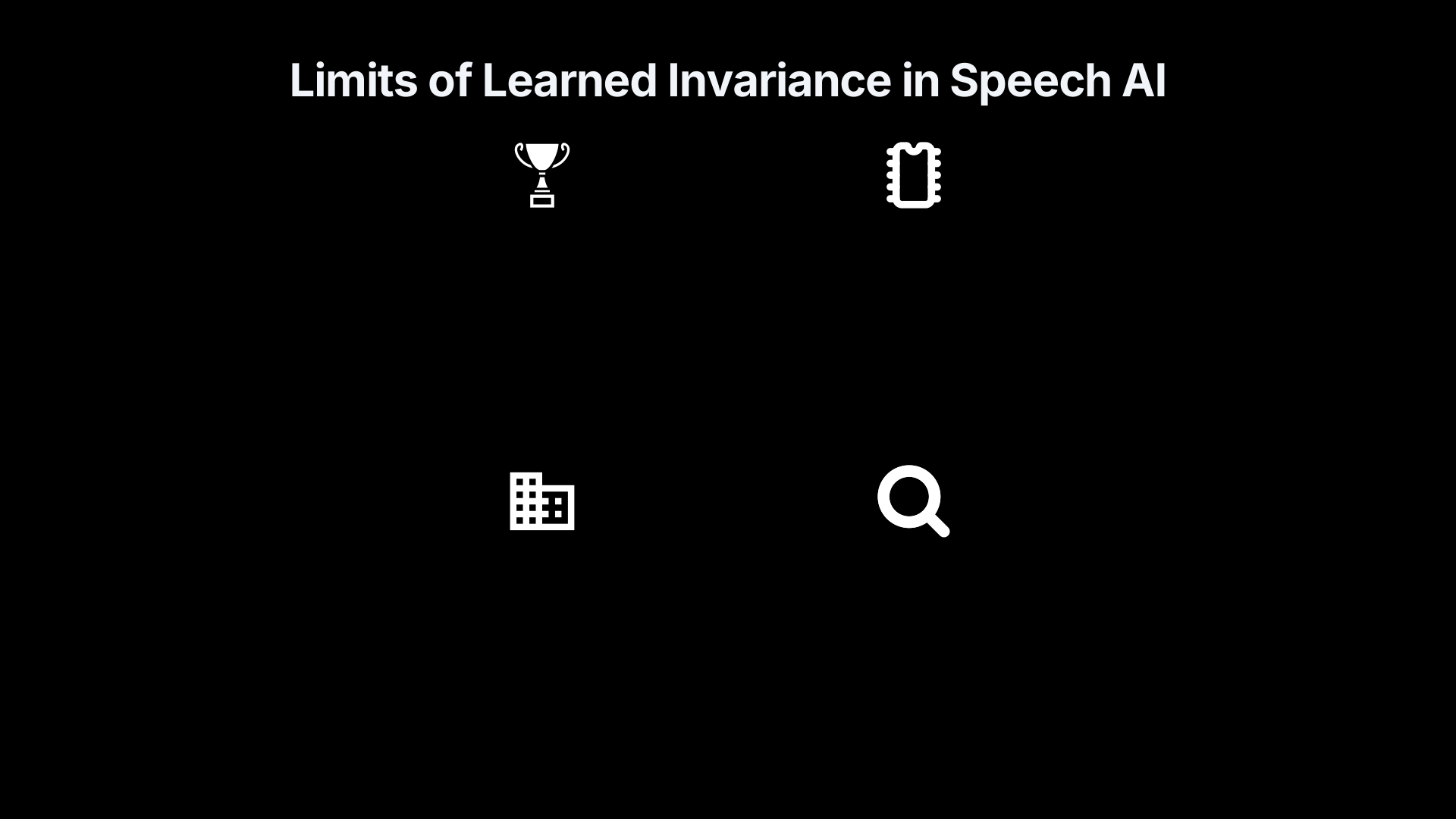 This matters because real-world speech is rarely recorded under ideal conditions. A system trained mainly on close-range microphones may later face distant microphones in echoing rooms. A model exposed to office noise may be deployed in factories, vehicles or crowded public spaces. Even highly capable neural networks can struggle when noise, reverberation, recording hardware or speaking conditions fall outside their learned experience.[Microsoft+2Nature]microsoft.comAn Overview of Noise-Robust Automatic Speech RecognitionModel-Domain Compensation: The acoustic mismatch between training and te…
Extreme Noise and Reverberation
The most obvious failures occur when speech becomes difficult to separate from the acoustic environment. Background sounds can mask important speech cues, while reverberation causes reflections that smear sounds across time. Instead of hearing a clean sequence of phonemes, the model receives overlapping and distorted information.
Research programmes such as the CHiME and REVERB challenges were created specifically because everyday environments expose speech systems to these conditions. Home environments, meeting rooms and distant-microphone recordings introduce competing sounds, echoes and signal degradation that remain difficult even for advanced models.[CHiME Challenges and Workshops+2ResearchGate]chimechallenge.orgCHi ME Challenges and WorkshopsCHiME Challenges and WorkshopsIntroduction | CHiME Challenges and WorkshopsA speech recognition system designed to operate in a family ho…
A particularly difficult situation arises when several adverse conditions occur simultaneously. A model may tolerate moderate noise or moderate reverberation separately, yet fail when both are present together. Studies on noisy-reverberant speech have repeatedly shown that combined distortions are harder to compensate for than either factor alone because each interferes with different parts of the speech signal.[PMC]pmc.ncbi.nlm.nih.govTwo-stage Deep Learning for Noisy-reverberant Speech…by Y Zhao · 2018 · Cited by 133 — We propose a two-stage strategy to enhance c…
Far-field speech recognition illustrates the problem clearly. A speaker standing several metres from a microphone produces a weaker signal, more room reflections and greater interference from other sounds. Recognition systems trained primarily on close-talk recordings often suffer significant performance losses when moved to these distant settings.[Cool Papers+2chimechallenge.github.io]papers.coolCool PapersINTERSPEECH.2017 - Speech RecognitionRecognition of distant (far-field) speech is a challenge for ASR due to mismatch in recor…
Domain Shifts and Specialised Environments
Not all failures involve loud noise. Sometimes the environment is acoustically different in subtler ways.
A speech model trained on one collection of recordings develops expectations about microphones, rooms, compression methods and speaker behaviour. When deployed elsewhere, those assumptions may no longer hold. Researchers studying speech adaptation frequently describe this as a domain mismatch between training and testing conditions.[PMC+2Spoken Language Systems Group]pmc.ncbi.nlm.nih.govDomain Adaptation with Augmented Data by Deep Neural…by R Nahar · 2022 · Cited by 10 — This paper explains research about fine-tuni…
Examples include:
- Call-centre systems deployed on mobile-phone recordings.
- Consumer voice assistants used in cars.
- Medical transcription systems exposed to specialised equipment noise.
- Meeting-transcription systems operating in large reverberant conference rooms.
- Speech systems trained on one accent population and used with another.[videostrong.com+2Springer]videostrong.comfar field speech recognition technologyIntroduction Application of Far-field Speech Recognition…11 Feb 2023 — This applications involves complex acoustic conditions, with ch…
Even when speech remains intelligible to humans, these shifts can alter the statistical patterns that the model relies upon. Research on unseen-domain speech recognition consistently finds that transcription quality degrades when audio originates from environments not represented during training.[arXiv]arxiv.orgUnsupervised domain adaptation for speech recognition with unsupervised error correctionSeptember 24, 2022…
Specialised environments create additional challenges because they combine unusual acoustics with vocabulary and speaking styles that differ from general-purpose training data. Industrial sites, emergency-response settings, aircraft cockpits and scientific laboratories often contain acoustic characteristics that standard consumer speech datasets barely represent. The resulting mismatch compounds recognition errors.[AIMultiple]aimultiple.comspeech recognition challengesTop 7 Speech Recognition Challenges & Solutions3 Mar 2026 — Key questions include its accuracy in noisy settings, ability to ha…
Why Learned Invariance Has Limits
Deep speech networks are often described as learning invariant representations. They attempt to represent what was said while ignoring irrelevant variations in how it sounded. This ability is real, but it is not unlimited.
A model can only learn invariance across the range of variation it encounters during training. If examples include many speakers, microphones and noise conditions, the system may generalise well across similar situations. However, genuinely novel acoustic conditions can fall outside the boundaries of those learned representations.[Spoken Language Systems Group]sls.csail.mit.eduThe performance of automatic speech recognition (ASR) systems can be significantly compromised by previously unseen conditions.Read more…
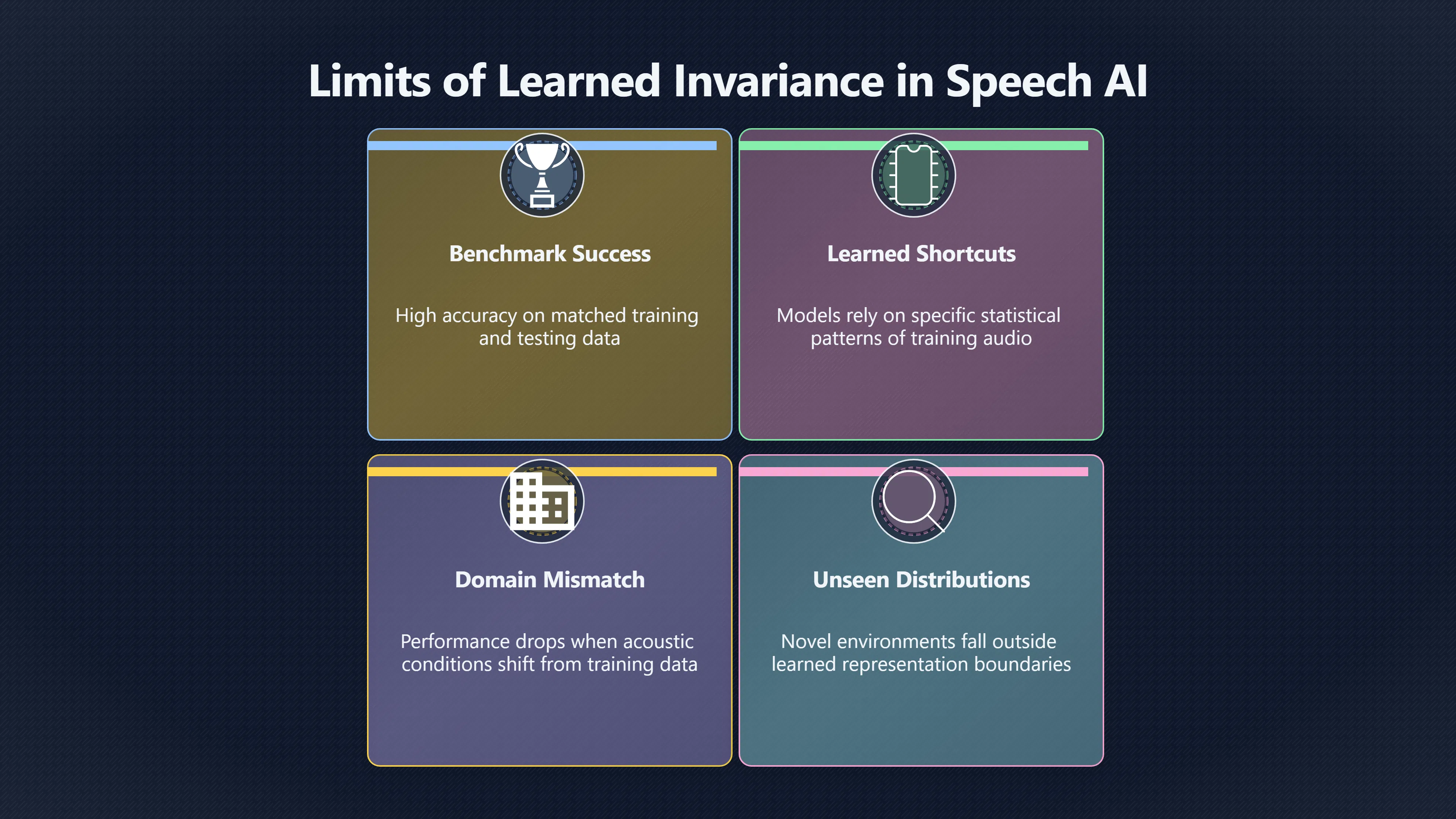
This limitation explains an important misconception about modern AI. Strong performance on benchmark datasets does not necessarily imply robustness in every environment. Many evaluations use matched or partially matched conditions in which testing data resemble training data. When researchers deliberately introduce unseen microphones, new environments or different noise profiles, performance often declines.[White Rose Research Online]eprints.whiterose.ac.ukWhite Rose Research OnlineAn analysis of environment, microphone and data…by E Vincent · 2017 · Cited by 476 — Adapting an automatic s…
The problem resembles image-recognition failures under distribution shift. Speech systems do not merely recognise words; they recognise words embedded within particular acoustic distributions. When those distributions change sufficiently, learned shortcuts and assumptions become unreliable.[arXiv]arxiv.orgAnalysis of Domain Shift across ASR Architectures via TTS-Enabled Separation of Target Domain and Acoustic ConditionsAugust 13, 2025…
Overlapping Voices: A Persistent Weak Spot
One failure mode is especially difficult: multiple people speaking at the same time.
Human listeners can often focus attention on a target speaker in a noisy room, a phenomenon sometimes called the cocktail-party effect. Speech-recognition systems have improved substantially at speaker separation, yet overlapping speech remains a major source of errors. CHiME challenge organisers and related research repeatedly identify overlap as a central obstacle in realistic conversational environments.[arXiv+2ISCA Archive]arxiv.orgCHiME-7 DASR descriptionby S Cornell · 2023 · Cited by 101 — Besides difficulties due to noise and reverberation in far-field speech…
The challenge is not simply noise removal. Overlapping speech contains competing linguistic information from different speakers. The system must determine who spoke, separate simultaneous voices and recognise the words correctly. Errors at any stage can propagate through the rest of the recognition pipeline.[arXiv]arxiv.orgCHiME-7 DASR descriptionby S Cornell · 2023 · Cited by 101 — Besides difficulties due to noise and reverberation in far-field speech…
As speech interfaces increasingly move into meetings, homes and collaborative workplaces, this failure mode becomes more important because real conversations frequently involve interruptions and simultaneous speech.
How Researchers Try to Reduce These Failures
Most modern robustness strategies attempt to expose models to greater diversity before deployment.
Common approaches include:
- Training with artificially added noise and reverberation.
- Using recordings from many microphone types and environments.
- Fine-tuning models on target-domain audio. * Learning domain-invariant representations.[researchgate.net]researchgate.netWhat are the key… * Combining speech enhancement with recognition.[chimechallenge.org]chimechallenge.orgCHi ME Challenges and WorkshopsCHiME Challenges and WorkshopsIntroduction | CHiME Challenges and WorkshopsA speech recognition system designed to operate in a family ho…
- Using large-scale self-supervised pretraining on diverse audio collections.[Springer+3ResearchGate+3PMC]researchgate.netRobust speech recognition in unknown reverberant and…The experimental evidence suggests that it is effective to add noise…
These methods improve average performance, but none completely eliminates the domain-shift problem. Recent work on cross-domain speech adaptation continues to treat robustness as an open research challenge, particularly when multiple mismatches—such as noise, reverberation and recording-channel changes—occur simultaneously.[arXiv]arxiv.orgUniversal Robust Speech Adaptation for Cross-Domain…Mar 1, 2026 — Pre-trained models for automatic speech recognition (ASR) and s…
What These Failures Reveal About Speech AI
The persistence of unfamiliar-condition failures highlights a broader lesson about artificial intelligence. Speech models are remarkably effective pattern learners, but their robustness is strongly tied to the diversity and representativeness of their training experience.
As conditions move further away from those experiences, performance can drop unexpectedly. Extreme noise, reverberant rooms, distant microphones, overlapping speakers and specialised environments all expose the boundaries of learned invariance. Understanding those boundaries is essential for evaluating speech AI realistically: high accuracy in familiar settings does not guarantee dependable behaviour in every acoustic world the system may encounter.[White Rose Research Online+2Nature]eprints.whiterose.ac.ukWhite Rose Research OnlineAn analysis of environment, microphone and data…by E Vincent · 2017 · Cited by 476 — Adapting an automatic s…
Amazon book picks
Further Reading
Books and field guides related to Why Robust Speech Systems Still Break Down. Use these as the next step if you want deeper reading beyond the article.
Speech and Language Processing: Pearson New International Edi...
Addresses speech recognition limitations, noise, and domain shifts.
Deep Learning
Rating: 3.5/5 from 6 Google Books ratings
Provides context for generalisation limits and distribution shift.
Hands-on Machine Learning with Scikit-Learn, Keras, and Tenso...
Discusses practical issues when models encounter unfamiliar data.
Fundamentals of Speech Recognition
Explains why recognition systems fail in difficult acoustic conditions.
Endnotes
1.
Source: microsoft.com
Link:https://www.microsoft.com/en-us/research/wp-content/uploads/2016/02/double_column.pdf
Source snippet
An Overview of Noise-Robust Automatic Speech RecognitionModel-Domain Compensation: The acoustic mismatch between training and te...
2.
Source: nature.com
Link:https://www.nature.com/nature-index/topics/l3/speech-recognition
Source snippet
Nature Index Speech RecognitionRobustness to background noise, far-field microphones and [accents]({{ 'accents/' | relative_url }}) remains a central challenge, driving res...
3.
Source: papers.cool
Link:https://papers.cool/venue/INTERSPEECH.2017?group=Speech+Recognition
Source snippet
Cool PapersINTERSPEECH.2017 - Speech RecognitionRecognition of distant (far-field) speech is a challenge for ASR due to mismatch in recor...
4.
Source: chimechallenge.org
Title: CHi ME Challenges and Workshops
Link:https://www.chimechallenge.org/challenges/chime1/introduction
Source snippet
CHiME Challenges and WorkshopsIntroduction | CHiME Challenges and WorkshopsA speech recognition system designed to operate in a family ho...
5.
Source: researchgate.net
Link:https://www.researchgate.net/publication/320733239_The_CHiME_Challenges_Robust_Speech_Recognition_in_Everyday_Environments
Source snippet
Robust Speech Recognition in Everyday EnvironmentsThe CHiME challenge series has been aiming to advance the development of robust automat...
6.
Source: link.springer.com
Link:https://link.springer.com/article/10.1186/s13634
Source snippet
for distant speech recognitionin reverberant...by M Delcroix · 2015 · Cited by 80 — The task of the REVERB challenge involves reverberan...
7.
Source: pmc.ncbi.nlm.nih.gov
Link:https://pmc.ncbi.nlm.nih.gov/articles/PMC6519714/
Source snippet
Two-stage [Deep Learning]({{ 'deep-learning/' | relative_url }}) for Noisy-reverberant Speech...by Y Zhao · 2018 · Cited by 133 — We propose a two-stage strategy to enhance c...
8.
Source: chimechallenge.github.io
Link:https://chimechallenge.github.io/chime6/overview.html
Source snippet
Task Overview | CHiME-6 ChallengeCHiME-6 targets the problem of distant microphone conversational speech recognition in everyday home env...
9.
Source: isca-archive.org
Link:https://www.isca-archive.org/interspeech_2018/barker18_interspeech.pdf
Source snippet
CHiME Challenge, which considers the task of distant multi- microphone conversational ASR in real home environments. Speech...Read more...
10.
Source: pmc.ncbi.nlm.nih.gov
Link:https://pmc.ncbi.nlm.nih.gov/articles/PMC9782479/
Source snippet
Domain Adaptation with Augmented Data by Deep Neural...by R Nahar · 2022 · Cited by 10 — This paper explains research about fine-tuni...
11.
Source: videostrong.com
Title: far field speech recognition technology
Link:https://www.videostrong.com/news-show/far-field-speech-recognition-technology
Source snippet
Introduction Application of Far-field Speech Recognition...11 Feb 2023 — This applications involves complex acoustic conditions, with ch...
12.
Source: link.springer.com
Link:https://link.springer.com/article/10.1186/s13636-025-00435-0
Source snippet
Accent-robust speech recognition for English in low-resource...by T Banerjee · 2025 — In our work, our primary objective was to...
13.
Source: arxiv.org
Link:https://arxiv.org/pdf/2306.13734
Source snippet
CHiME-7 DASR descriptionby S Cornell · 2023 · Cited by 101 — Besides difficulties due to noise and reverberation in far-field speech...
14.
Source: arxiv.org
Link:https://arxiv.org/abs/2209.12043
Source snippet
Unsupervised domain adaptation for speech recognition with unsupervised error correctionSeptember 24, 2022...
Published: September 24, 2022
15.
Source: aimultiple.com
Title: speech recognition challenges
Link:https://aimultiple.com/speech-recognition-challenges
Source snippet
Top 7 Speech Recognition Challenges & Solutions3 Mar 2026 — Key questions include its accuracy in noisy settings, ability to ha...
16.
Source: arxiv.org
Link:https://arxiv.org/abs/2508.09868
Source snippet
Analysis of Domain Shift across ASR Architectures via TTS-Enabled Separation of Target Domain and Acoustic ConditionsAugust 13, 2025...
Published: August 13, 2025
17.
Source: researchgate.net
Link:https://www.researchgate.net/publication/304407308_Robust_speech_recognition_in_unknown_reverberant_and_noisy_conditions
Source snippet
Robust speech recognition in unknown reverberant and...The experimental evidence suggests that it is effective to add noise...
18.
Source: link.springer.com
Link:https://link.springer.com/article/10.1186/s13636-026-00451-8
Source snippet
[speed]({{ 'speed/' | relative_url }}) perturbation plus SpecAugment be outperformed...by D Mengke · 2026 — This paper introduces a time-domain augmentation method, Fade...
19.
Source: arxiv.org
Link:https://arxiv.org/html/2602.04307v2
Source snippet
Universal Robust Speech Adaptation for Cross-Domain...Mar 1, 2026 — Pre-trained models for automatic speech recognition (ASR) and s...
20.
Source: arxiv.org
Link:https://arxiv.org/html/2602.04307v1
Source snippet
Universal Robust Speech Adaptation for Cross-Domain...4 Feb 2026 — This study is motivated by the need for a unified framework that can...
21.
Source: arxiv.org
Link:https://arxiv.org/pdf/2104.10757
Source snippet
2104.10757v1 [eess.AS] 21 Apr 2021by Z Tang · 2021 · Cited by 6 — When creating a training set with a combination of all the AIRs c...
22.
Source: arxiv.org
Link:https://arxiv.org/html/2401.08887v1
Source snippet
NOTSOFAR-1 Challenge: New Datasets, Baseline, and...16 Jan 2024 — The challenge focuses on distant speaker diarization and automatic spe...
23.
Source: arxiv.org
Link:https://arxiv.org/pdf/2507.18161
Source snippet
The CHiME-7 and 8 distant speech recognition (DASR) challenges focus on multi-channel, generalizable, joint automatic speech recognition...
24.
Source: chimechallenge.org
Link:https://www.chimechallenge.org/challenges/chime4/software
Source snippet
Software | CHiME Challenges and WorkshopsWe provide three software baselines for acoustic simulation, speech enhancement, and ASR (used t...
25.
Source: chimechallenge.org
Link:https://www.chimechallenge.org/
Source snippet
Welcome | CHiME Challenges and WorkshopsWelcome to the home of the CHiME (Computational Hearing in Multisource Environments) challenges a...
26.
Source: chimechallenge.org
Link:https://www.chimechallenge.org/challenges/chime3/software
Source snippet
Software | CHiME Challenges and WorkshopsWe provide three software tools for acoustic simulation, speech enhancement, and ASR...
27.
Source: app.chime.com
Link:https://app.chime.com/login
Source snippet
chime.comChime: Member LoginLogin to your account or download the Chime mobile app...
28.
Source: isca-archive.org
Title: novitasari22 interspeech
Link:https://www.isca-archive.org/interspeech_2022/novitasari22_interspeech.pdf
Source snippet
VAD information in training RNN-T based ASR to improve the robustness of speech recognition in...Re...
29.
Source: isca-archive.org
Title: kolossa11 chime
Link:https://www.isca-archive.org/chime_2011/kolossa11_chime.html
Source snippet
CHiME challenge: approaches to robustness using...by D Kolossa · 2011 · Cited by 30 — This strategy allows the use of reverberation-inse...
30.
Source: researchgate.net
Link:https://www.researchgate.net/publication/259974780_The_REVERB_challenge_A_common_evaluation_framework_for_dereverberation_and_recognition_of_reverberant_speech
Source snippet
uses on speech enhancement and recognition in reverberant conditions [42].Read more...
31.
Source: researchgate.net
Link:https://www.researchgate.net/post/What_are_the_existing_research_gaps_in_the_domain_of_deep_learning-based_automatic_speech_recognition_for_low-resource_languages
Source snippet
What are the key...
32.
Source: eprints.whiterose.ac.uk
Link:https://eprints.whiterose.ac.uk/id/eprint/111196/
Source snippet
White Rose Research OnlineAn analysis of environment, microphone and data...by E Vincent · 2017 · Cited by 476 — Adapting an automatic s...
33.
Source: sls.csail.mit.edu
Link:https://sls.csail.mit.edu/publications/2018/Wei-NingHsu_ICASSP18.pdf
Source snippet
The performance of automatic speech recognition (ASR) systems can be significantly compromised by previously unseen conditions.Read more...
Additional References
34.
Source: semanticscholar.org
Link:https://www.semanticscholar.org/paper/Acoustic-Modeling-for-Overlapping-Speech-Jhu-System-Manohar-Chen/3efee0095cb578659dfaaf0d87a616f133ecf85c
Source snippet
Acoustic Modeling for Overlapping Speech RecognitionThis paper summarizes the acoustic modeling efforts in the Johns Hopkins University s...
35.
Source: academia.edu
Title: Generalization problem in ASR acoustic model training and adaptation
Link:https://www.academia.edu/25229182/Generalization_problem_in_ASR_acoustic_model_training_and_adaptation
Source snippet
Generalization problem in ASR acoustic model training...Oct 11, 2025 — Since speech is highly variable, even if we have a fairly large-s...
36.
Source: kclpure.kcl.ac.uk
Title: Towards Robust Waveform Based Acoustic Models 1 12
Link:https://kclpure.kcl.ac.uk/portal/files/172003272/Towards_Robust_Waveform_Based_Acoustic_Models_1_12.pdf
Source snippet
King's College LondonTowards Robust Waveform-Based Acoustic Modelsby D Oglic · 2022 · Cited by 6 — Abstract—We study the problem of learn...
37.
Source: k4all.org
Title: chime speech separation and recognition challenge
Link:https://k4all.org/project/chime-speech-separation-and-recognition-challenge/
Source snippet
CHiME – Speech Separation and Recognition Challenge1 Sept 2010 — The task is to separate the speech and recognise the commands being spok...
38.
Source: medium.com
Link:https://medium.com/%40jesus.cantu217/enhancing-speech-recognition-accuracy-with-data-augmentation-techniques-1debcb54628d
Source snippet
odels become more robust to different acoustic conditions...
39.
Source: sri.com
Link:https://www.sri.com/wp-content/uploads/2021/12/speech_recognition_in_unseen_and_noisy_channel_conditions.pdf
Source snippet
Speech recognition in Unseen and Noisy Channel Conditionsby V Mitra · Cited by 16 — In this work, we investigated techniques to cope w...
40.
Source: youtube.com
Title: Robust wav2vec 2.0: Analyzing Domain Shift in Self-Supervised Pre-Training
Link:https://www.youtube.com/watch?v=NhAF5EBDmkU
Source snippet
Distant microphone conversational ASR in domestic environments...
41.
Source: www-i6.informatik.rwth-aachen.de
Title: Keynote Jon Barker
Link:https://www-i6.informatik.rwth-aachen.de/web/Listen/PDFs/Keynote-Jon-Barker.pdf
Source snippet
WSJ sentences remixed into background noise. Page 21. LISTEN Workshop, Bonn, July 17-19, 2018.Read more...
42.
Source: dl.acm.org
Link:https://dl.acm.org/doi/10.1145/3773365.3773556
Source snippet
Status on Performance Degradation of Automatic...23 Dec 2025 — Automatic Speech Recognition (ASR) systems often face performance degrada...
43.
Source: youtube.com
Title: Distant Speech Recognition: No Black Boxes Allowed
Link:https://www.youtube.com/watch?v=M6aQ-yoc8_M
Source snippet
Blind Multi-Microphone Noise Reduction and Dereverberation Algorithms...
Topic Tree