Within AI Sense
What Counts as AI Today?
AI is easier to understand when it is seen as software that turns inputs into predictions, recommendations, content, or decisions.
On this page
- Predictions, recommendations, and decisions
- Why AI is not a machine mind
- How definitions shape public expectations

Page outline Jump by section
Introduction
AI is easiest to recognise by what it does: it takes inputs and produces outputs such as predictions, recommendations, content or decisions. That may sound ordinary, but it explains why AI appears in everyday software long before it looks like a chatbot, robot or science-fiction machine. A search engine ranks pages, a streaming service recommends a programme, a medical device estimates a health risk, and a bank may use a score to support a lending decision. In each case, the “AI” is not a mind inside the system. It is a machine-based process that infers from data, rules, prompts or other inputs how to generate an output that can affect a digital or physical environment.
This output-centred view is now built into major definitions. NIST describes AI as a machine-based system that can make predictions, recommendations or decisions for human-defined objectives, while the OECD and the EU AI Act use a broader formulation that includes predictions, content, recommendations and decisions. NIST Computer Security Resource Center+2OECD.AI[csrc.nist.gov]csrc.nist.govComputer Security Resource Centerartificial intelligenceComputer Security Resource Centerartificial intelligence
The practical definition: inputs become outputs
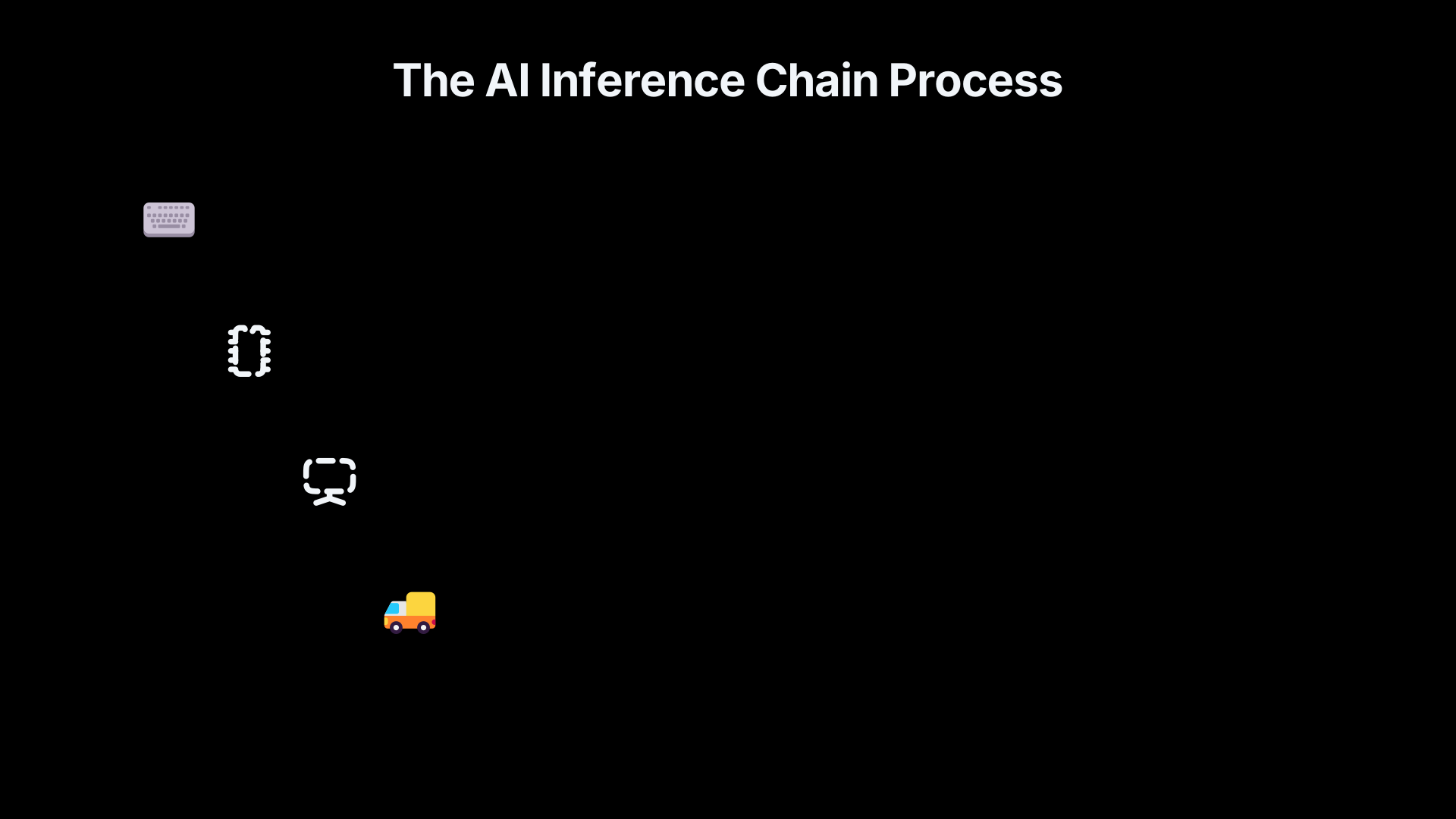
A useful definition of an AI system starts with a simple chain: input, inference, output and effect. The input might be a search query, an image, a credit record, a temperature reading, a user prompt, a click history or a set of rules. The system then infers how to produce an output: a label, score, ranking, generated paragraph, warning, route, recommendation or decision. The output matters because it can shape what a person sees, buys, believes, receives, is denied or is asked to do.
The OECD’s updated definition makes this chain explicit: an AI system is machine-based, works towards explicit or implicit objectives, infers from the input it receives, and generates outputs such as predictions, content, recommendations or decisions that can influence physical or virtual environments. It also stresses that AI systems vary in autonomy and in how much they adapt after deployment.[OECD.AI]oecd.aiWhat is AI? Can you make a clear distinction between AI and non-AI systems?What is AI? Can you make a clear distinction between AI and non-AI systems? The EU AI Act adopts a closely aligned definition, adding that an AI system may exhibit adaptiveness after deployment and may operate with varying levels of autonomy.[Artificial Intelligence Act]artificialintelligenceact.euOpen source on artificialintelligenceact.eu.
This is why “AI” is not limited to systems that talk like people. Many AI systems never produce a sentence. A fraud model may produce a risk score. A medical imaging tool may flag a suspicious lesion. A search ranking system may decide which pages appear first. A recommender system may choose the next video or product to show. The common feature is not conversation; it is machine-based inference that turns inputs into outputs.
The European Commission’s guidance on the AI Act puts special weight on outputs because they reveal both the function and the impact of a system. It identifies four broad output categories: predictions, content, recommendations and decisions. It also notes that deciding whether software counts as an AI system cannot be done through a single automatic list; the system’s architecture, functionality and role must be assessed in context.[AI Act Service Desk]ai-act-service-desk.ec.europa.euAI Act Service Desk
Predictions, recommendations and decisions
Many familiar AI systems are best understood by asking which kind of output they produce. The categories overlap in practice, but separating them helps explain what is happening and where responsibility sits.
Predictions estimate something not directly known from information the system has received. A spam filter predicts whether an email is unwanted. A weather-linked energy model may predict demand. A health device may estimate the probability of a heart attack. The FDA gives examples of AI and machine-learning medical technologies such as an imaging system that provides diagnostic information for skin cancer and a smart sensor device that estimates heart attack probability.[U.S. Food and Drug Administration]fda.govOpen source on fda.gov.
Predictions can look modest, but they often carry real consequences. A predicted risk may trigger extra checks, a warning, a referral, a price change or a refusal. The prediction itself is not always the final decision, yet it can strongly shape the decision path that follows. That is why the difference between “the AI predicted” and “the organisation decided” matters: the output may be statistical, but the consequences are social, legal and practical.
Recommendations suggest an action, item or next step. A recommendation system uses data to narrow down choices among many options, such as products, films, articles or services. NVIDIA describes recommender systems as machine-learning systems that use data to help predict, narrow down and find what people are looking for among a large number of options; they may use past purchases, searches, demographic information, clicks, likes and other interaction data.[NVIDIA]nvidia.comWhat is a Recommendation System? | Data Science | NVIDIA GlossaryWhat is a Recommendation System? | Data Science | NVIDIA Glossary
Recommendations are powerful because they shape attention. Google says its automated ranking systems look at many factors and signals across hundreds of billions of pages and other content to present relevant results quickly.[Google for Developers]developers.google.comOpen source on google.com. Search ranking is not usually framed by users as a dramatic AI decision, but it is one of the clearest everyday examples of software turning a query into an ordered output that affects what people see first.
Decisions go one step further: the system’s output may directly determine or trigger an outcome, sometimes with little human intervention. This can include approving a transaction, blocking an account action, routing a delivery, prioritising a case or denying access to a service. In lower-stakes settings, this may be useful automation. In higher-stakes settings, it raises harder questions about accuracy, appeal, explanation and human oversight.
The output categories are not sealed boxes. A generative AI chatbot may produce content by making many small predictive choices about likely next tokens. A recommender system may start with predictions about user interest and then produce a ranked list. A decision engine may combine a prediction with business rules before approving or rejecting an action. The reader-friendly point is that the label “AI” should prompt a practical question: what output is being generated, and what does that output change?
Why AI is not a machine mind
Calling an AI system “intelligent” can mislead people into imagining a machine that understands, intends or judges in a human way. Most real-world AI systems do not have beliefs, motives or awareness. They produce outputs by applying learned patterns, statistical associations, rules, optimisation methods or model-based inference to inputs. They may appear fluent or perceptive because their outputs are useful, but usefulness is not the same as understanding.
This matters most when the output sounds authoritative. A generated paragraph can be grammatically polished while still being wrong. A risk score can be numerically precise while resting on incomplete or biased data. A recommendation can feel personalised while mainly reflecting engagement targets, popularity signals or past behaviour. A decision can be automated while no person fully understands the model’s internal route to the result.
Modern definitions avoid the “machine mind” trap by defining AI systems functionally rather than psychologically. The OECD deliberately focuses on an “AI system” rather than trying to define intelligence itself, because a system is more tangible for policy and governance.[OECD.AI]oecd.aiWhat is AI? Can you make a clear distinction between AI and non-AI systems?What is AI? Can you make a clear distinction between AI and non-AI systems? The EU AI Act similarly focuses on machine-based systems, autonomy, adaptiveness, inputs, inference and outputs rather than consciousness or person-like reasoning.[Artificial Intelligence Act]artificialintelligenceact.euOpen source on artificialintelligenceact.eu.
The boundary with ordinary software is also important. A spreadsheet that calculates an average, a database that filters customers who bought a product last month, or a dashboard that displays sales trends is not automatically an AI system just because it processes data. The Commission’s guidance distinguishes basic data processing and descriptive analysis from systems that learn, reason or model in ways that generate AI-like outputs.[AI Act Service Desk]ai-act-service-desk.ec.europa.euAI Act Service Desk
This is the practical correction to hype. AI is not magic, but it is not “just any software” either. The key difference is that AI systems can infer patterns or generate outputs in ways that are less directly hand-coded than traditional fixed-rule systems. That can make them powerful in messy environments, but also harder to inspect, predict and contest.
Real-world outputs are often ordinary, not futuristic
The most common AI outputs are embedded in routine interactions. They decide which search result is prominent, which advert appears, which route is suggested, which support ticket is prioritised, which image is flagged, which product is recommended or which text is generated. The ordinariness is part of the point: AI often changes the texture of everyday decisions before it announces itself as AI.
Health care shows the output-centred definition clearly. The FDA says AI and machine-learning technologies can derive insights from large volumes of health-care data and are being used by medical device manufacturers to assist providers and improve patient care. Its examples include diagnostic information from imaging and probability estimates from sensor data.[U.S. Food and Drug Administration]fda.govOpen source on fda.gov. In these cases, the AI output is not a robot doctor. It is information offered inside a clinical workflow.
Online discovery is another clear example. Search ranking systems and recommender systems do not simply “find” information neutrally; they order, filter and prioritise. Google’s ranking documentation describes automated systems that use many signals to present useful results rapidly.[Google for Developers]developers.google.comOpen source on google.com. Recommender systems, meanwhile, learn from interactions such as impressions, clicks, likes and purchases to predict interests and personalise suggestions.[NVIDIA]nvidia.comWhat is a Recommendation System? | Data Science | NVIDIA GlossaryWhat is a Recommendation System? | Data Science | NVIDIA Glossary
Consumer and eligibility decisions show the higher-stakes version. Regulators have warned that automated tools used for credit, employment, insurance, housing or similar benefits can trigger legal duties, including notices and opportunities to correct inaccurate information.[Privacy Security Academy]privacysecurityacademy.comPrivacy Security Academy Using Artificial Intelligence and AlgorithmsPrivacy Security Academy Using Artificial Intelligence and Algorithms The important point is not whether a system looks sophisticated; it is whether its output affects a person’s access to money, work, housing, health care or other meaningful opportunities.
Definitions shape public expectations
Definitions are not just academic wording. They decide what organisations must inventory, test, explain, regulate or disclose. If “AI” is defined too narrowly, important systems may escape scrutiny because they do not look like chatbots or robots. If it is defined too broadly, ordinary software may be treated as if it carries AI-specific risks even when it only applies fixed instructions.
The EU’s formulation tries to draw the line around systems that infer how to generate outputs capable of influencing physical or virtual environments. Its guidance says the capacity to generate outputs is central to understanding both the functionality and the impact of an AI system.[AI Act Service Desk]ai-act-service-desk.ec.europa.euAI Act Service Desk It also states that most systems qualifying as AI systems under the definition will not automatically face regulatory obligations; the AI Act applies a risk-based approach, with stricter rules for higher-risk uses.[AI Act Service Desk]ai-act-service-desk.ec.europa.euAI Act Service Desk
NIST’s AI Risk Management Framework takes a similar practical stance by focusing on the risks AI systems create for individuals, organisations and society. NIST describes the framework as a voluntary tool intended to help incorporate trustworthiness into the design, development, use and evaluation of AI products, services and systems.[NIST]nist.govAI Risk Management Framework | NISTAI Risk Management Framework | NIST This reinforces a key point: once AI is understood through outputs and effects, governance becomes less about whether a system seems impressive and more about whether it is valid, reliable, explainable, safe, fair and accountable in its actual context.
Public expectations also change when content generation is included explicitly. Older definitions often highlighted predictions, recommendations and decisions. Newer definitions include “content” because generative systems can now produce text, images, video, music, code and other material at scale. The OECD’s revised definition added content as an output category, and the EU AI Act definition includes it alongside predictions, recommendations and decisions.[OECD.AI]oecd.aiWhat is AI? Can you make a clear distinction between AI and non-AI systems?What is AI? Can you make a clear distinction between AI and non-AI systems?
That change matters because content outputs influence people differently from scores or rankings. A generated answer can become a source of apparent knowledge. A synthetic image can become evidence in a viewer’s mind. Generated code can become part of a working product. The output may not be a “decision” in the narrow sense, but it can still shape decisions made by humans downstream.
A simple test for spotting AI in practice
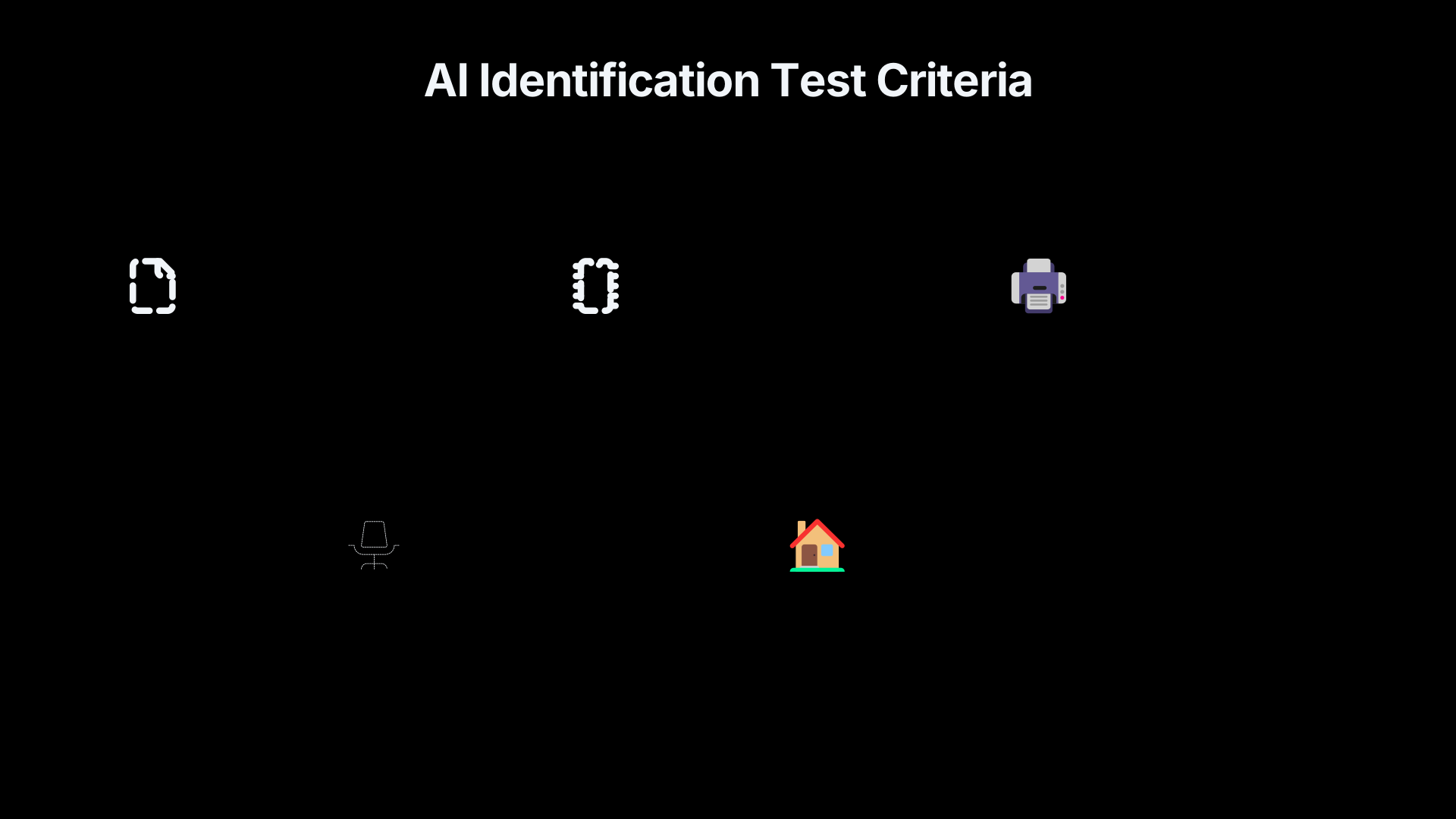
A practical way to identify AI is to ask five questions.
First, what goes in? Inputs may include user prompts, sensor data, documents, images, transaction records, clicks, ratings, rules or historical examples.
Second, what is inferred? The system may estimate a probability, classify an item, rank options, generate content, detect a pattern or select an action.
Third, what comes out? The output may be a prediction, recommendation, generated artefact or decision.
Fourth, who acts on the output? A human may use it as advice, a platform may use it to rank content, or another system may automatically trigger the next step.
Fifth, what changes because of it? The effect may be minor, such as a film suggestion, or serious, such as a clinical warning, fraud block, job-screening score or credit decision.
This test keeps attention on mechanism rather than mythology. It avoids treating AI as a machine mind, while still taking seriously the fact that AI outputs can influence behaviour, opportunity and safety. The most useful question is not “Is the software really intelligent?” but “What output does it generate, from which inputs, for which objective, and with what consequences?”
eBay marketplace picks
Marketplace Samples
Example marketplace items related to this page. Use the search link to explore similar finds on eBay.




Endnotes
1.
Source: csrc.nist.gov
Title: Computer Security Resource Centerartificial intelligence
Link:https://csrc.nist.gov/glossary/term/artificial_intelligence
2.
Source: oecd.ai
Title: What is AI? Can you make a clear distinction between AI and non-AI systems?
Link:https://oecd.ai/en/wonk/definition
3.
Source: ai-act-service-desk.ec.europa.eu
Title: AI Act Service Desk
Link:https://ai-act-service-desk.ec.europa.eu/sites/default/files/2025-08/commission_guidelines_on_the_definition_of_an_artificial_intelligence_system_established_by_regulation_eu_20241689_ai_actenglish_nf2skcqfrtjdfggjavcodopcwz4_112455.PDF
4.
Source: fda.gov
Link:https://www.fda.gov/medical-devices/software-medical-device-samd/artificial-intelligence-software-medical-device
5.
Source: nvidia.com
Title: What is a Recommendation System? | Data Science | NVIDIA Glossary
Link:https://www.nvidia.com/en-us/glossary/recommendation-system/
6.
Source: developers.google.com
Link:https://developers.google.com/search/docs/appearance/ranking-systems-guide
7.
Source: nist.gov
Title: AI Risk Management Framework | NIST
Link:https://www.nist.gov/itl/ai-risk-management-framework
8.
Source: nist.gov
Link:https://www.nist.gov/artificial-intelligence
9.
Source: airc.nist.gov
Link:https://airc.nist.gov/airmf-resources/airmf/0-ai-rmf-1-0/
10.
Source: nist.gov
Title: draft nist guidelines rethink cybersecurity ai era
Link:https://www.nist.gov/news-events/news/2025/12/draft-nist-guidelines-rethink-cybersecurity-ai-era
11.
Source: csrc.nist.gov
Link:https://csrc.nist.gov/glossary/term/AI
12.
Source: nist.gov
Link:https://www.nist.gov/document/artificial-intelligence-key-consideration-and-effective-implementation-strategies
13.
Source: nvlpubs.nist.gov
Title: ai.100 1
Link:https://nvlpubs.nist.gov/nistpubs/ai/nist.ai.100-1.pdf
14.
Source: oecd.org
Link:https://www.oecd.org/content/dam/oecd/en/publications/reports/2024/03/explanatory-memorandum-on-the-updated-oecd-definition-of-an-ai-system_3c815e51/623da898-en.pdf
15.
Source: legalinstruments.oecd.org
Title: oecd legal 0449
Link:https://legalinstruments.oecd.org/en/instruments/oecd-legal-0449
16.
Source: legalinstruments.oecd.org
Link:https://legalinstruments.oecd.org/public/doc/648/1df51f15-53fc-43ef-9f13-ee9f957076bc.htm
17.
Source: stip.oecd.org
Link:https://stip.oecd.org/stip/interactive-dashboards/policy-initiatives/2025%2Fdata%2FpolicyInitiatives%2F26839
18.
Source: oecd.org
Link:https://www.oecd.org/content/dam/oecd/en/publications/reports/2022/02/oecd-framework-for-the-classification-of-ai-systems_336a8b57/cb6d9eca-en.pdf
19.
Source: google.com
Link:https://www.google.com/intl/en_us/search/howsearchworks/how-search-works/ranking-results
20.
Source: fda.gov
Link:https://www.fda.gov/medical-devices/software-medical-device-samd/artificial-intelligence-enabled-medical-devices
21.
Source: oecd.ai
Link:https://oecd.ai/en/ai-principles
22.
Source: artificial-intelligence-act.com
Title: E U AI Act
Link:https://www.artificial-intelligence-act.com/
23.
Source: artificialintelligenceact.eu
Link:https://artificialintelligenceact.eu/article/3/
24.
Source: privacysecurityacademy.com
Title: Privacy Security Academy Using Artificial Intelligence and Algorithms
Link:https://www.privacysecurityacademy.com/wp-content/uploads/2021/08/01-FTC-Using-Artificial-Intelligence-and-Algorithms-blog-post-2020.pdf
25.
Source: Wikipedia
Title: Recommender system
Link:https://en.wikipedia.org/wiki/Recommender_system
26.
Source: ftc.gov
Link:https://www.ftc.gov/system/files/documents/public_statements/1564883/remarks_of_commissioner_rebecca_kelly_slaughter_on_algorithmic_and_economic_justice_01-24-2020.pdf
27.
Source: ftc.gov
Title: EEOC CRT FTC CFPB AI Joint Statement(final)
Link:https://www.ftc.gov/system/files/ftc_gov/pdf/EEOC-CRT-FTC-CFPB-AI-Joint-Statement%28final%29.pdf
28.
Source: ftc.gov
Title: ftc releases 2023 privacy data security update
Link:https://www.ftc.gov/news-events/news/press-releases/2024/03/ftc-releases-2023-privacy-data-security-update
29.
Source: ftc.gov
Title: ai companies uphold your privacy confidentiality commitments
Link:https://www.ftc.gov/policy/advocacy-research/tech-at-ftc/2024/01/ai-companies-uphold-your-privacy-confidentiality-commitments
30.
Source: ftc.gov
Title: 2024.03.21 PrivacyandDataSecurityUpdate 508
Link:https://www.ftc.gov/system/files/ftc_gov/pdf/2024.03.21-PrivacyandDataSecurityUpdate-508.pdf
31.
Source: artificialintelligenceact.eu
Link:https://artificialintelligenceact.eu/assessment/eu-ai-act-compliance-checker/
32.
Source: digital-strategy.ec.europa.eu
Title: eu A I Act | Shaping Europe’s digital future
Link:https://digital-strategy.ec.europa.eu/en/policies/regulatory-framework-ai
33.
Source: eur-lex.europa.eu
Title: rules for trustworthy artificial intelligence in the eu
Link:https://eur-lex.europa.eu/EN/legal-content/summary/rules-for-trustworthy-artificial-intelligence-in-the-eu.html
34.
Source: edps.europa.eu
Title: 2025 11 11 ai risks management guidance en
Link:https://www.edps.europa.eu/system/files/2025-11/2025-11-11_ai_risks_management_guidance_en.pdf
35.
Source: interoperable-europe.ec.europa.eu
Title: artificial intelligence rp2024
Link:https://interoperable-europe.ec.europa.eu/collection/rolling-plan-ict-standardisation/artificial-intelligence-rp2024
36.
Source: europarl.europa.eu
Link:https://www.europarl.europa.eu/RegData/etudes/STUD/2019/624261/EPRS_STU%282019%29624261_EN.pdf
37.
Source: blog.google
Title: how ai powers great search results
Link:https://blog.google/products-and-platforms/products/search/how-ai-powers-great-search-results/
38.
Source: privacysecurityacademy.com
Title: Using Artificial Intelligence and Algorithms Federal Trade Commission
Link:https://privacysecurityacademy.com/wp-content/uploads/2021/01/Using-Artificial-Intelligence-and-Algorithms-_-Federal-Trade-Commission.pdf
39.
Source: privacysecurityacademy.com
Link:https://www.privacysecurityacademy.com/wp-content/uploads/2022/09/EXCERPT-Biden-Blueprint-for-AI-Bill-of-Rights.pdf
40.
Source: digital.gov.au
Link:https://www.digital.gov.au/policy/ai/AI-technical-standard/technical-standard-governments-use-artificial-intelligence-key-terms
41.
Source: ojs.aaai.org
Link:https://ojs.aaai.org/index.php/aimagazine/article/view/18140
42.
Source: intelligence.dlapiper.com
Title: artificial intelligence
Link:https://intelligence.dlapiper.com/artificial-intelligence/?c=EU&t=04-definitions
43.
Source: mindgard.ai
Title: ai risk management framework
Link:https://mindgard.ai/blog/ai-risk-management-framework
44.
Source: digital.nsw.gov.au
Title: nsw.gov.ausimplified AI definitions from leading standards
Link:https://www.digital.nsw.gov.au/policy/artificial-intelligence/a-common-understanding-simplified-ai-definitions-from-leading
45.
Source: gdpr.blog.hu
Title: hu Deep dive into the AI Act
Link:https://gdpr.blog.hu/2024/06/10/deep_dive_into_the_ai_act_part_3_the_definition_of_ai_systems
Additional References
46.
Source: youtube.com
Title: How AI Systems Work: From Inputs to Outputs (With Examples) | AI Literacy Series
Link:https://www.youtube.com/watch?v=uE_ahBZ78RA
Source snippet
7 Stages of the AI System Lifecycle for AI Governance | AI Literacy Series...
47.
Source: youtube.com
Title: 7 Stages of the AI System Lifecycle for AI Governance | AI Literacy Series
Link:https://www.youtube.com/watch?v=IxzckDC784s
Source snippet
Understanding the European AI Act: Key Insights on New AI Regulations...
48.
Source: govinfo.gov
Link:https://www.govinfo.gov/app/details/GOVPUB-PREX23-PURL-gpo193638
49.
Source: youtube.com
Title: Understanding the European AI Act: Key Insights on New AI Regulations
Link:https://www.youtube.com/watch?v=PGyg1GFteHM
Source snippet
Developing a Classification of AI Systems...
50.
Source: youtube.com
Title: Developing a Classification of AI Systems
Link:https://www.youtube.com/watch?v=ZGuDK-vPes0
Source snippet
AI Governance Basics: Simple Explanation & Real-World Examples | AI Literacy Series...
51.
Source: medium.com
Link:https://medium.com/data-science/recommender-systems-a-complete-guide-to-machine-learning-models-96d3f94ea748
52.
Source: ketryx.com
Link:https://www.ketryx.com/blog/a-complete-guide-to-the-fdas-ai-ml-guidance-for-medical-devices
53.
Source: teradata.com
Link:https://www.teradata.com/insights/ai-and-machine-learning/ai-decision-making
54.
Source: medium.com
Link:https://medium.com/stacknova/ai-series-part-1-what-is-artificial-intelligence-880406121a36
55.
Source: abbacustechnologies.com
Link:https://www.abbacustechnologies.com/ai-decision-making/
Topic Tree
Follow this branch
Parent topic
AI SenseRelated pages 11
- AI Errors Why AI Can Be Confidently Wrong
- Business Adoption Why AI Pilots Often Stall
- Deep Learning Why Layers Changed AI
- Generative AI Why Generative AI Feels Different
- Language Models Why Chatbots Sound So Fluent
- Machine Learning How Machines Learn From Examples
- Narrow vs AGI Is Today’s AI Actually General?
- Responsible AI Who Is Responsible When AI Fails?
- +3 more in sidebar