Within Generative AI
Can AI Images Be Trusted?
Text-to-image and video tools lower the cost of making realistic scenes, which raises new questions about evidence, trust, and manipulation.
On this page
- From text prompts to realistic visual scenes
- Inpainting, variations, and video generation workflows
- Detection, disclosure, and evidence checks
Page outline Jump by section
Modern image-generation systems are trained on vast collections of images and associated text. When a user enters a prompt such as “a flooded city street at sunset” or “a politician speaking at a rally”, the model does not retrieve an existing photograph. Instead, it generates a new image by predicting visual patterns that match the prompt.
 The realism of these systems has improved rapidly. Earlier generations often produced distorted faces, unnatural hands, or obvious visual artefacts. Newer systems generate lighting, textures, reflections, camera angles, and facial details that can appear convincing at a glance. For many everyday viewers, identifying synthetic content through visual inspection alone has become increasingly unreliable.[NIST Publications]nvlpubs.nist.govAI.100 4NIST PublicationsReducing Risks Posed by Synthetic Contentby N AI · 2024 · Cited by 4 — Synthetic content detection may detect the existe…
This matters because photographs have long occupied a special place in public understanding. Images are often treated as direct records of reality rather than interpretations of it. When synthetic systems can produce a seemingly authentic image of an event that never happened, the evidential value of visual media becomes less certain. The result is not only a risk of false information spreading, but also a broader erosion of trust in genuine evidence.
A related concern is the so-called “liar’s dividend”. As synthetic media become more common, individuals confronted with authentic photographs or videos may claim that genuine evidence is AI-generated. In this way, the existence of deepfakes can undermine confidence in both fake and real material.[UNESCO]unesco.orgdeepfakes and crisis knowingDeepfakes and the crisis of knowing27 Oct 2025 — As deepfakes blur reality, education must go beyond detection, teaching students t…
How Video Generation Raises the Stakes
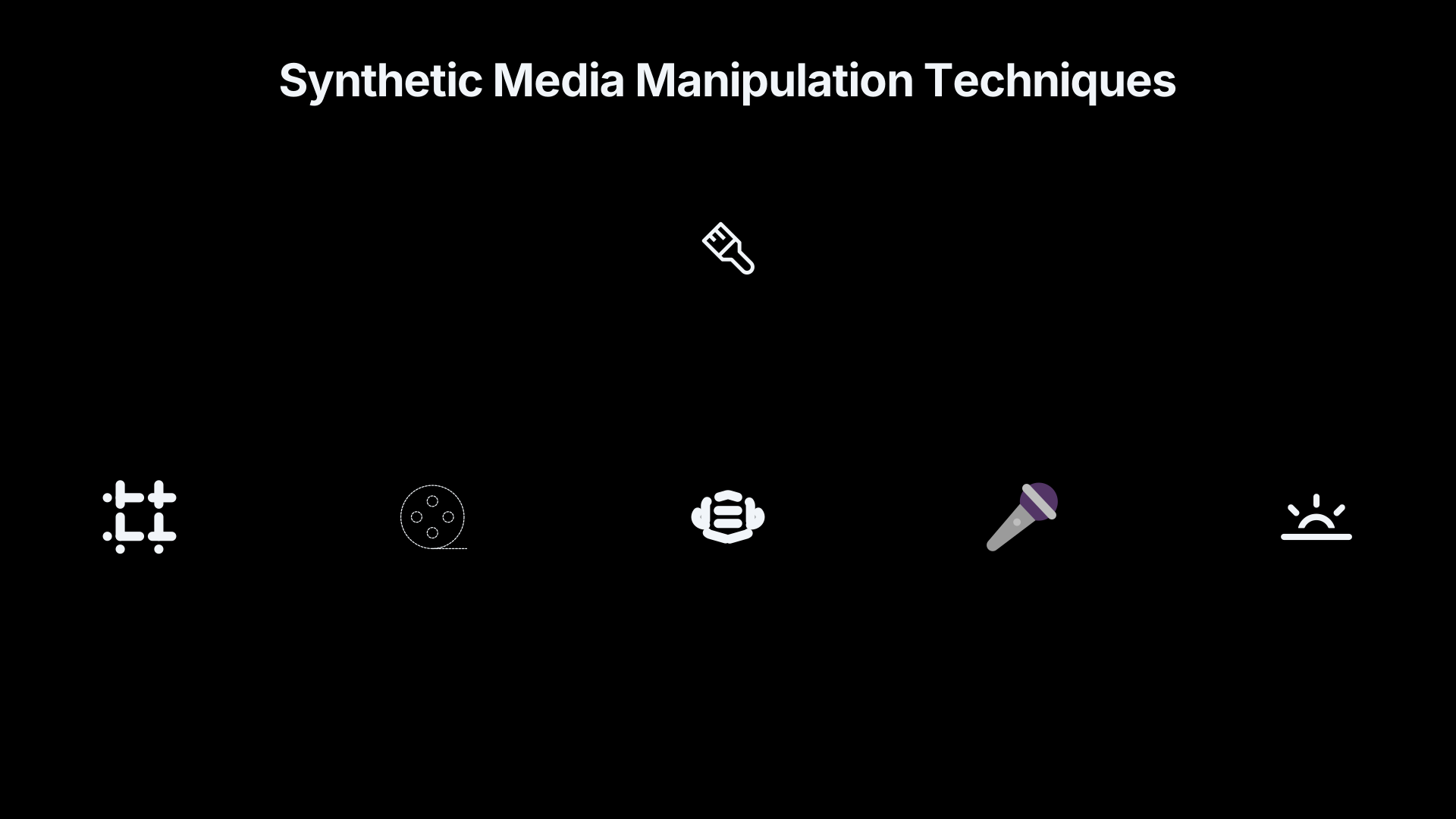
Still images can mislead, but realistic video often carries greater persuasive power. Video-generation models can now create moving scenes, camera motion, facial expressions, and environmental details from text descriptions or reference images. Other systems can alter existing footage, replace faces, change backgrounds, or generate synthetic speech to match visual content.
The resulting “deepfakes” are not always malicious. Film production, accessibility tools, education, and creative media all benefit from synthetic video techniques. Yet the same capabilities can be used to create fabricated interviews, false confessions, misleading campaign content, or impersonations of public figures.
Researchers and policymakers have become particularly concerned about elections and political communication because visual misinformation can spread quickly through social platforms. Studies and incident databases tracking political deepfakes show that synthetic media has become a recurring feature of online political discourse, even if its measurable influence remains difficult to quantify.[arXiv]arxiv.orgMerging AI Incidents Research with Political Misinformation Research: Introducing the Political Deepfakes Incidents DatabaseSeptembe…
Recent reporting has also documented how increasingly capable AI tools have lowered the barrier to producing convincing political deepfakes and other synthetic campaign material.[The Wall Street Journal]wsj.comai deepfakes are getting weirder and harder to spot in the midterms 88b4f7admidterm elections approach, the use of artificial intelligence (AI) in political campaigns has surged, leading to a proliferation of AI-g…
Inpainting, Variations, and Video Generation Workflows
Information-integrity concerns do not arise only from fully generated images. Many modern workflows combine generation with editing tools that can modify real photographs in subtle ways.
Inpainting and selective editing
Inpainting systems allow users to erase or replace specific parts of an image. A person can remove objects, alter signs, insert people, change weather conditions, or modify backgrounds while leaving the rest of the image untouched. Because much of the original photograph remains intact, viewers may not realise that important details have been altered.
This creates a difficult grey area between routine editing and deceptive manipulation. Traditional photo editing has existed for decades, but AI tools dramatically reduce the skill and effort required to make complex alterations appear natural.
Variations and synthetic derivatives
Many systems can generate multiple variations of an image. A user may start with one photograph and create dozens of alternative versions showing different expressions, settings, objects, or actions. This capability makes it easier to produce fabricated visual narratives around a real person or event.
Text-to-video and image-to-video systems
Video-generation tools extend these capabilities further. A single image can be animated into a short clip, while text prompts can produce entirely synthetic sequences. The distinction between recorded footage and generated footage becomes less obvious as realism improves.
The information-integrity issue is therefore not limited to completely fabricated content. It also includes partial modifications, recombinations, and synthetic extensions of authentic media.
Why Detection Alone Is Not Enough
A common assumption is that deepfake detectors will solve the problem. In practice, detection is far more complicated.
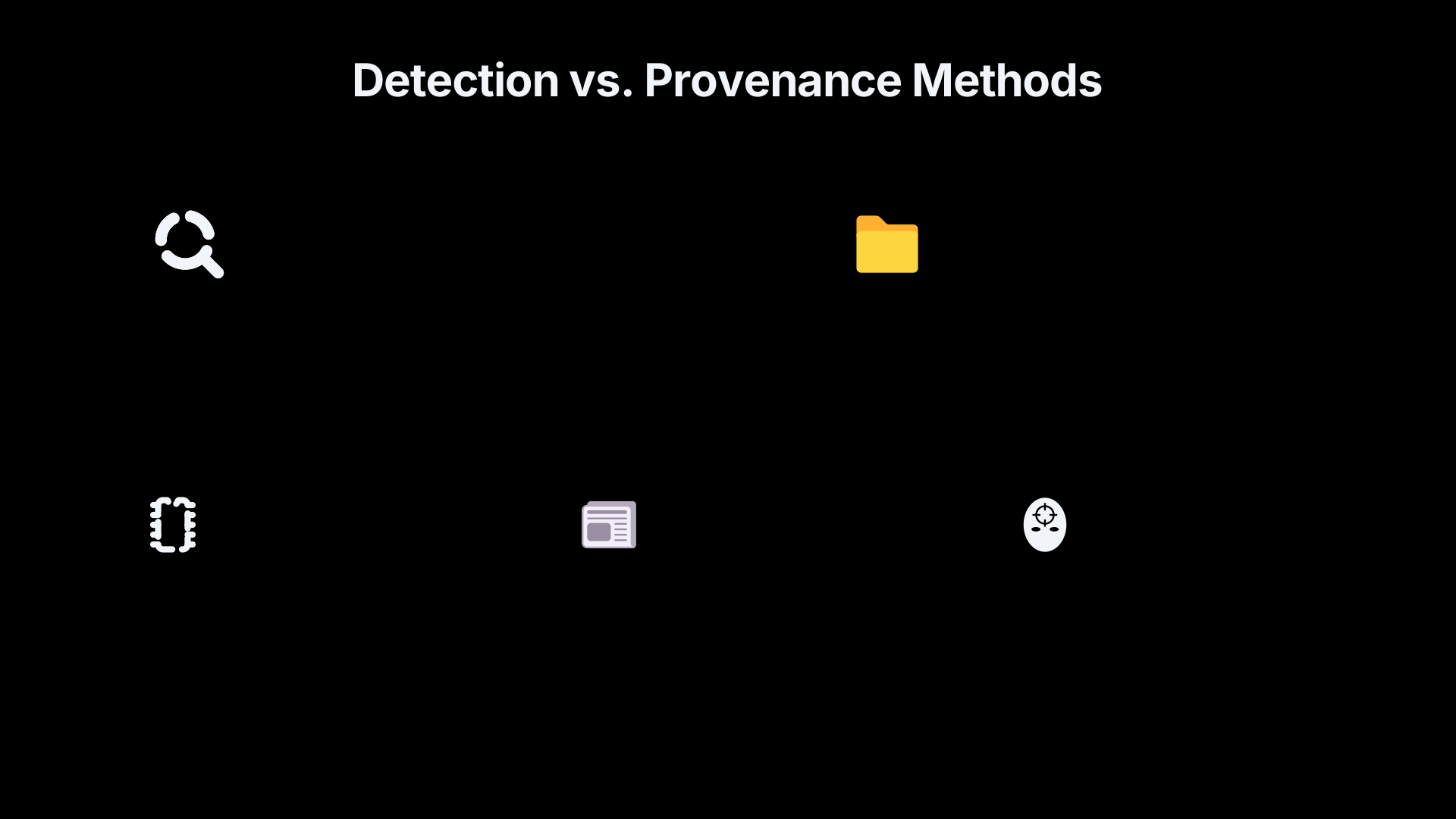
Detection systems typically look for statistical patterns, inconsistencies, artefacts, or traces left by generation models. However, generation methods improve continuously, creating an ongoing competition between creators and detectors. A detector that performs well today may become less effective against future models. NIST has highlighted both the potential and the limitations of synthetic-content detection technologies, noting that detection is only one part of a broader risk-management approach.[NIST Publications]nvlpubs.nist.govAI.100 4NIST PublicationsReducing Risks Posed by Synthetic Contentby N AI · 2024 · Cited by 4 — Synthetic content detection may detect the existe…
Another challenge is scale. Billions of images and videos circulate online, making comprehensive verification difficult. Even highly accurate systems can generate false positives or false negatives when applied at internet scale.
Human judgement also has limits. Research on deepfake recognition consistently shows that people often struggle to distinguish synthetic from authentic content. At the same time, educational interventions and digital-literacy training can improve performance, suggesting that public awareness remains an important part of the response.[arXiv]arxiv.orgarXiv Digital literacy interventions can boost humans in discerning deepfakesDigital literacy interventions can boost humans in discerning deepfakesJuly 31, 2025…
Detection, Disclosure, and Evidence Checks
Because perfect detection is unlikely, many organisations are increasingly focusing on provenance: documenting where content came from and how it was created.
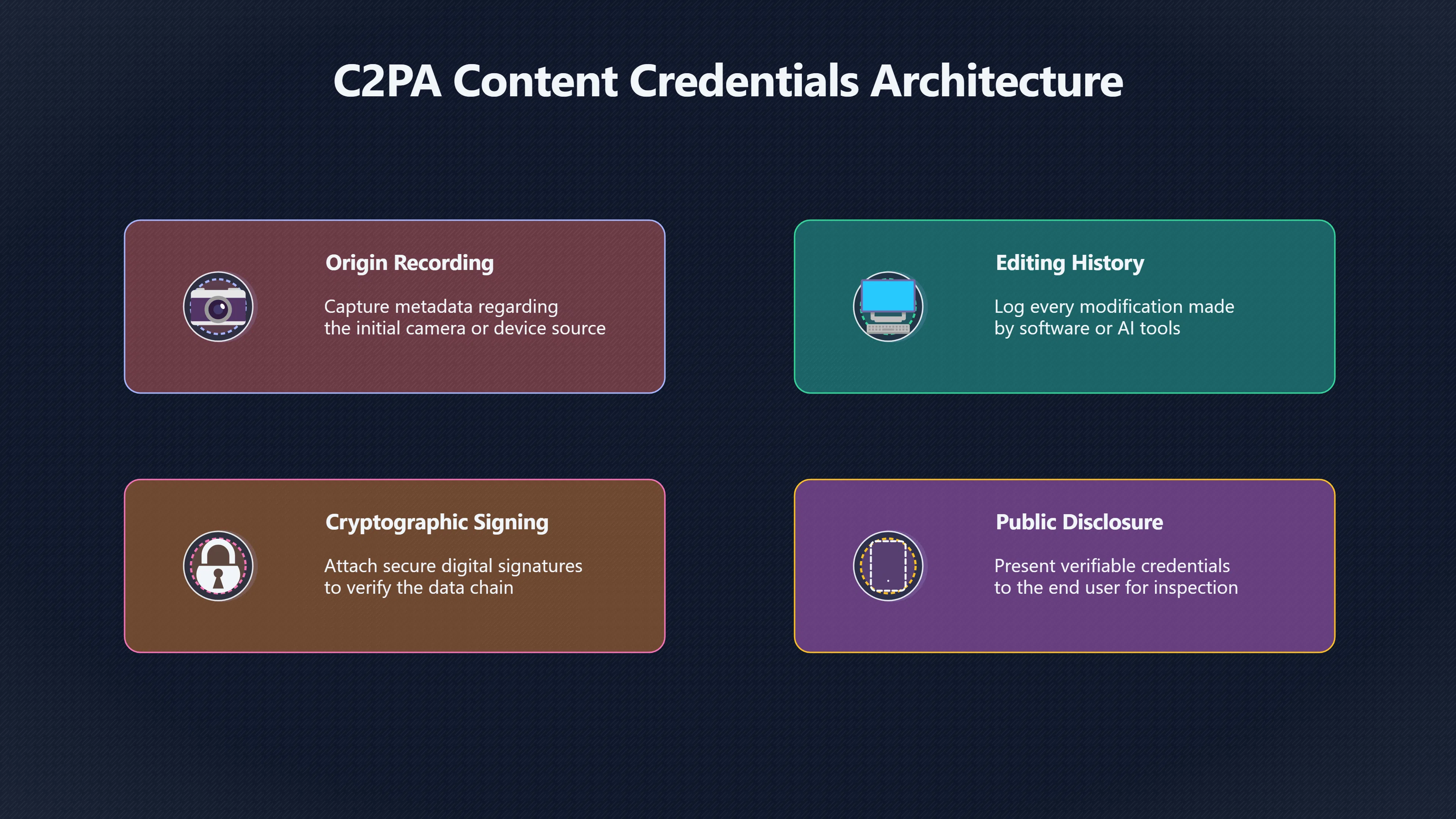
The Coalition for Content Provenance and Authenticity (C2PA) has developed technical standards designed to record information about a piece of media’s origin and editing history. These systems, often presented to users as “Content Credentials”, aim to provide a verifiable record showing whether AI tools were involved in creation or modification.[C2PA+2Content Credentials]c2pa.orgC2PA | Verifying Media Content SourcesC2PA provides an open technical standard for publishers, creators and consumers to establish th…
In principle, provenance offers a different approach from detection. Instead of asking whether an image looks fake, it asks whether there is trustworthy information about how the image was produced. Cameras, editing software, and publishing platforms can attach cryptographically signed records that help establish a chain of custody for digital media.[C2PA Specification]spec.c2pa.orgC2PA SpecificationContent Credentials: C2PA Technical SpecificationThis specification describes the technical aspects of the C2PA archit…
However, provenance systems face practical challenges:
- Adoption remains incomplete across platforms and devices.
- Metadata can be removed during uploading or reposting.
- Not all authentic content will carry provenance records.
- Attackers may seek ways to bypass or undermine the system.
- Researchers continue to debate the security and limitations of current standards.[The Washington Post+2The Verge]washingtonpost.comThe Washington Post We uploaded a fake video to 8 social appsOnly one told users it wasn't real.October 22, 2025 — A Washington Post investigation revealed that among eight major social media platfo…
For readers evaluating visual evidence, a more realistic approach combines several checks:
- Consider the source and publication context.
- Look for corroboration from independent reporting.
- Examine whether provenance information is available.
- Check whether reputable fact-checkers have investigated the content.
- Be cautious when emotionally charged content appears suddenly without supporting evidence.
No single signal guarantees authenticity, but multiple independent signals can improve confidence.
The Larger Trust Problem
The most significant consequence of synthetic media may not be individual fake images or videos. It may be the gradual weakening of shared assumptions about evidence itself.
When realistic fabrications become common, people can become uncertain about what to trust. UNESCO has described this as part of a broader “crisis of knowing”, in which increasingly convincing synthetic media complicates how people establish what is true.[UNESCO]unesco.orgdeepfakes and crisis knowingDeepfakes and the crisis of knowing27 Oct 2025 — As deepfakes blur reality, education must go beyond detection, teaching students t…
This does not mean photographs and videos have lost all value as evidence. Instead, visual media increasingly require supporting context, provenance, verification, and corroboration. The transition resembles earlier shifts in information systems, but with a crucial difference: AI dramatically lowers the cost of producing realistic visual content at scale. As NIST’s generative AI guidance notes, this capability creates new risks for information integrity by making misleading content easier to generate and distribute.[NIST Publications+2nist.gov]nvlpubs.nist.govAI.600 1NIST PublicationsArtificial Intelligence Risk Management Frameworkby N AI · 2024 · Cited by 128 — Organizational risk management efforts…
Understanding artificial intelligence therefore requires understanding not only how synthetic images and videos are created, but also how societies establish trust when seeing is no longer sufficient proof.
Amazon book picks
Further Reading
Books and field guides related to Can AI Images Be Trusted?. Use these as the next step if you want deeper reading beyond the article.
A History of Fake Things on the Internet
Covers manipulated media from early hoaxes to AI-generated content.
eBay marketplace picks
Marketplace Samples
Example marketplace items related to this page. Use the search link to explore similar finds on eBay.




Endnotes
1.
Source: nvlpubs.nist.gov
Title: AI.600 1
Link:https://nvlpubs.nist.gov/nistpubs/ai/NIST.AI.600-1.pdf
Source snippet
NIST PublicationsArtificial Intelligence Risk Management Frameworkby N AI · 2024 · Cited by 128 — Organizational risk management efforts...
2.
Source: unesco.org
Title: deepfakes and crisis knowing
Link:https://www.unesco.org/en/articles/deepfakes-and-crisis-knowing
Source snippet
Deepfakes and the crisis of knowing27 Oct 2025 — As deepfakes blur reality, education must go beyond detection, teaching students t...
3.
Source: nvlpubs.nist.gov
Title: AI.100 4
Link:https://nvlpubs.nist.gov/nistpubs/ai/NIST.AI.100-4.pdf
Source snippet
NIST PublicationsReducing Risks Posed by Synthetic Contentby N AI · 2024 · Cited by 4 — Synthetic content detection may detect the existe...
4.
Source: arxiv.org
Link:https://arxiv.org/abs/2409.15319
Source snippet
Merging AI Incidents Research with Political Misinformation Research: Introducing the Political Deepfakes Incidents DatabaseSeptembe...
5.
Source: arxiv.org
Link:https://arxiv.org/abs/2512.13915
Source snippet
Deepfakes in the 2025 Canadian Election: Prevalence, Partisanship, and Platform Dynamics...
6.
Source: arxiv.org
Title: arXiv Digital literacy interventions can boost humans in discerning deepfakes
Link:https://arxiv.org/abs/2507.23492
Source snippet
Digital literacy interventions can boost humans in discerning deepfakesJuly 31, 2025...
Published: July 31, 2025
7.
Source: c2pa.org
Link:https://c2pa.org/
Source snippet
C2PA | Verifying Media Content SourcesC2PA provides an open technical standard for publishers, creators and consumers to establish th...
8.
Source: spec.c2pa.org
Link:https://spec.c2pa.org/specifications/specifications/2.4/specs/C2PA_Specification.html
Source snippet
C2PA SpecificationContent Credentials: C2PA Technical SpecificationThis specification describes the technical aspects of the C2PA archit...
9.
Source: arxiv.org
Link:https://arxiv.org/abs/2604.24890
10.
Source: nist.gov
Title: A I Risk Management Framework | NISTOn
Link:https://www.nist.gov/itl/ai-risk-management-framework
Source snippet
AI Risk Management Framework | NISTOn July 26, 2024, NIST released NIST-AI-600-1, Artificial Intelligence Risk Management Framework: Gene...
Published: July 26, 2024
11.
Source: nist.gov
Link:https://www.nist.gov/
Source snippet
National Institute of Standards and TechnologyNIST promotes U.S. innovation and industrial competitiveness by advancing measurement scien...
12.
Source: nist.gov
Link:https://www.nist.gov/publications/artificial-intelligence-risk-management-framework-generative-artificial-intelligence
Source snippet
Artificial Intelligence Risk Management Frameworkby C Autio · 2024 · Cited by 128 — This document is a cross-sectoral profile of and comp...
13.
Source: airc.nist.gov
Title: technical reports
Link:https://airc.nist.gov/technical-reports/
Source snippet
Reports - AIRC - NIST AI Resource CenterNIST AI 100-4 lays out methods for detecting, authenticating and labeling synthetic content, incl...
14.
Source: unesco.de
Link:https://www.unesco.de/
Source snippet
Deutsche UNESCO-KommissionDie Deutsche UNESCO-Kommission ist Deutschlands multilaterale Mittlerorganisation für Bildung, Wissenschaft, Ku...
15.
Source: unesco.org
Link:https://www.unesco.org/en/internet-trust/guidelines
Source snippet
Guidelines for the Governance of Digital PlatformsInternet Trust Guidelines provide... misinformation, disinformation, ideological polar...
16.
Source: spec.c2pa.org
Link:https://spec.c2pa.org/specifications/specifications/2.4/index.html
Source snippet
c2pa.orgC2PA Specifications:: C2PA SpecificationsThis site contains the various specifications and informative documents produced by the...
17.
Source: spec.c2pa.org
Link:https://spec.c2pa.org/specifications/specifications/1.4/explainer/Explainer.html
Source snippet
c2pa.orgC2PA ExplainerContent Credentials becomes useful to consumers of assets when they can use the information contained in the C2PA M...
18.
Source: gov.br
Link:https://www.gov.br/g20/en/news/unesco-offers-recommendations-for-regulation-and-national-policies-on-ai
Source snippet
offers recommendations for regulation and national...This initiative addresses problems such as the spread of disinformation and so-call...
19.
Source: arxiv.org
Link:https://arxiv.org/html/2604.24890v1
Source snippet
These credentials can describe: who or what created the content (e.g., a camera or...Read more...
20.
Source: arxiv.org
Link:https://arxiv.org/pdf/2506.23949
Source snippet
AI Risk-Management Standards Profile for General-...by AM Barrett · 2025 · Cited by 10 — Develop and implement testing techniques to ide...
21.
Source: wsj.com
Title: ai deepfakes are getting weirder and harder to spot in the midterms 88b4f7ad
Link:https://www.wsj.com/politics/elections/ai-deepfakes-are-getting-weirder-and-harder-to-spot-in-the-midterms-88b4f7ad
Source snippet
midterm elections approach, the use of artificial intelligence (AI) in political campaigns has surged, leading to a proliferation of AI-g...
22.
Source: contentcredentials.org
Link:https://contentcredentials.org/
Source snippet
Content Provenance and Authenticity (C2PA). 500+ Companies.Read more...
23.
Source: washingtonpost.com
Title: The Washington Post We uploaded a fake video to 8 social apps
Link:https://www.washingtonpost.com/technology/2025/10/22/ai-deepfake-sora-platforms-c2pa/
Source snippet
Only one told users it wasn't real.October 22, 2025 — A Washington Post investigation revealed that among eight major social media platfo...
Published: October 22, 2025
24.
Source: theverge.com
Link:https://www.theverge.com/report/806359/openai-sora-deepfake-detection-c2pa-content-credentials
Source snippet
Although these videos are embedded with metadata from the C2PA (Coalition for Content Provenance and Authenticity), the system is failing...
25.
Source: contentcredentials.org
Link:https://contentcredentials.org/news/
Source snippet
News – Content CredentialsNews and updates on Content Credentials. Explore the latest on Content Credentials and how they're quickly beco...
26.
Source: linkedin.com
Link:https://www.linkedin.com/help/linkedin/answer/a6282984
Source snippet
Content credentials | LinkedIn HelpContent Provenance and Authenticity (C2PA) is a standards body that aims to develop technical standard...
Additional References
27.
Source: linkedin.com
Link:https://www.linkedin.com/posts/nasifay-girma-65632b1b9_mediaandinformationliteracy-unesco-mil-activity-7419589603835179008-C5gJ
Source snippet
AI-generated content threatens trust in online informationCan you still trust what you see online AI-generated images and videos are chan...
28.
Source: contentauthenticity.org
Link:https://contentauthenticity.org/
Source snippet
Content Authenticity InitiativeJoin the movement for content authenticity and provenance. The CAI is a global community promoting adoptio...
29.
Source: linkedin.com
Link:https://www.linkedin.com/posts/ma-aly-hazzaz-91033ba_fake-ai-deepfakes-activity-7446041841197592576-EwPf
Source snippet
Ma'aly Hazzaz's PostFake news doesn't look fake. It looks real. It feels real. That's why it works. In a world shaped by AI-generated con...
30.
Source: algosoc.org
Link:https://algosoc.org/results/not-just-fake-news-deepfakes-and-the-crisis-of-trust
Source snippet
Not Just Fake News: Deepfakes and the Crisis of TrustLastly, in conflict zones, AI-generated synthetic media can be used to spread narrat...
31.
Source: reuters.com
Link:https://www.reuters.com/world/us/openai-microsoft-ai-tools-generate-misleading-election-images-researchers-say-2024-03-06/
Source snippet
presidential election. Despite these companies' policies against creating deceptive content, CCDH successfully generated images such as J...
32.
Source: docs.modulos.ai
Link:https://docs.modulos.ai/frameworks/nist-ai-rmf/generative-ai-profile
Source snippet
AI RMF Generative AI Profile (NIST AI 600-1)It defines 12 risk categories unique to or exacerbated by generative AI and provides suggeste...
33.
Source: connectontech.bakermckenzie.com
Link:https://connectontech.bakermckenzie.com/united-states-ai-safety-institute-releases-its-first-synthetic-content-guidance-report-nist-ai-100-4/
Source snippet
States: AI Safety Institute releases its first synthetic...Dec 19, 2024 — NIST AI 100-4's main goal is to identify a series of voluntary...
34.
Source: digitalgovernmenthub.org
Link:https://digitalgovernmenthub.org/examples/nist-artificial-intelligence-risk-management-framework-generative-artificial-intelligence-profile/
Source snippet
NIST Artificial Intelligence Risk Management FrameworkThis profile provides a cross-sectoral profile of the AI Risk Management Framework...
35.
Source: itu.int
Title: detecting deepfakes generative ai uptake casts doubt on multimedia content
Link:https://www.itu.int/hub/2024/05/detecting-deepfakes-generative-ai-uptake-casts-doubt-on-multimedia-content/
Source snippet
Detecting deepfakes: Generative AI uptake casts doubt on...24 May 2024 — Synthetic AI-generated media – known for short as “deepfakes” –...
Published: May 2024
36.
Source: youtube.com
Link:https://www.youtube.com/watch?v=wMnVHeXPb6c
Source snippet
What is C2PA? C2PA and Digital AuthenticityC2PA, or The Coalition for Content Provenance and Authenticity, intends to address misinformat...
Topic Tree