Within AI Search
Why Source Checking Gets Harder With AI Answers
AI search answers combine information from multiple pages, making it harder to trace where each claim originated.
On this page
- Retrieval versus synthesis
- Multi source claims and attribution
- Tracing evidence back to sources
Page outline Jump by section
Introduction
AI-generated search answers change source verification because users are no longer checking a single webpage or even a ranked list of pages. Instead, they are evaluating a synthesis: a newly generated answer that combines information from multiple sources into one narrative. This shift makes verification more difficult because a claim may not exist in any single source exactly as presented. The answer may be partly supported by several documents, may omit important qualifications, or may blend facts and inferences in ways that are hard to detect at a glance. Research on generative search systems has repeatedly found that citations can create an impression of reliability even when some statements are not fully supported by the linked sources.[arXiv]arxiv.orgarXiv Evaluating Verifiability in Generative Search EnginesEvaluating Verifiability in Generative Search EnginesApril 19, 2023…
 Within the broader discussion of AI search summaries and source-checking risk, the key issue is not simply whether a source is trustworthy. It is whether the AI’s synthesis faithfully represents what the sources actually say.
Retrieval Versus Synthesis
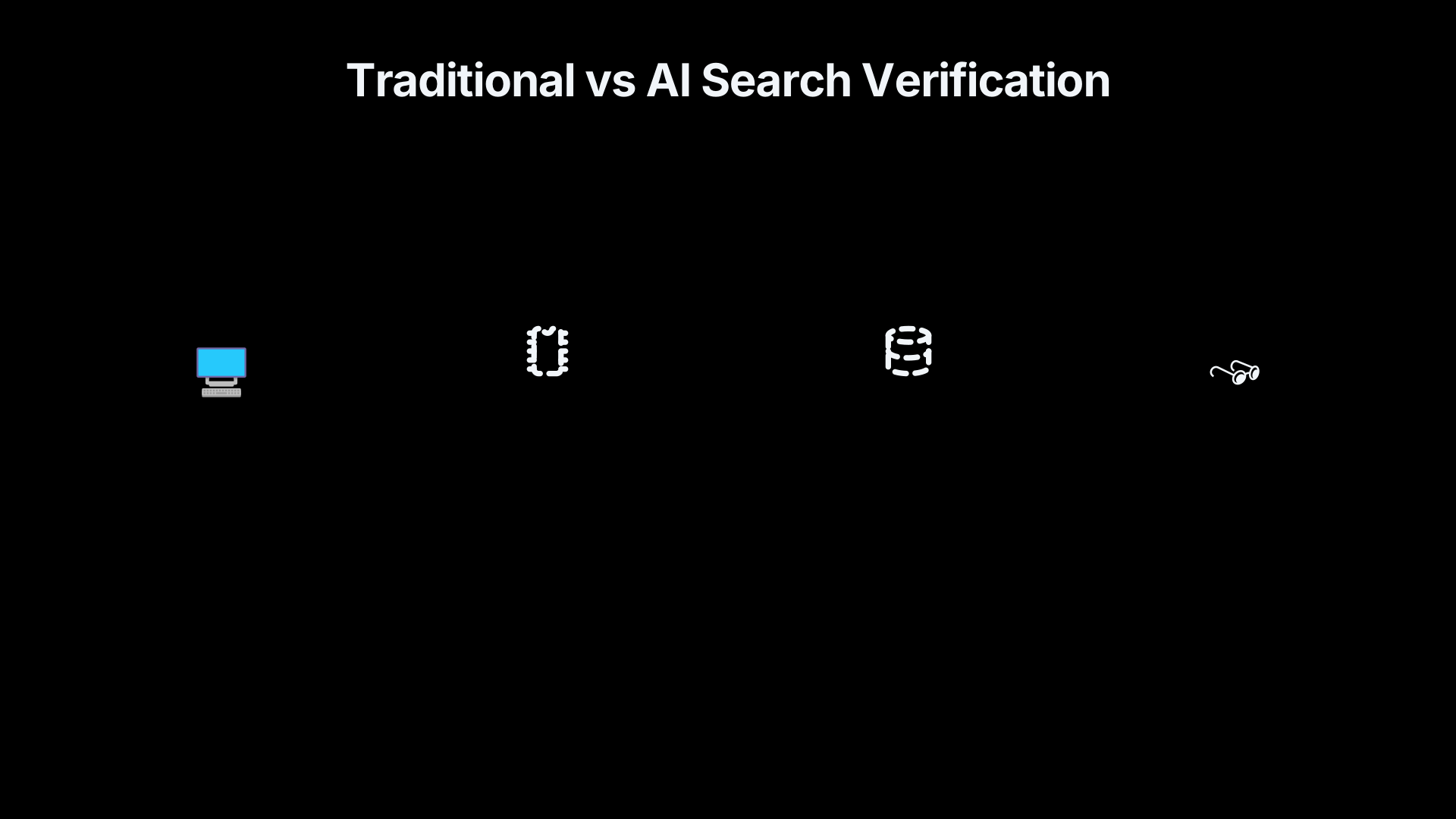
Traditional search engines primarily performed retrieval. They identified potentially relevant webpages and presented them to users, who then compared sources and formed their own conclusions.
Generative search adds a second stage: synthesis. After retrieving documents, the system extracts information, combines material from multiple pages, and generates a new answer in natural language. Google AI Overviews, for example, are designed as search-integrated generative summaries rather than simple lists of links.[arXiv]arxiv.orgMeasuring Google AI Overviews: Activation, Source Quality…13 May 2026 — AI Overviews are therefore better understood as search-in…
This distinction matters because verification becomes a two-step task:
- Was the source appropriate?
- Did the AI represent the source accurately?
In traditional search, users mostly focused on the first question. In AI-generated search, both questions must be evaluated. A highly credible source can still be summarised incorrectly, and a correct statement can become misleading if important context is removed during synthesis. Research measuring Google AI Overviews found that source quality and claim fidelity were largely independent, meaning that better sources did not automatically produce more faithful summaries.[arXiv+2ResearchGate]arxiv.orgOpen source on arxiv.org.
The result is a subtle but important change: verification shifts from checking documents to checking an interpretation of documents.
Why Multi-Source Claims Are Harder to Verify
A major challenge arises when an AI answer combines fragments from several sources into a single statement.
Consider a generated answer that explains a medical treatment, historical event, or scientific finding. One source might provide background facts, another might contain a study result, and a third might offer expert commentary. The AI can merge these elements into one concise paragraph. While efficient, the final claim may not appear verbatim in any source.
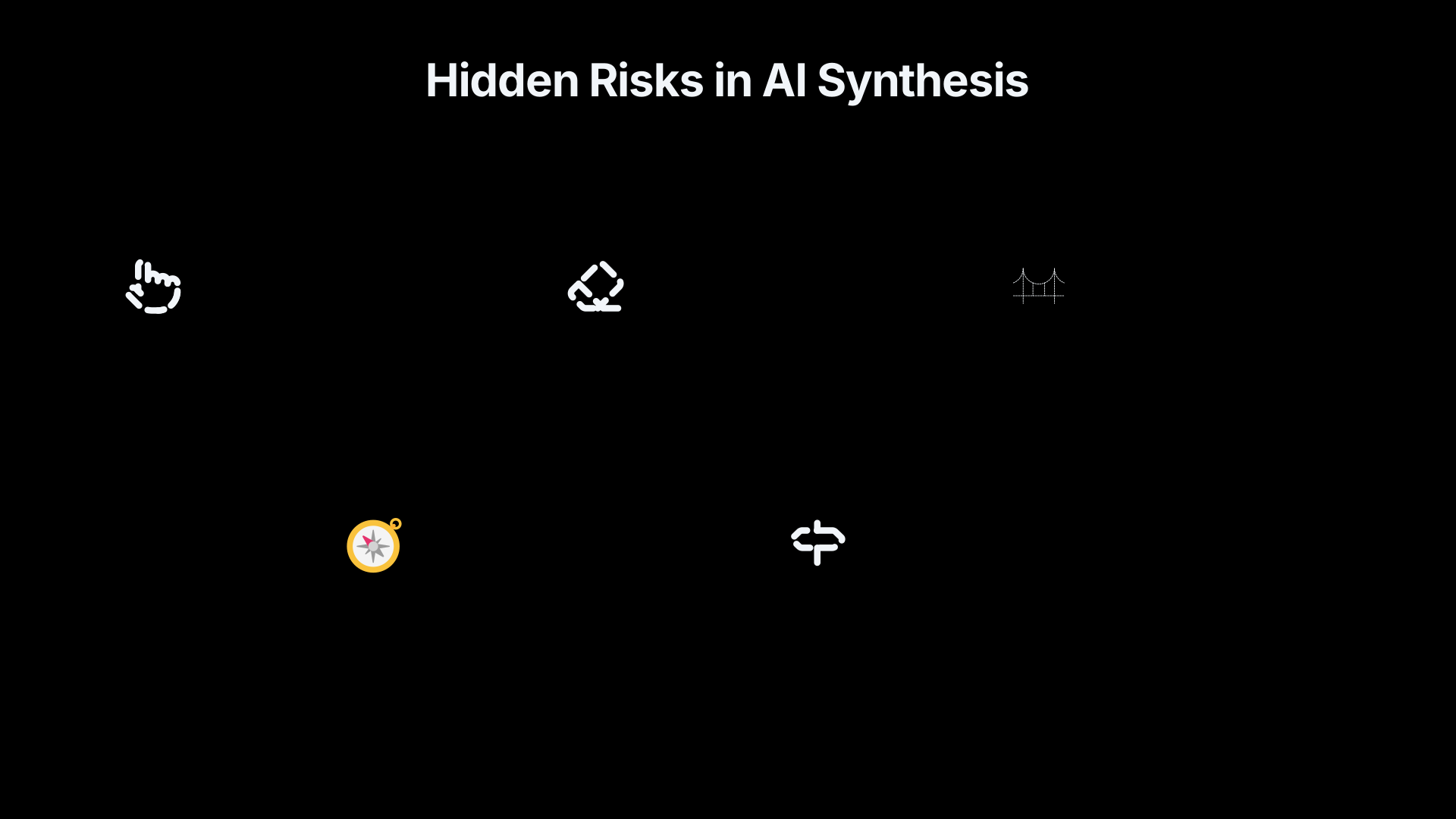
This creates several verification problems:
- Distributed evidence: Support for a statement may be spread across multiple documents rather than located in one place.
- Hidden inference: The model may connect facts and draw conclusions that none of the sources explicitly state.
- Lost uncertainty: Qualifications, confidence levels, and disagreements may disappear during compression.
- Attribution ambiguity: Users may not know which source supports which part of a complex claim.
Researchers studying long-form AI answer generation have identified multi-source attribution as a particularly difficult problem. A single sentence may require evidence from several documents, making accurate citation and traceability technically challenging.[ACL Anthology]aclanthology.orgACL Anthology Towards Improved Multi-Source Attribution for Long-FormACL AnthologyTowards Improved Multi-Source Attribution for Long-Form…June 26, 2024 — by N Patel · 2024 · Cited by 15 — We highlight th…
The difficulty increases when the generated answer sounds coherent. Human readers often interpret coherence as evidence that the underlying reasoning is well supported, even when the supporting information is fragmented across sources.
When Citations Do Not Fully Explain the Claim
Many users assume that a citation attached to an AI-generated statement proves that the linked source supports the statement. In practice, the relationship can be much weaker.
A large 2026 analysis of Google AI Overviews examined 98,020 individual claims and found that 11% were unsupported by the cited pages. The most common problem was omission: the source discussed the topic but did not actually provide evidence for a specific detail included in the AI-generated summary.[arXiv+2arXiv]arxiv.orgOpen source on arxiv.org.
Earlier research on generative search engines reached similar conclusions. Human evaluators found that many generated sentences were only partially supported by their citations and that citation accuracy frequently fell below levels expected from traditional reference systems.[arXiv]arxiv.orgarXiv Evaluating Verifiability in Generative Search EnginesEvaluating Verifiability in Generative Search EnginesApril 19, 2023…
This creates a verification trap. A user may click a cited source, see that it discusses the same general topic, and conclude that the AI answer is validated. Yet the specific statement in question may not actually appear in the source.
The challenge is not always outright fabrication. Often the problem is a small shift in meaning:
- A tentative finding becomes a firm conclusion.
- A narrow study result becomes a general claim.
- An expert opinion becomes a factual statement.
- An exception disappears from the summary.
These transformations can occur even when the cited sources themselves are reliable.
Tracing Evidence Back to Sources
The practical difficulty for users is tracing generated claims back to their origins.
With a conventional search result, the path is straightforward: the claim is read directly from a webpage. With AI synthesis, the path can be more complex:
- The answer may draw on multiple sources simultaneously.
- Different parts of a sentence may originate from different documents.
- Some wording may be generated by the model rather than copied from any source.
- The source list may not indicate which citation supports which specific statement.
This means that checking a single link is often insufficient. Verifying an important claim may require examining several cited sources and determining how the AI combined them.
Researchers evaluating generative search have therefore argued that verifiability depends not only on whether sources are present but also on whether citations are comprehensive and precisely connected to individual claims.[arXiv]arxiv.orgarXiv Evaluating Verifiability in Generative Search EnginesEvaluating Verifiability in Generative Search EnginesApril 19, 2023…
The challenge has become significant enough that AI researchers are actively developing new methods for attribution, citation alignment, and evidence tracing in generated answers. The existence of a growing research field around multi-source attribution reflects how difficult this problem remains.[ACL Anthology+2Amazon Science]aclanthology.orgACL Anthology Towards Improved Multi-Source Attribution for Long-FormACL AnthologyTowards Improved Multi-Source Attribution for Long-Form…June 26, 2024 — by N Patel · 2024 · Cited by 15 — We highlight th…

A Concrete Example of the Verification Shift
Imagine a user asking whether a particular health marker indicates disease risk.
A traditional search engine would present links from hospitals, government agencies, research institutions, and patient organisations. The user would compare the sources directly.
An AI-generated search answer may instead present a concise explanation that blends information from several of those sources into a single paragraph. If the summary omits caveats about age, sex, population differences, or diagnostic limitations, the answer may appear more definitive than the underlying evidence.
Investigations of AI-generated health summaries have documented cases where important context was lost, creating misleading impressions despite the presence of source material discussing the topic.[The Guardian]theguardian.comAI Overviews, which generate top-of-search health snapshots using generative AI, were found to provide inaccurate data—particularly regar…
The verification task therefore changes from “Is this source trustworthy?” to “Does this generated interpretation accurately reflect the sources?”
Why This Matters for Understanding AI
The most important consequence of AI synthesis is that source checking becomes an attribution problem rather than a simple credibility problem.
In the era of link-based search, users mainly evaluated websites. In the era of AI-generated search answers, users must evaluate a chain of information processing: retrieval, selection, interpretation, compression, and presentation. Every step can affect the final claim.
This does not mean AI-generated summaries are inherently unreliable. They often provide useful overviews and can save substantial time. The challenge is that verification now requires checking not only where information came from, but also how the AI transformed that information on its way to the reader. Research on generative search consistently shows that trustworthy sources alone are not enough; faithful synthesis is a separate requirement that users cannot safely assume.[arXiv+2arXiv]arxiv.orgOpen source on arxiv.org.
eBay marketplace picks
Marketplace Samples
Example marketplace items related to this page. Use the search link to explore similar finds on eBay.


Endnotes
1.
Source: arxiv.org
Title: arXiv Evaluating Verifiability in Generative Search Engines
Link:https://arxiv.org/abs/2304.09848
Source snippet
Evaluating Verifiability in Generative Search EnginesApril 19, 2023...
Published: April 19, 2023
2.
Source: arxiv.org
Link:https://arxiv.org/abs/2605.14021
3.
Source: arxiv.org
Link:https://arxiv.org/html/2605.14021v1
Source snippet
Measuring Google AI Overviews: Activation, Source Quality...13 May 2026 — AI Overviews are therefore better understood as search-in...
Published: May 2026
4.
Source: researchgate.net
Link:https://www.researchgate.net/publication/404890793_Measuring_Google_AI_Overviews_Activation_Source_Quality_Claim_Fidelity_and_Publisher_Impact
Source snippet
Measuring Google AI Overviews: Activation, Source Quality...17 May 2026 — Third, decomposing responses into 98,020 atomic claims, 11.0%...
Published: May 2026
5.
Source: amazon.science
Title: towards improved multi source attribution for long form answer generation
Link:https://www.amazon.science/publications/towards-improved-multi-source-attribution-for-long-form-answer-generation
Source snippet
Towards improved multi-source attribution for long-form...by N Patel · 2024 · Cited by 15 — To address this, in this paper we aim to imp...
6.
Source: arxiv.org
Link:https://arxiv.org/pdf/2605.14021
Source snippet
Measuring Google AI Overviews: Activation, Source Quality...by H Xu · 2026 — Our third research ques- tion is: what fraction of atomic c...
7.
Source: developers.google.com
Title: succeeding in ai search
Link:https://developers.google.com/search/blog/2025/05/succeeding-in-ai-search
Source snippet
ways to ensure your content performs well in Google's...21 May 2025 — AI Overviews display links in a range of ways, and show a wider ra...
Published: May 2025
8.
Source: aclanthology.org
Title: ACL Anthology Towards Improved Multi-Source Attribution for Long-Form
Link:https://aclanthology.org/2024.naacl-long.216.pdf
Source snippet
ACL AnthologyTowards Improved Multi-Source Attribution for Long-Form...June 26, 2024 — by N Patel · 2024 · Cited by 15 — We highlight th...
Published: June 26, 2024
9.
Source: theguardian.com
Link:https://www.theguardian.com/technology/2026/jan/11/google-ai-overviews-health-guardian-investigation
Source snippet
AI Overviews, which generate top-of-search health snapshots using generative AI, were found to provide inaccurate data—particularly regar...
10.
Source: theguardian.com
Title: This article is more than 4 months old.Read more
Link:https://www.theguardian.com/technology/2026/jan/24/google-ai-overviews-youtube-medical-citations-study
Source snippet
Google AI Overviews cite YouTube more than any medical...25 Jan 2026 — Google AI Overviews cite YouTube more than any medical site for h...
11.
Source: evergreen.media
Title: google ai overviews
Link:https://www.evergreen.media/en/guide/google-ai-overviews/
Source snippet
What's Changing for SEO & SEA in...6 Feb 2026 — AI Overviews were rolled out in Germany, Austria, and Switzerland on March 26, 2025; AI...
Published: March 26, 2025
12.
Source: aclanthology.org
Title: 2025.hcinlp 1.4
Link:https://aclanthology.org/2025.hcinlp-1.4.pdf
Source snippet
Transparent Post-Hoc Verification of Biomedical Claims in...by AV González · 2025 — Results show that TripleCheck provides nuanced in- s...
Additional References
13.
Source: europarl.europa.eu
Link:https://www.europarl.europa.eu/RegData/etudes/BRIE/2026/787211/IUST_BRI%282026%29787211_EN.pdf
Source snippet
Impact of Google AI Summaries and Google AI Overviews...AI-generated summaries may reduce the visibility of competing editorial framings...
14.
Source: linkedin.com
Link:https://www.linkedin.com/posts/stuart-winter-tear_measuring-google-ai-overviews-activity-7461097322270302211-jLJi
Source snippet
Google AI Overviews: Quality and Credibility Concerns... cited sources are generally more credible than co-displayed first-page results...
15.
Source: niemanlab.org
Title: google highlights links from subscribed publications in new ai overviews update
Link:https://www.niemanlab.org/2026/05/google-highlights-links-from-subscribed-publications-in-new-ai-overviews-update/
Source snippet
Google highlights links from subscribed publications in...6 May 2026 — And Google claims that, overall, more publisher links will appear...
Published: May 2026
16.
Source: medium.com
Title: googles 1b user ai mode exposes your homepage s answer debt 0352eb6289f4
Link:https://medium.com/kairi-ai/googles-1b-user-ai-mode-exposes-your-homepage-s-answer-debt-0352eb6289f4
Source snippet
Google's 1B-User AI Mode Exposes Your Homepage's...At I/O 2026, Google put a new AI-powered Search box in front of your homepage, close...
17.
Source: mbrenndoerfer.com
Title: Michael Brenndoerfer Attribution and Citation: Sourcing LLM Outputs
Link:https://mbrenndoerfer.com/writing/attribution-and-citation
Source snippet
Michael BrenndoerferAttribution and Citation: Sourcing LLM Outputs - Interactive16 Feb 2026 — Learn how [language models]({{ 'language-models/' | relative_url }}) link generated cl...
18.
Source: suprmind.ai
Title: ai hallucination statistics research report 2026
Link:https://suprmind.ai/hub/insights/ai-hallucination-statistics-research-report-2026/
Source snippet
AI Hallucination Statistics 2026: 50+ Sourced Data Points15 Feb 2026 — Columbia Journalism Review found that eight generative search tool...
19.
Source: discoveredlabs.com
Title: google ai overviews vs featured snippets the new rules of search visibility
Link:https://discoveredlabs.com/blog/google-ai-overviews-vs-featured-snippets-the-new-rules-of-search-visibility
Source snippet
Google AI Overviews vs. Featured Snippets9 Feb 2026 — Google AI Overviews vs. Featured Snippets redefine search visibility. Learn how to...
20.
Source: stackoverflow.blog
Link:https://stackoverflow.blog/2026/06/08/what-can-500-years-of-journalism-teach-developers-about-ai-trustworthiness/
Source snippet
aims and runs them against the retrieval index before synthesis starts...
21.
Source: linkedin.com
Link:https://www.linkedin.com/posts/triscritti_how-accurate-are-googles-ai-overviews-activity-7447664788207202304-nkMs
Source snippet
Google AI Overviews 91% accurate but cite flawed sourcesAccording to a recent study, roughly 90% of Google's AI Overviews are accurate...
22.
Source: emergentmind.com
Title: ai answer engine citation behavior
Link:https://www.emergentmind.com/topics/ai-answer-engine-citation-behavior
Source snippet
Citation Behavior in AI Answer Engines17 Nov 2025 — Explore how AI answer engines integrate retrieval-augmented generation with layered c...
Topic Tree