Within Over compression
The Financial Risks AI Summaries Smooth Over
A tidy financial narrative may capture the main trend while muting stress scenarios, footnotes, and low-probability losses.
On this page
- Why finance depends on stress scenarios
- How footnotes and risk disclosures get compressed
- Practical checks for summary driven investment research
Page outline Jump by section
Introduction
AI-generated financial summaries are often praised for turning dense earnings reports, annual filings and analyst notes into a few readable paragraphs. The problem is that financial risk is not distributed evenly. The most important dangers are frequently hidden in low-probability, high-impact scenarios: a liquidity squeeze, a regulatory shock, a concentrated customer loss, a cyber incident, or a market stress event. These are known as tail risks because they sit in the extreme ends of a probability distribution rather than in the expected outcome.
 When AI compresses financial information into a tidy narrative, it tends to preserve the main story while reducing the visibility of these extreme possibilities. The result is not necessarily a false summary. Instead, it is a summary that can sound accurate and balanced while understating the very risks that matter most when markets stop behaving normally. This is one of the clearest examples of how AI can over-compress risk in a high-stakes domain.
Why finance depends on stress scenarios
Most financial analysis is built around a central narrative. Revenue is growing. Margins are improving. Debt appears manageable. The market opportunity is expanding.
However, investment losses are often driven by scenarios outside that narrative. Financial institutions therefore devote significant resources to stress testing, scenario analysis and risk-factor disclosure. The goal is not merely to understand what is likely to happen, but what could happen if conditions deteriorate sharply. Financial regulators and disclosure frameworks explicitly require discussion of material risks because investors need information about potential downside outcomes, not just baseline expectations.[Harvard Law Forum on Governance]corpgov.law.harvard.eduLaw Forum on Governance SEC Risk Factor Disclosure RulesHarvard Law Forum on GovernanceSEC Risk Factor Disclosure RulesDecember 22, 2021…
This creates a tension with AI summarisation. Summaries are rewarded for brevity, coherence and readability. Stress scenarios are often conditional, technical and awkwardly phrased. They rely on chains of events:
- If interest rates remain elevated.
- If refinancing markets tighten.
- If a major customer leaves.
- If litigation expands.
- If a cyberattack disrupts operations.
A concise summary naturally gravitates towards the central trend and away from the conditional branches. The more aggressively information is compressed, the more likely these branches disappear.
In finance, that is a serious distortion because the branch may be where most of the downside resides.
How AI summaries flatten tail risk
The mechanism is not usually fabrication. It is compression.
Large language models learn to identify the dominant themes in a document and express them efficiently. Risk language often appears as qualifications, caveats and disclosures surrounding the main narrative. During summarisation, these elements compete for limited space with revenue growth, earnings figures, strategic announcements and management commentary.
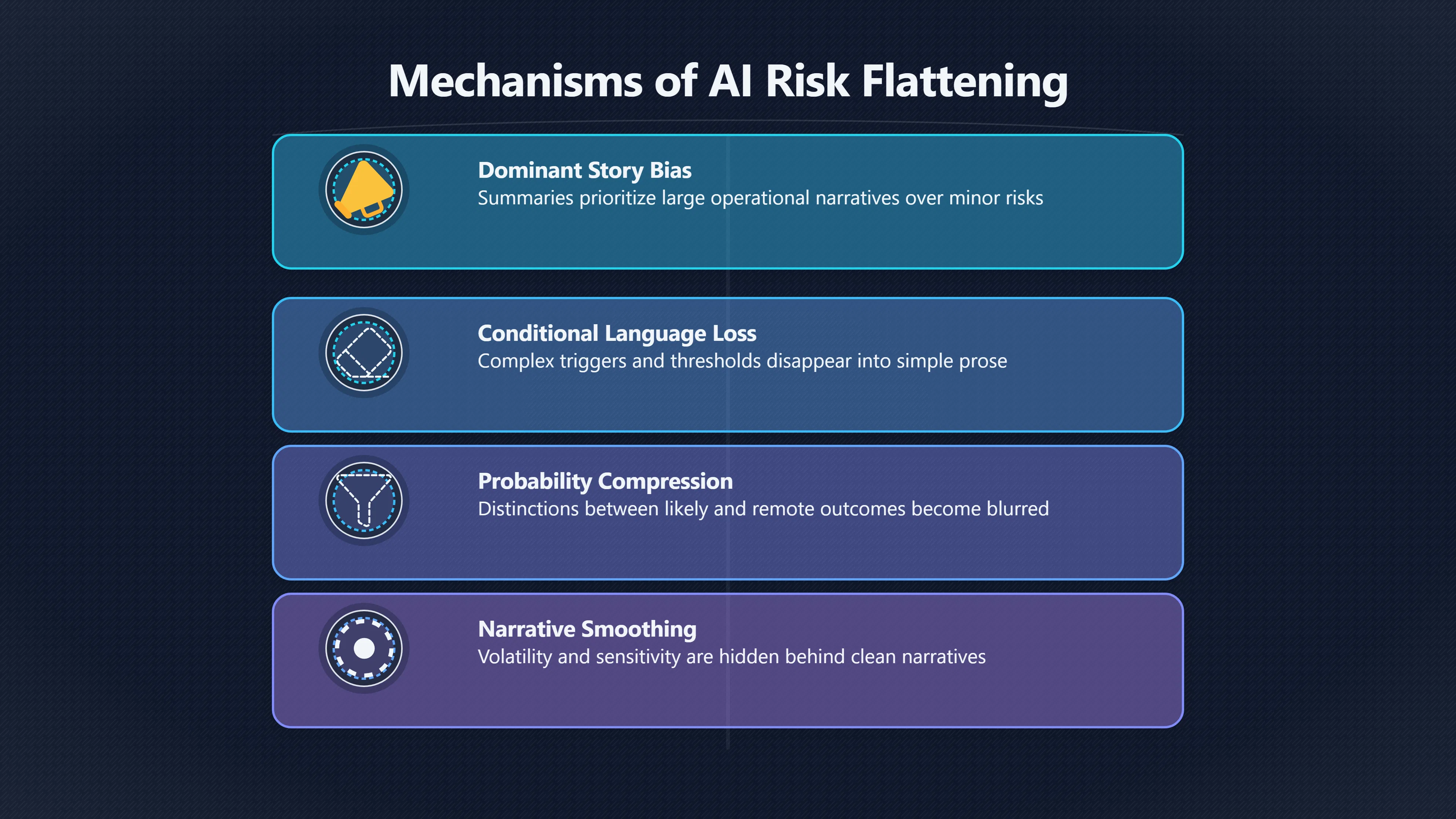
Several mechanisms contribute to the flattening of tail risk:
Dominant-story bias. If a filing contains 100 pages describing operations and three pages discussing a severe but unlikely risk, the summary may devote most of its attention to the dominant operational story.
Conditional-language loss. Tail risks are commonly expressed through conditional statements. When AI rewrites these into simpler prose, thresholds and triggers can disappear. A statement such as “significant liquidity pressure could emerge if refinancing conditions deteriorate” can become a softer observation about financing challenges.[Alibaba]alibaba.comWhy Do Ai-generated Financial Summaries Oversimplify Risk And How To Add Contextual GuardrailsJanuary 5, 2026…
Probability compression. Financial documents often distinguish between likely, possible and remote outcomes. Summaries frequently reduce these distinctions into broad descriptions of risk without preserving the underlying probability structure.
Narrative smoothing. Research and industry commentary on AI-assisted financial analysis have identified a tendency for generated summaries to hide volatility, sensitivity and scenario dependence behind clean narratives that appear more certain than the source material warrants.[My WordPress]quantintegrity.comMy Word Press AI Financial Analysis Errors | Quant IntegrityMy WordPressAI Financial Analysis Errors | QuantIntegrityFebruary 14, 2026…
The resulting output may accurately describe the company’s current position while failing to communicate how fragile that position could become under stress.
How footnotes and risk disclosures get compressed
One reason tail risk is vulnerable to omission is where it lives.
The most consequential warnings in financial reporting are often not found in headline earnings figures. They are embedded in:
- Risk-factor sections.[corpgov.law.harvard.edu]corpgov.law.harvard.eduLaw Forum on Governance SEC Risk Factor Disclosure RulesHarvard Law Forum on GovernanceSEC Risk Factor Disclosure RulesDecember 22, 2021…
- Management discussion and analysis (MD&A).
- Notes to financial statements.[econpapers.repec.org]econpapers.repec.orgQuantifying material risks from textual disclosures in financial statements using LLMs and LLM agents - a case study on physi…
- Debt covenant disclosures.
- Litigation disclosures.
- Customer concentration disclosures.
- Liquidity discussions.
Regulators require many of these disclosures because they provide investors with information about potential adverse outcomes. New or substantially revised risk disclosures can be early indicators of emerging problems before those problems become visible in reported results.[LegalClarity]legalclarity.orgLegal Clarity How to Read SEC Filings: Key Sections ExplainedHow to Read SEC Filings: Key Sections Explained - LegalClarityMarch 12, 2026…
Yet these sections are precisely the material most vulnerable to summarisation loss.
A risk disclosure may contain several layers of information:
- The risk exists.
- The probability is uncertain.
- The impact could be severe.
- Specific conditions increase exposure.
- Management’s mitigation strategy has limitations.
A short AI summary may preserve only the first layer.
For example, a filing might explain that a company depends heavily on a small number of customers and could experience substantial revenue disruption if one relationship ends. A compressed summary may merely state that the company faces customer concentration risk. Technically, the risk remains mentioned. What disappears is the scale of the potential downside.
This matters because investment decisions are often driven not by whether a risk exists, but by how large the loss could be if it materialises.
A concrete example: liquidity risk versus liquidity stress
Liquidity provides a useful illustration of the difference between a normal summary and a stress-oriented reading.
An AI summary might conclude:
The company maintains adequate liquidity and has access to financing.
That statement could be entirely consistent with the filing.
However, the underlying disclosure may also reveal:
- Major debt maturities within two years.
- Dependence on favourable credit markets.
- Exposure to variable interest rates.
- Covenant constraints.
- Reliance on a limited group of lenders.
The first statement describes current conditions. The second describes what happens if conditions change.
Tail risk analysis focuses on the second set of facts because financial crises often emerge when previously available funding suddenly becomes unavailable. A summary centred on present adequacy can therefore obscure the more important question: what happens under stress?
Why polished summaries can increase overconfidence
A further problem is psychological rather than technical.
People tend to trust information that is coherent and easy to understand. A concise AI-generated narrative can feel more authoritative than a fragmented collection of disclosures, footnotes and caveats.
This creates a subtle danger. Investors may believe they have absorbed the essential information when they have actually consumed a filtered version of it.
Industry analyses of AI-assisted financial workflows repeatedly highlight this issue. The risk is not merely incorrect numbers or fabricated facts. It is the creation of outputs that appear comprehensive while concealing sensitivity to assumptions, volatility exposure or adverse scenarios.[My WordPress]quantintegrity.comMy Word Press AI Financial Analysis Errors | Quant IntegrityMy WordPressAI Financial Analysis Errors | QuantIntegrityFebruary 14, 2026…
In effect, readability can become a source of risk.
Practical checks for summary-driven investment research
AI summaries can still be useful. The challenge is preventing them from becoming the sole lens through which financial information is viewed.
When using AI-generated financial summaries, several checks help preserve tail-risk awareness:
Read the risk-factor section separately. Do not assume a summary has captured all material risks. Risk disclosures exist precisely because adverse scenarios matter.[LegalClarity]legalclarity.orgLegal Clarity What Does Risk Factors Mean in Securities Law?What Does Risk Factors Mean in Securities Law? - LegalClarity…
Look for what changed. New risk factors or substantial revisions often contain more information than long-standing boilerplate disclosures.[LegalClarity]legalclarity.orgLegal Clarity How to Read SEC Filings: Key Sections ExplainedHow to Read SEC Filings: Key Sections Explained - LegalClarityMarch 12, 2026…
Ask for downside scenarios explicitly. Instead of requesting a general summary, ask for the three most severe low-probability risks, the assumptions behind them, and the potential financial consequences.
Review footnotes and MD&A discussions. Many emerging problems appear first in explanatory notes rather than headline figures.
Compare narrative and stress views. Generate one summary focused on the central business story and another focused solely on adverse scenarios. Differences between the two often reveal what compression removed.
Treat confidence as a warning sign. The cleaner and more certain a summary appears, the more important it becomes to verify whether uncertainty, probability ranges and conditional outcomes have been preserved.
The key mechanism
The flattening of tail risk occurs because AI summarisation rewards central narratives and penalises complexity. Financial risk disclosures are often complex, conditional and disproportionately important despite occupying relatively little space in a document. When those disclosures are compressed, the summary may accurately describe the expected path while understating the scenarios that drive the largest losses.
In finance, that distinction is critical. The average outcome is not always what matters most. Investors, regulators and risk managers often focus on the situations where the normal story breaks down. Those situations are exactly where an over-compressed AI summary is most likely to leave out information that changes the decision.
Amazon book picks
Further Reading
Books and field guides related to The Financial Risks AI Summaries Smooth Over. Use these as the next step if you want deeper reading beyond the article.
Fooled by Randomness
Rating: 4.0/5 from 15 Google Books ratings
Explains how people underestimate uncertainty and overstate confidence in financial outcomes.
Against the Gods
Provides foundational understanding of probability, uncertainty and risk assessment.
The Black Swan
Rating: 4.0/5 from 25 Google Books ratings
Focuses on rare, high-impact risks that simplified narratives routinely overlook.
Thinking, Fast and Slow
Helps readers understand cognitive shortcuts that can make summaries seem more convincing than warranted.
eBay marketplace picks
Marketplace Samples
Example marketplace items related to this page. Use the search link to explore similar finds on eBay.




Endnotes
1.
Source: corpgov.law.harvard.edu
Title: Law Forum on Governance SEC Risk Factor Disclosure Rules
Link:https://corpgov.law.harvard.edu/2021/12/22/sec-risk-factor-disclosure-rules/
Source snippet
Harvard Law Forum on GovernanceSEC Risk Factor Disclosure RulesDecember 22, 2021...
Published: December 22, 2021
2.
Source: legalclarity.org
Title: Legal Clarity What Does Risk Factors Mean in Securities Law?
Link:https://legalclarity.org/what-does-risk-factors-mean-in-securities-law/
Source snippet
What Does Risk Factors Mean in Securities Law? - LegalClarity...
3.
Source: alibaba.com
Link:https://www.alibaba.com/product-insights/why-do-ai-generated-financial-summaries-oversimplify-risk-and-how-to-add-contextual-guardrails.html
Source snippet
Why Do Ai-generated Financial Summaries Oversimplify Risk And How To Add Contextual GuardrailsJanuary 5, 2026...
Published: January 5, 2026
4.
Source: legalclarity.org
Title: Legal Clarity How to Read SEC Filings: Key Sections Explained
Link:https://legalclarity.org/how-to-read-sec-filings-key-sections-explained/
Source snippet
How to Read SEC Filings: Key Sections Explained - LegalClarityMarch 12, 2026...
Published: March 12, 2026
5.
Source: quantintegrity.com
Title: My Word Press AI Financial Analysis Errors | Quant Integrity
Link:https://quantintegrity.com/insights/ai-financial-analysis-errors/
Source snippet
My WordPressAI Financial Analysis Errors | QuantIntegrityFebruary 14, 2026...
Published: February 14, 2026
6.
Source: lexology.com
Title: www.lexology.com Lengthy Risk Factors
Link:https://www.lexology.com/library/detail.aspx?g=831fea1c-e270-4dde-8840-0ba5bfa34ca8
Source snippet
Risk Factors - LexologyJuly 6, 2018...
Published: July 6, 2018
Additional References
7.
Source: econpapers.repec.org
Link:https://econpapers.repec.org/bookchap/bisbisifc/65-09.htm
Source snippet
Quantifying material risks from textual disclosures in financial statements using LLMs and LLM agents - a case study on physi...
8.
Source: ijisae.org
Link:https://www.ijisae.org/index.php/IJISAE/article/view/7974
Source snippet
www.ijisae.orgGenai-Driven Scenario Generation For Intraday Market Risk, Liquidity Stress Testing, And Portfolio Optimization | Internati...
9.
Source: reddit.com
Link:https://www.reddit.com/r/BusinessIntelligence/comments/1q4f745/what_i_learned_trying_to_get_ai_to_actually/
Source snippet
I learned trying to get AI to actually analyze financial scenarios (not just describe charts - Technical Deep Dive)January 5, 2026...
Published: January 5, 2026
10.
Source: aimodels.fyi
Link:https://www.aimodels.fyi/papers/arxiv/evaluating-large-language-models-financial-report-summarization
Source snippet
Large Language Models on Financial Report Summarization: An Empirical Study | AI Research Paper DetailsNovember 12, 2024...
Published: November 12, 2024
11.
Source: mdpi.com
Link:https://www.mdpi.com/1911-8074/19/4/271
Source snippet
AI Disclosure Intensifies: Nonlinear Effects on Governance-Risk Disclosures in Selected U.S. Public FirmsApril 8, 2026...
Published: April 8, 2026
12.
Source: imfalpha.com
Link:https://imfalpha.com/article/ais-new-frontier-in-finance-how-[generative
Source snippet
AI’s New Frontier in Finance: How Generative Models Are Redefining Risk Analysis — IMF AlphaMay 20, 2026...
Published: May 20, 2026
13.
Source: onlinelibrary.wiley.com
Link:https://onlinelibrary.wiley.com/doi/abs/10.1155/int/9295056
Source snippet
Liu - 2026 - International Journal of Intelligent Systems - Wiley Online LibraryFebruary 16, 2026...
Published: February 16, 2026
14.
Source: youtube.com
Link:https://www.youtube.com/watch?v=7eqFDlggqNg
Source snippet
LLMs in Financial Analysis: From Promise to Practice...
15.
Source: elibrary.imf.org
Title: article A001 en.xml
Link:https://www.elibrary.imf.org/view/journals/063/2023/006/article-A001-en.xml
Source snippet
Artificial Intelligence in Finance in: FinTech Notes Volume 2023 Issue 006 (2023)August 22, 2023...
Published: August 22, 2023
16.
Source: researchgate.net
Title: www.researchgate.net Risk Factor Disclosure Summaries
Link:https://www.researchgate.net/publication/405698253_Risk_Factor_Disclosure_Summaries
Source snippet
Factor Disclosure SummariesJanuary 1, 2026...
Published: January 1, 2026
Topic Tree